MCQ
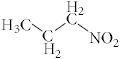
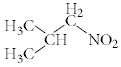
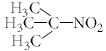
Which one of the following nitro-compounds does not react with nitrous acid ?
- A
- B
- ✓
- D
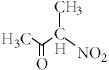
$2^{o}$ nitro compound react with $\mathrm{HNO}_{2}$ acid
but $3^{o}$ nitro compound does not react with nitrous acid.
$(i)$ ${\mkern 1mu} \mathop {\begin{array}{*{20}{c}}
{\,\,\,\,\,\,\begin{array}{*{20}{c}}
{\,\,\,\,\,C{H_2}} \\
{|\,\,}
\end{array}} \\
{C{H_3} - C - CH - N{O_2}} \\
{||\,\,\,\,\,\,\,\,\,\,\,\,\,\,\,\,\,\,} \\
{O\,\,\,\,\,\,\,\,\,\,\,\,\,\,\,\,\,\,}
\end{array}}\limits_{{1^o}\,\,nitro} $ $\xrightarrow{{HN{O_2}}}$ $\begin{matrix}
\,\,\,\,\,\,\,\,\,\begin{matrix}
\,\,\,\,\,\,C{{H}_{3}} \\
| \\
\end{matrix} \\
C{{H}_{3}}-C-C-N{{O}_{2}} \\
\,||\,\,\,\,\,\,\,\,\,|\,\, \\
\,\,\,\,\,\,\,\,\,\,\,\,O\,\,\,\,\,\,\,N=O \\
\end{matrix}$
$(ii)$ $\mathop {C{H_3} - C{H_2} - C{H_2} - N{O_2}}\limits_{{1^o}\,nitro} $ $\xrightarrow{{HO - N = O}}$ $\begin{array}{*{20}{c}}
{C{H_3} - C{H_2} - C - N{O_2}} \\
{\,\,\,\,\,\,\,\,\,\,\,\,\,\,\,\,\,\,||} \\
{\,\,\,\,\,\,\,\,\,\,\,\,\,\,\,\,\,\,\,\,\,\,\,\,\,\,\,\,\,\,\,\,N - OH}
\end{array}$
$(iii)$ $\mathop {\begin{array}{*{20}{c}}
{C{H_3} - CH - C{H_2} - N{O_2}} \\
{|\,\,\,\,\,\,\,\,\,\,\,\,\,\,\,\,\,\,\,\,\,\,\,\,} \\
{C{H_3}\,\,\,\,\,\,\,\,\,\,\,\,}
\end{array}\,}\limits_{{1^o}\,\,nitro} $ $\xrightarrow{{HO - N = O}}$ $\begin{matrix}
C{{H}_{3}}-CH-C-N{{O}_{2}} \\
|\,\,\,\,\,\,\,\,\,\,\,\,\,|| \\
\,\,\,\,\,\,\,\,\,\,\,\,\,\,C{{H}_{3}}\,\,\,\,\,\,N-OH \\
\end{matrix}$
$3^o$ nitro $\xrightarrow{HN{{O}_{2}}}$ No reaction.
Generate a complete, print-ready paper with questions like this in minutes — across 16+ boards, with answer keys.
$N_2 + 3H_2 \rightleftharpoons 2NH_3 \,;$ $K_1$
$N_2 + O_2 \rightleftharpoons 2NO\,;$ $K_2$
$H_2 + 2 O_2 \rightleftharpoons H_2O\,;$ $K_3$
The equilibrium constant $(K)$ of the reaction :
$2NH_3 + \frac{5}{2} \overset K \leftrightarrows 2NO + 3H_2O$
$STATEMENT-2:$ No process is possible in which the sole result is the absorption of heat from a reservoir and its complete conversion into work.
[Assume : No cyano complex is formed; $K _{ sp }( AgCN )$ $=2.2 \times 10^{-16}$ and $\left. K _{ a }( HCN )=6.2 \times 10^{-10}\right]$
$STATEMENT-2$: The $\mathrm{Fe}$ in $\left[\mathrm{Fe}\left(\mathrm{H}_2 \mathrm{O}\right)_5 \mathrm{NO}_3 \mathrm{SO}_4\right.$ has three unpaired electrons.