MCQ
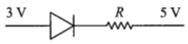
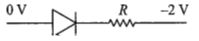
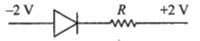
Which one of the following represents forward bias diode?
  • A

  • B

  • C


Answer

Correct option: D.

d
A diode is said to be forward biased if $ p-$side is at higher potential than $n-$side of $p-n$ junction

Need a full question paper?

Generate a complete, print-ready paper with questions like this in minutes — across 16+ boards, with answer keys.

Start Generating Free

Similar questions

A rectangular film of liquid is extended from $(4 \,\,cm \times 2\, cm)$ to $(5\,\, cm \times 4\, cm).$ If the work done is $3 \times 10^{-4}\, J,$ the value of the surface tension of the liquid is ............ $Nm^{-1}$
If the maximum velocity and maximum acceleration of a particle executing $SHM$ are equal in magnitude, the time period will be .... $\sec$
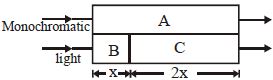
Consider slabs of three media $A, B$ and $C$ arranged as shown in figure. $R.I. $ of $A$ is $1.5$ and that of $C$ is $1.4.$ If the number of waves in $A$ is equal to the number of waves in the combination of $B$ and $C$ then refractive index or $B$ is :-
At $23^{\circ} C$, a pipe open at both ends resonates at a frequency of $450 \,Hz$. At what frequency does the same pipe resonate on a hot day when the speed of sound is $4 \%$ higher than it would be at $23^{\circ} C$ ?
A sensor is exposed for time $t$ to a lamp of power $P$ placed at a distance $l$. The sensor has a circular opening that is $4d$ in diameter. Assuming all energy of the lamp is given off as light, the number of photons entering the sensor if the wavelength of light is $\lambda $ is $(l >> d)$
Two infinitely long parallel wires carry currents of magnitude $I_1$ and $I_2$ are at a distance $4 cm$ apart. The magnitude of the net magnetic field is found to reach a non-zero minimum value between the two wires and $1 \,cm$ away from the first wire. The ratio of the two currents and their mutual direction is
A rope of length $L$ is pulled by a constant force $F$. What is the tension in the rope at a distance $x$ from the end where the force is applied
Only an aldehyde having..... can undergo the aldol condensation
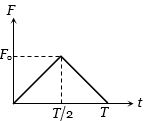
A particle of mass $m$ moving with velocity $u$ makes an elastic one dimensional collision with a stationary particle of mass $m$. They are in contact for a very short time $T$. Their force of interaction increases from zero to $F_0$ linearly in time $T/2$, and decreases linearly to zero in further time $T/2$. The magnitude of $F_0$ is
Particles of masses $m, 2m, 3m,......nm$ $grams$ are placed on the same line at distances $l, 2l, 3l,....nl\, cm$ from a fixed point. The distance of centre of mass of the particles from the fixed point in centimetres is