Which one of the following statements is true for the speed $v$ and the acceleration $a$ of a particle executing simple harmonic motion
AIPMT 2004, Easy
Download our app for free and get started
(d) In $S.H.M.$ $v = \sqrt {{a^2} - {y^2}} $ and $a = - \,{\omega ^2}y$ when $y = a$
==> ${v_{\min }} = 0$ and ${a_{\max }} = \, - \,{\omega ^2}a$
==> ${v_{\min }} = 0$ and ${a_{\max }} = \, - \,{\omega ^2}a$

Download our appand get started for free
Experience the future of education. Simply download our apps or reach out to us for more information. Let's shape the future of learning together!No signup needed.*
Similar Questions
- 1A mass $m$ attached to free end of a spring executes SHM with a period of $1\; s$. If the mass is increased by $3\; kg$ the period of oscillation increases by one second, the value of mass $m$ is $..............kg$.View Solution
- 2Function $x$ = $A sin^2 wt + B cos^2 wt + C sin wt \ cos wt$ does not represents $SHM$ for this conditionView Solution
- 3Assume that the earth is a solid sphere of uniform density and a tunnel is dug along its diameter throughout the earth. It is found that when a particle is released in this tunnel, it executes a simple harmonic motion. The mass of the particle is $100 g$. The time period of the motion of the particle will be (approximately) (take $g =10\,ms ^{-2}$, radius of earth $=6400\,km$ )View Solution
- 4Two masses $M_{A}$ and $M_{B}$ are hung from two strings of length $l_{A}$ and $l_{B}$ respectively. They are executing SHM with frequency relation $f_{A}=2 f_{B}$, then relationView Solution
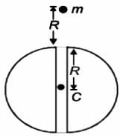
- 5A particle of mass $m$ is dropped from a height $R$ equal to the radius of the earth above the tunnel dug through the earth as shown in the figure. Hence the correct statement isView Solution
- 6View SolutionA simple pendulum is set into vibrations. The bob of the pendulum comes to rest after some time due to
- 7Acceleration of a particle, executing $SHM$, at it’s mean position isView Solution
- 8A block of mass $m$ rests on a platform. The platform is given up and down $SHM$ with an amplitude $d$ . What can be the maximum frequency so that the block never leaves the platformView Solution
- 9A heavy small-sized sphere is suspended by a string of length $l$. The sphere rotates uniformly in a horizontal circle with the string making an angle $\theta $ with the vertical. Then the time period of this conical pendulum isView Solution
- 10A simple pendulum is executing simple harmonic motion with a time period $T$. If the length of the pendulum is increased by $21\%$, the percentage increase in the time period of the pendulum of increased length is ..... $\%$View Solution