MCQ
Which pairs of the salts would have identical solubilities in methanol ?
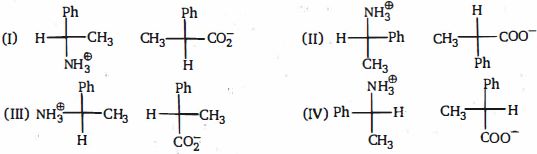
  • $I$ & $IV$
  • B
    $I$ & $III$
  • C
    $I$ & $II$
  • D
    $II$ & $IV$

Answer

Correct option: A.
$I$ & $IV$
a
$(a)$ Enantiomers have same solubility in optically inactive solvents so $(I)$ & $(IV)$ have same solubility because are enantiomers

$I \to R - R -$ Configuration  ;   $II \to S -S -$ Configuration

Need a full question paper?

Generate a complete, print-ready paper with questions like this in minutes — across 16+ boards, with answer keys.

Start Generating Free

Similar questions

In the formation of $NaCl$ from $Na$ and $Cl$
$Z_{eff}$ of $B$ is $2.6$, then value of zeff of oxygen and fluorine will be :-
Given below are two statements:

Statement $I :$ A mixture of chloroform and aniline can be separated by simple distillation.

Statement $II :$ When separating aniline from a mixture of aniline and water by steam distillation aniline boils below its boiling point. In the light of the above statements, choose the most appropriate answer from the options given below.

$C{H_3} - C \equiv C - C{H_3}\,\xrightarrow[{C{H_3}COOH}]{{B{H_3},THF}}$ Major product
Oxyacid of chloride show similarity in
In the following reaction

$\begin{array}{*{20}{c}}
  {C{H_3}\,\,\,\,\,\,\,} \\ 
  {|\,\,\,\,\,\,\,\,\,\,\,\,\,} \\ 
  {{H_3}C - C - CH = C{H_2}} \\ 
  {|\,\,\,\,\,\,\,\,\,\,\,\,\,} \\ 
  {C{H_3}\,\,\,\,\,\,\,\,\,} 
\end{array}$ $\xrightarrow{{{H_2}O/{H^ \oplus }}}{\mkern 1mu} \mathop A\limits_{Major\,product} \, + \,\mathop B\limits_{Minor\,product} $

major product:

Enthalpy of hydrogenation of Benzene is $\Delta H_1$ and for cyclohoxene is $\Delta H_2$. Then resonance energy of Benzene is
The energy of one mole of photons of radiation of frequency $2 \times 10^{12}\,Hz$ in $Jmol ^{-1}$ is $.....$(Nearest integer) (Given: $h =6.626 \times 10^{-34}\,JS$ $\left. N _{ A }=6.022 \times 10^{23}\, mol ^{-1}\right)$
As compared to covalent compounds, electrovalent compounds generally have
For the reaction $XC{O_3}(s)\, \rightleftharpoons \,XO(s)\, + \,C{O_2}(g),$ $K_p = 1.642$ atm at $727\ ^oC.$ If $4$ moles of $XCO_3(s)$ was put into a $50 $ litre container and heated to $727\,^oC.$ What mole precent of the $XCO_3$ remains unreacted at equilibrium ?