MCQ
Which relation is correct for isometric process
  • $\Delta Q = \Delta U$
  • B
    $\Delta W = \Delta U$
  • C
    $\Delta Q = \Delta W$
  • D
    None of these

Answer

Correct option: A.
$\Delta Q = \Delta U$
a
(a)For isochoric process $\Delta V = 0==>\Delta W = 0$
From FLOT $\Delta Q = \Delta U + \Delta W$ ==>$\Delta Q = \Delta U$

Need a full question paper?

Generate a complete, print-ready paper with questions like this in minutes — across 16+ boards, with answer keys.
Start Generating Free

Similar questions

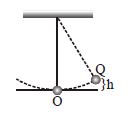
The bob of a simple pendulum is displaced from its equilibrium position $O$ to a position $Q$ which is at height $h$ above $O$ and the bob is then released. Assuming the mass of the bob to be $m$ and time period of oscillations to be $2.0\  s$, the tension in the string when the bob passes through $O$ is
A $2\,mW$ laser operates at a wavelength of $500\,nm.$ The number of photons that will be emitted per second is [Given Planck’s constant $h = 6.6 \times 10^{-34}\,Js,$ speed of light $c = 3.0\times 10^8\,m/s$ ]
If $50$ Vernier divisions are equal to $49$ main scale divisions of a travelling microscope and one smallest reading of main scale is $0.5 \ mm,$ the Vernier constant of travelling microscope is:
Pulling force making an angle $\theta $ to the horizontal is applied on a block of weight $W$ placed on a horizontal table. If the angle of friction is $\alpha $, then the magnitude of force required to move the body is equal to
Four molecules of a gas have speeds $1, 2, 3$ and $4\, km/sec$. The value of root mean square speed of the gas molecules is
A thin circular ring first slips down a smooth incline then rolls down a rough incline of identical geometry from same height. Ratio of time taken in the two motion is ........
Out of the following functions representing motion of a particle which represents $SHM$ 

$(A)\;y= sin\omega t-cos\omega t$

$(B)\;y=sin^3\omega t$

$(C)\;y=5cos\left( {\frac{{3\pi }}{4} - 3\omega t} \right)$

$(D)\;y=1+\omega t+{\omega ^2}{t^2}$

Two short bar magnets of magnetic moments ' $M$ ' each are arranged at the opposite corners of a square of side ' $d$ ', such that their centres coincide with the corners and their axes are parallel to one side of the square. If the like poles are in the same direction, the magnetic induction at any of the other corners of the square is
A piece of copper and another of germanium are cooled from room temperature to $80\, K$. The resistance of :-
$A$ thin rod of length $L$ is placed vertically on a frictionless horizontal floor and released with a negligible push to allow it to fall. At any moment, the rod makes an angle $\theta$ with the vertical. If the center of mass has acceleration $= A$, and the rod an angular acceleration $= \alpha$ at initial moment, then