Question
Which represents a greater temperature rise,$ 20^0C$ or $20^0 F?$

Answer

$ F =\frac{9}{5} C +32$
$=\frac{9}{5} \times 20+32=68^{\circ} F$
$\Rightarrow 20^{\circ} C =68^{\circ} F$
$68^{\circ} F >20^{\circ} F$
$\text { or, } 20^{\circ} C >20^{\circ} F $
$20^{\circ} C$ represents a greater temperature rise.

Need a full question paper?

Generate a complete, print-ready paper with questions like this in minutes — across 16+ boards, with answer keys.

Start Generating Free

Similar questions

The refractive index of air with respect to glass is defined: as ${ }_g \mu_a=\sin i / \sin r$
Write down a similar expression for $a _{ g }$ in terms of angle i and r .
What is the function of the split rings in a d.c. motor?
Explain why does a wine glass starts rattling, when a note of some particular frequency is struck by a piano?
An observer standing in front of a vertical wall claps 10 times one second. He adjusts his distance from the wall in such a way that the second of his clapping coincides with the echo. This happens when bis distance from the wall is 17.5m. What is the velocity of sound heard by him?
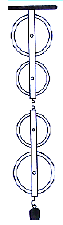
In following figure , shows a system of four pulleys, The upper two pulleys are fixed and the lower two are movable.
(a) Draw a string around the pulleys. Also show the place and direction in which the effort if applied.
(b) What is the velocity ratio of the system?
(c) How are load and effort of the pulley system related?
(d) What assumption do you make in arriving at your answer in part(c)?
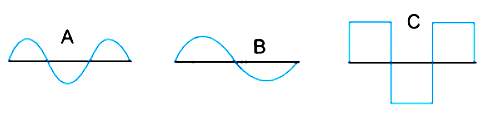
Shows the wave patterns of three sounds A, B and C. Name the characteristic of sound which is same between (i) A and B, (ii) B and C, and (iii) C and A.
Draw a diagram to show the waveforms of a pure note and a musical note, of the same pitch and same loudness.
State whether the potential is a scalar or vector? What does the positive and negative sign of potential convey?
Mention two properties of a wave, one property which varies and the other which remains constant when the wave passes from one medium to another.
A bulb is connected to a battery of p.d. $4 V$ and internal resistance $2.5 \Omega$. A steady current of $0.5 A$ flows through the circuit. Calculate:The energy dissipated in the bulb in $10$ minutes.