Questions

[3 Mark Question Answer]

🎯

Test yourself on this topic

24 questions · timed · auto-graded

Question 13 Marks
Why does the temperature of a substance remain constant during the process of melting?
Answer
The molecules in a solid are held by strong intermolecular bonds. For the solid to melt, these bonds have to be broken. Since energy is needed to break the intermolecular bonds, the thermal energy supplied at the melting point is used to do the work to break the intermolecular bonds between the molecules of the solid. Once the intermolecular bonds are broken, the molecules can then move out of their fixed positions. Hence it can then be said that the solid has melted, which is the change of state from solid to liquid. This explains why temperature remains constant during the melting phases.
View full question & answer
Question 23 Marks
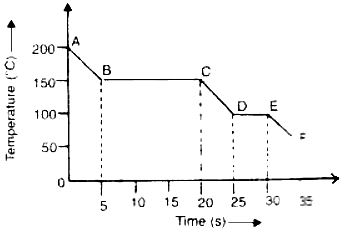
The graph given below represents a cooling curve fore a substance being cooled from a higher temperature to a lower temperature.

(a)What is the boiling point of the substance?
(b)What happens in the region DE?
(c)What is the melting point of the substance?
Answer
(a)Boiling point of substance is 150°C (because the part BC represents condensation where the vapour changes into liquid without the change in temperature.
(b)DE represents freezing of the substance where the liquid changes into solid at a constant temperature of 100°C.
(c)Melting point is the temperature of the region DE where liquid changes into solid i.e., 100°C.
View full question & answer
Question 33 Marks
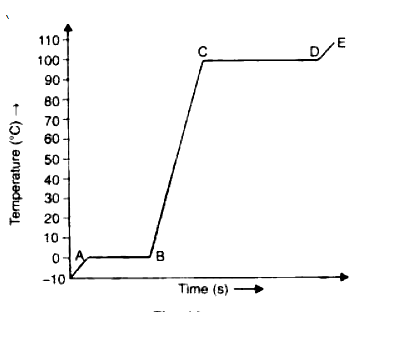
A piece of ice is heated at a constant rate. The variation in temperature with time of heating is shown in the graph (see fig.)
(i) What is represented by AB?
(ii) What does CD represent?
(iii) What conclusion can you draw regarding the nature of ice from the graph below?
Answer
i.AB represents the change of state from solid to liquid i.e., AB represents melting of ice at 0°C.
ii.CD represents the change of state from liquid to vapour i.e., CD represents boiling of water at 100°C.
iii.The ice initially is in solid state at -10°C. On heating, its temperature rises to 0°C. It then takes some heat at 0°C to melt in water at 0°C which is its latent heat.
View full question & answer
Question 43 Marks
Which represents a greater temperature rise,$ 20^0C$ or $20^0 F?$
Answer
$ F =\frac{9}{5} C +32$
$=\frac{9}{5} \times 20+32=68^{\circ} F$
$\Rightarrow 20^{\circ} C =68^{\circ} F$
$68^{\circ} F >20^{\circ} F$
$\text { or, } 20^{\circ} C >20^{\circ} F $
$20^{\circ} C$ represents a greater temperature rise.
View full question & answer
Question 53 Marks
A bucket contains $8$ kg of water at $25^{\circ} C .2 kg$ of water at $80^{\circ} C$ is poured into it. Neglecting the heat energy absorbed by the bucket, calculate the final temperature of water.
Answer
$30$. Let C be the specific heat capacity of water.
Let final temperature of the mixture be $8^\circ C.$
Heat energy lost by hot water = Heat energy gained by cold water
$2 x C x (80 - 8) = 8 x C x (8 - 25)$
$or, 2(80 - 8) = 8 (8 - 25)$
$or,80 - 8 = 48 - 100$
$or, 58 = 180$
$0 = 36$
So, the final temperature of water will be $36^\circ C.$
View full question & answer
Question 63 Marks
$0.5 \ kg$ of lemon squash at $30^{\circ} C$ is placed in a refrigerator which can remove heat at an average rate of $30 \ Js$ . How long will it take to cool the lemon squash to $5^0 C ?\left( Sp\right.$. heat capacity of lemon squash $=4200 J kg ^{-1}{ }^{\circ} C ^{-1}$.)
Answer
Change in temperature of lemon squash $=30-5=25^{\circ} \mathrm{C}$
Heat lost by lemon squash, $Q=m \times C \times \Delta T$
$ Q=0.5 \times 4200 \times 25=52500 $
Rate at which heat is removed is $30 \mathrm{Js}^{-1}$
$ \begin{aligned} & \frac{\mathrm{Q}}{\mathrm{t}}=30 \mathrm{Js}^{-1} \\ & \frac{52500 \mathrm{~J}}{\mathrm{t}}=30 \mathrm{Js}^{-1} \\ & \mathrm{t}=\frac{52500 \mathrm{~J}}{30 \mathrm{Js}^{-1}} \\ & =1750 \mathrm{sec}=29.2 \mathrm{~min} \end{aligned} $
View full question & answer
Question 73 Marks
The temperature of 600 g of cold water rises by $15^{\circ} C$ when 300 g of hot water at $50^{\circ} C$ is added to it. What was the initial temperature of the cold water?
Answer
Let the initial temperature of cold water be $t$ and the final temperature of the mixture be 8 .
Rise in temperature of cold water, $(8-t)=15^{\circ} \mathrm{C}$.
Heat gained by cold water $=$ Heat given out by hot water
or, $600 \times \mathrm{C} \times
15=300 \times \mathrm{C} \times(50-8)$
or, $\theta=50-\frac{600 \times 15}{300}=20^{\circ} \mathrm{C}$
$ \begin{aligned} & \theta-t=15^{\circ} \mathrm{C} \\ & t=20-15=5^{\circ} \mathrm{C} \end{aligned} $
View full question & answer
Question 83 Marks
If 10125 J of heat energy boils off 4.5 g of water at 100°C to steam at 100°C, find the specific latent heat of steam.
Answer
$ \begin{aligned} & Q=10125 \mathrm{~J} \\ & \mathrm{~m}=4.5 \mathrm{~g} \\ & \mathrm{Q}=\mathrm{m} \times \mathrm{L} \\ & 10125=4.5 \times \mathrm{L} \\ & \mathrm{L}=\frac{10125}{4.5}=2250 \mathrm{~J} / \mathrm{G} \end{aligned} $
Specific latent heat of steam is $2250 \mathrm{~J} / \mathrm{g}$
View full question & answer
Question 93 Marks
1 kg of molten lead at its melting point of $327^{\circ} C$ is dropped into 1 kg of water at $20^{\circ} C$. Assuming no loss of heat, calculate the final temp. of water. ( Sp . heat of lead $=130 J / kg ^{\circ} C$, latent heat of lead $=27000 J / kg$ and Sp . heat of water $=4200 J / kg ^{\circ} C$ ).
Answer
Let the final temperature of the mixture be t
Heat lost by lead = Heat gained by water
$m_1L + m_1 x CL x (327 - t) = m_z x c_w x (t - 20)$
$1 x 27000 + 1 x 130 x (327 - t) = 1 x 4200 x (t - 20)$
$27000 + 42510 _ 130t = 4200t - 84000$
$t = 35.45^\circ C$
So, the final temperature of water is $35.45^\circ C.$
View full question & answer
Question 103 Marks
1 kg of molten lead at its melting point of $327^{\circ} C$ is dropped in 1 kg of water at $20^{\circ} C$. Assuming no heat is lost; calculate the final temperature of water. (Sp. heat cap. of lead $=130 J / kg ^{\circ} C$, Sp. latent heat of fusion of lead $=27000$ $J / g , Sp$. heat cap. of water $=4200 j / kg ^{\circ} C$ )
Answer
Let the final temperature of the mixture be t.
Heat lost by lead = Heat gained by water
$m_1L + M_1 x C_L x (327 - t) = m_2 x C_w x (t - 20)$
$1 x 27000 + 1 x 130 x (327 - t) = 1 x 4200 x (t - 20)$
$27000 + 42510 - 130t = 4200t - 84000$
$153510 = 4330 t$
$t = 35.45^\circ C$
So, the final temperature of water is $35 .45^\circ C.$
View full question & answer
Question 113 Marks
Calculate the time taken by an immersion heater, which supplies energy at the rate of 7000 J/minute to raise temp. of 5 kg water from 22°C to 47°C.
Answer
$ \begin{aligned} & \frac{\mathrm{Q}}{\mathrm{t}}=7000 \mathrm{~J} / \mathrm{min} \\ & \mathrm{m}=5 \mathrm{~kg} \\ & \Delta \mathrm{T}=47-22=25^{\circ} \mathrm{C} \\ & \mathrm{C}=4200 \mathrm{~J} / \mathrm{kg}^{\circ} \mathrm{C} \\ & \mathrm{Q}=\mathrm{m} \times \mathrm{C} \times \mathrm{T} \\ & \quad=5 \times 4200 \times 25=525000 \mathrm{~J} \end{aligned} $
Time taken $=\frac{525000}{7000}=75 \mathrm{~min}$
View full question & answer
Question 123 Marks
A refrigerator converts 100 g of water at 20°C to ice at -10°C in 73.5 minutes. Calculate the average rate of heat extraction from water in watt. (Sp. heat of ice= 2100 J/kgK, sp. heat of water = 4200 J/kgK, Sp. latent heat of ice = 336000 J/kg.)
Answer
Heat given out during the following three stages:
1. Cooling water from $20^{\circ} \mathrm{CtD} 0^{\circ} \mathrm{C}=\mathrm{mC}_1 \theta_1=100 \times 4.2 \times 20=8400 \mathrm{~J}$
2. Water at $0^{\circ} \mathrm{C}$ freezes $\mathrm{tD}$ form ice at $0^{\circ}
\mathrm{C}=\mathrm{m} \times \mathrm{L}=100 \times 336=33600 \mathrm{~J}$
3. Cooling of ice at $0^{\circ} \mathrm{CtD}-10^{\circ} \mathrm{C}=\mathrm{mC}_z \theta_z=100 \times 2.1 \times 10=2100 \mathrm{~J}$
Total quantity of heat given out $=44100 \mathrm{~J}$
Rate of heat extraction in watts $=\frac{44100}{73.5 \times 60}=10 \mathrm{~W}$
View full question & answer
Question 133 Marks
100 g of ice at -10°C is heated. It is converted into steam. Calculate the quantity of heat which it has consumed. (Sp. heat of ice = 2100J/kg°C, sp. heat of water= 4200 J/kgK, sp. heat of water = 42000 J/kgK, sp. latent heat of ice = 2260000 J/kg).
Answer
Amount of heat required to oonvert ice into steam is as given below:
(ice from -10°C to 0°C) = 0.1 x 2100 x 10 = 2100 J
(ice at 0°C to water at 0°C) = 0.1 x 336000 = 33600 J
(water from 0°C to 100°C) = 0.1 x 4200 x 100 = 42000 J
(water at 100°C to steam at 100°C) = 0.1 x 2260000 = 226000 J
Total amount of heat required = 2100 + 33600 + 42000 + 226000 = 30370 J
View full question & answer
Question 143 Marks
A block of lead of mass 250 g, at 27°C was heated in a furnace till it completely melted. Find the quantity of heat required
(a) To bring the lead block upto its melting point,
(b) To completely melt the block at its melting point (Melting point of lead is 327°C, Sp. heat cap. of lead is 0.13 J/gk and latent heat of fusion of lead is 26 J/g)
Answer
Mass of lead block, m = 250 g
Change in temperature, ΔT = 327°C - 27°C = 300°C = 300 K
C = 0.13 J/gK
Amount of heat required to raise the temperature to 327°C
Q = m x C ΔT
= 250 x 0.13 x 300 = 9750 J
Amount of heat required to completely melt the block upto its melting point
Q = m x L
= 250 x 26 = 6500 J
View full question & answer
Question 153 Marks
Calculate the amount of heat given out while converting 100 g of water at 50°C into ice at -5°C. (refer Q.9 for data).
Answer
Amount of heat given out while converting water from 50°C to 0°C
= m x c x θ
= 100 x 4.2 x 50
= 21000 J
Amount of heat given out while converting water at 0°C to ice at 0°C = mL
= 100 x 330
= 33000 J
Amount of heat given out while converting ice from 0°C to 50°C
= 100 x 2.1 x 5
= 10500 J
Total heat required during the process = 64500 J
View full question & answer
Question 163 Marks
Calculate the amount of heat required to change 40 G of ice at -10°C into water at 20°C. (sp. heat cap. of ice = 2.1 J/g°C, latent heat of fusion of ice = 330 j/g)
Answer
Amount of heat requird to convert ice from -10°C to 0°C = m x c x θ
= 40 x 2.1 x 10 = 840 J
Amount of heat required to convert ice at 0°C to water at 0°C = mL
= 40 x 330 = 13200 J
Amount of heat required to convert water at 0°C to water at 20°C
= 40 x 4.2 x 20 = 3360 J
Total heat required during the process = 17400 J
View full question & answer
Question 173 Marks
A copper calorimeter of heat capacity $32 J /{ }^{\circ} C$ contains 100 g of oil at $30^{\circ} C .80 g$ of a metal of sp. heat cap. $0.12 J / g ^{\circ} C$ at $90^{\circ} C$ is dropped into the oil and final temperature is $35^{\circ} C$. Calculate the sp. heat cap. of the oil.
Answer
Heat lost by metal = Heat gained by calorimeter and oil
$m_3C_3(x-z) = m_1C_1(z-y) + m_zC_z(z-y)$
where, $m_1C_1= 32 J/^\circ C$
$m_2= 100 g$
$y = 30^\circ c$
$m_3= 80 g$
$C_3= 0.12 J/g^\circ C$
$x = 90^\circ C$
$z = 35^\circ C$
$\Rightarrow 80 x 0.12 x (90 - 35) = 32x (35 - 30) + l00 x C_2 x (35 - 30)$
$\Rightarrow 528 = 160 + 500C_2$
$\Rightarrow C_2 = 0.736 J/ g^\circ c$
View full question & answer
Question 183 Marks
A piece of copper of mass 1 kg is dropped into 2 kg of water at 15°C. If the final temperature of the mixture is 40°C, calculate the intial temperature of copper.
Answer
Specific heat of copper $=390 \mathrm{~J} \mathrm{~kg}^{-1} \mathrm{~K}^{-1}$
Let the initial temperature of copper be $t$.
Heat lost by copper $=$ Heat gained by water
$1 \times 390 \times(\mathrm{t}-40)=2 \times 4200 \times(40-15)$
or, $\mathrm{t}-40=\frac{2 \times 4200 \times 25}{390}=538.46$
or, $\mathrm{t}=578.46^{\circ} \mathrm{C}$
View full question & answer
Question 193 Marks
A burner raises the temperature of 360 g of water from 40°C to 100°C in 5 minutes. Calculate the rate of heat supplied by the burner.
Answer
$ \mathrm{m}=360 \mathrm{~g}=0.36 \mathrm{~kg} $
Change in temperature, $\Delta \mathrm{T}=(100-40)^{\circ} \mathrm{C}=60^{\circ} \mathrm{C}=60 \mathrm{~K}$
Amount of heat required, $Q=m \times C \times \Delta T$
$ =0.36 \times 4200 \times 60=90720 \mathrm{~J} $
Time taken $=5 \mathrm{~min}=300 \mathrm{sec}$
$ \text { Rate of heat supplied }=\frac{\mathrm{Q}}{\mathrm{t}}=\frac{90720}{300}=302.4 \mathrm{~J} / \mathrm{s} $
View full question & answer
Question 203 Marks
State the principle of calorimeter and define calorie and kilocalorie.
Answer
Principle of Calorimeter:
When a hot body is mixed or kept in contact with a oold body, there is a transfer of heat from hot body to oold body such that
Total heat gained by oolder body= Total heat lost by the hot body,
if there is no loss of heat to the surroundings.
One calorie is the quantity of heat required tD raise the temperature of 1 g of water by $1^{\circ} C$.
1 calorie= 4.186 joule
One kilocalorie is the quantity of heat required to raise the temperature of 1 kg of water by $1^{\circ} C$.
$1 kcal =4.186 \times 10^3$ joule
View full question & answer
Question 213 Marks
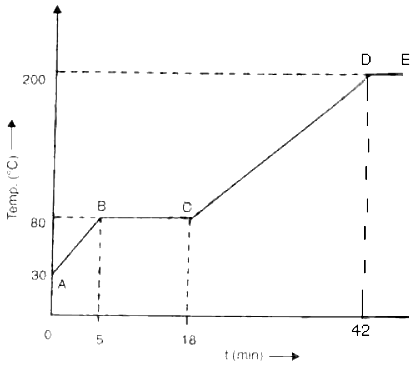
A solid of mass 100 g is heated with a burner which is supplying heat at the rate of 100 J/s. The graph in the following fig shows the changes that take place.
(a) What is the melting point of the substance?
(b) What is boiling point of the substance?
(c) Calculate the Sp. heat cap. of solid.
(d) Calculate the Sp. latent heat of fusion.
(e) Calculate the Sp. heat cap. of the liquid.
Answer
(a) Melting point is $80^{\circ} \mathrm{C}$
(b) Boiling point is $200^{\circ} \mathrm{C}$.
(c) In $5 \mathrm{~min}$, change in temperature $=50^{\circ} \mathrm{C}$
$ \frac{\mathrm{Q}}{\mathrm{t}}=100 \mathrm{~J} / \mathrm{s} $
Heat supplied in $5 \min , Q=100 \times 30=3000 \mathrm{~J}$
$ \begin{aligned} & \mathrm{Q}=\mathrm{mC}_{\mathrm{s}} \Delta \mathrm{T} \\ & \mathrm{C}_{\mathrm{s}}=\frac{\mathrm{Q}}{\mathrm{m}} \Delta \mathrm{T}=\frac{3000}{100 \times 50}=0.6 \mathrm{~J} / \mathrm{g}^{\circ} \mathrm{C} \end{aligned} $
(d) From 5 min tD 18 min, hea: supplied, Q= $780 \times 100=78000 \mathrm{~J}$
$ \begin{aligned} & Q=m l \\ & 78000=100 \times \mathrm{L} \\ & \mathrm{L}=780 \mathrm{~J} / \mathrm{g} \end{aligned} $
(e) From $18 \mathrm{~min}$ to $40 \mathrm{~min}$, change in tempera:ure $=120^{\circ} \mathrm{C}$
$ \frac{\mathrm{Q}}{\mathrm{t}}=100 \mathrm{~J} / \mathrm{s} $
Heat supplied in $22 \mathrm{~min}, \mathrm{Q}=100 \times 1320=132000 \mathrm{~J}$
$ \begin{aligned} & \mathrm{Q}=m C_L \Delta T \\ & C_L=\frac{Q}{m \Delta T}=\frac{132000}{100 \times 120}=11 \mathrm{~J} / \mathrm{g}^{\circ} \mathrm{C} \end{aligned} $
View full question & answer
Question 223 Marks
200 g of of ice at $0^{\circ} C$ is added to 2 kg of water at $30^{\circ} C$. What is the temperature of the mixture?
Answer
Let the final temperature of the mixture be $t.$
Heat gained by ice = Heat lost by water
$m1L + m_1 x C x (t - 0) = m_z x C x (30 - t)$
$(200 x 336) + (200 x 4.2 x t) = 2000 x 4.2 x (30 - t)$
$336 + 4.2t = 42 (30 - t)$
$t = 20^\circ C$
View full question & answer
Question 233 Marks
When steam at 100°C is passed through a hole drilled in a slab of ice at 0°C certain amount of ice melts. Find the amount of ice that melts. (sp. latent heat of fusion of ice = 336 J/g, sp. latent heat of vapourisation of steam = 2268 J/g, Sp. heat cap. of water= 4.2 J/g°C) (Take mass of steam as 1000 g)
Answer
$\begin{aligned} & \text { Heat given out by steam }=\text { Heat taken by ice } \\ & m_1 L_v+m 1 \times C \times \Delta T=m_2 L_i \\ & (1000 \times 2268)=(1000 \times 4.2 \times 100)=m_2 \times 336 \\ & m_2=\frac{2688000}{336}=8000 \mathrm{~g} \\ & 8000 \mathrm{~g} \text { of ice melts. }\end{aligned}$
View full question & answer
Question 243 Marks
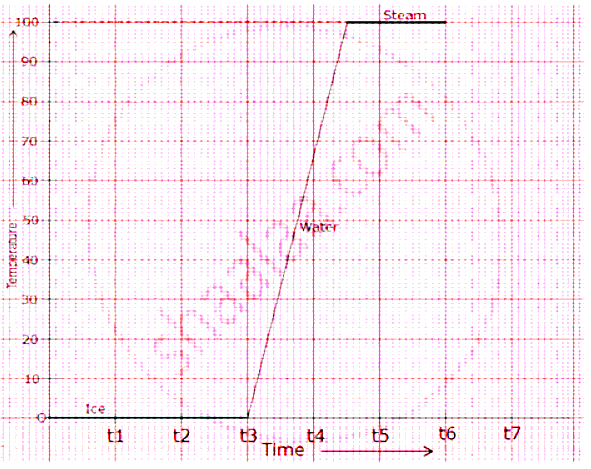
Heat is supplied at a constant rate to $200\  g$ of ice at $0^\circ C$ until finally all the ice is converted into steam at $100^\circ C.$ If the specific latent heat of ice is $3.3 x 10^5\  J/kg$ and that of steam is $2.3 x 10^6\  J/kg$ and the Sp. heat capacity of water is $4200\  J/kg$, draw rough graphs for the following to illustrate the changes which take place as the solid ice is converted into water and finally into steam, the pressure remaining constant all the time.
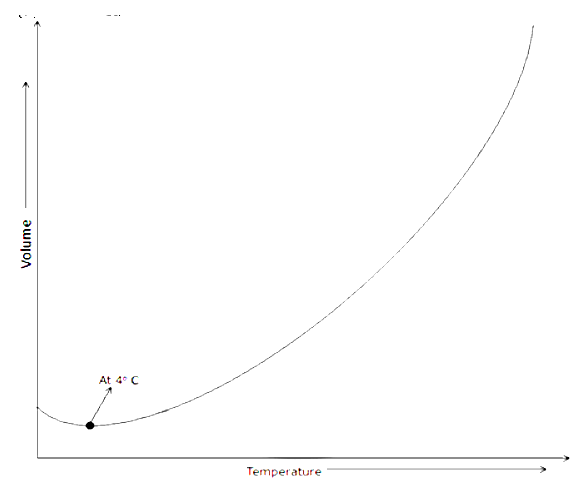
$(a)$ Volume against temperature,
$(b)$ Temperature against time.
Answer
$(a)$ Volume against temperature

$(b)$ Temperature against time
View full question & answer
[3 Mark Question Answer] - Physics STD 10 Questions - Vidyadip