Question
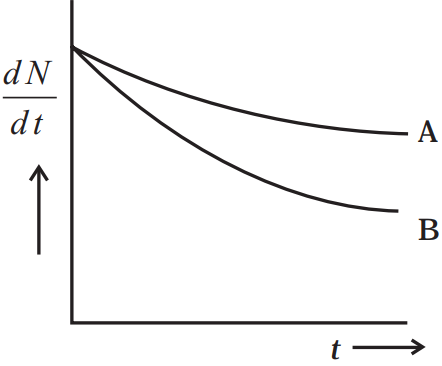
Which sample, A or B shown in Fig. has shorter mean-life?

Answer

B has shorter mean life as $\lambda$ is greater for B. This can be explained mathematically as given below
From the given graph, at $\text{t}=0,\Big(\frac{\text{dN}}{\text{dt}}\Big)_\text{A}=\Big(\frac{\text{dN}}{\text{dt}}\Big)_\text{B}\Rightarrow\ (\text{N}_0)_\text{A}=(\text{N}_0)_\text{B}$
Considering any instant t by drawing a line perpendicular to time axis, we find that $\Big(\frac{\text{dN}}{\text{dt}}\Big)_\text{A}>\Big(\frac{\text{dN}}{\text{dt}}\Big)_\text{B}$
$\Rightarrow\ \lambda_\text{A}\text{N}_\text{A}>\lambda_\text{B}\text{N}_\text{B}$
$\because\ \text{N}_\text{A}>\text{N}_\text{B}$ (rate of decay of B is slower)
$\because\ \lambda_\text{B}>\lambda_\text{A}$
As, average life, $\tau=\frac{1}{\lambda}$
$\Rightarrow\ \tau_\text{A}>\tau_\text{B}$

Need a full question paper?

Generate a complete, print-ready paper with questions like this in minutes — across 16+ boards, with answer keys.
Start Generating Free

Similar questions

A transverse wave described by$\text{y}=(0.02\text{m})\sin\Big[(1.0\text{m}^{-1})\text{x}+(30\text{s}^{-1})\text{t}\Big]$
propagates on a stretched string having a linear mass density of $1.2 \times 10^{-4}kg/m$. Find the tension in the string.
A hydrogen atom emits ultraviolet radiation of wavelength 102.5nm. What are the quantum numbers of the states involved in the transition?
A block is projected along a rough horizontal road with a speed of 10m/s. If the coefficient of kinetic friction is 0.10, how far will it travel before coming to rest?
A square coil of edge l and with n turns carries a current i. It is kept on a smooth horizontal plate. A uniform magnetic field B exists parallel to an edge. The total mass of the coil is M. What should be the minimum value of B for which the coil will start tipping over?
In a Quincke's experiment, the sound intensity has a minimum value I at a particular position. As the sliding tube is pulled out by a distance of 16.5mm, the intensity increases to a maximum of 9I. Take the speed of sound in air to be 330m/s.
  1. Find the frequency of the sound source.
  2. Find the ratio of the amplitudes of the two waves arriving at the detector assuming that it does not change much between the positions of minimum intensity and maximum intensity.
Two circular loops are placed coaxially but separated by a distance. A battery is suddenly connected to one of the loops establishing a current in it. Will there be a current induced in the other loop? If yes, when does the current start and when does it end? Do the loops attract each other or do they repel?
In Bohr’s theory of hydrogen atom, calculate the energy of the photon emitted during a transition of the electron from the first excited state to the ground state. Write in which region of the electromagnetic spectrum this transition lies.
Light of frequency $7.21 \times 10^{14} Hz$ is incident on a metal surface. Electrons with a maximum speed of $6.0 \times 10^5\ m/s$ are ejected from the surface. What is the threshold frequency for photoemission of electrons?
Explain the behaviour of non polar molecule and polar molecule in uniform electric field.
Explain why the reactance offered by an inductor increases with increasing frequency of an alternating voltage.