Question
  1. Which segment of electromagnetic waves has highest frequency? How are these waves produced ? Give one use of these waves.
  2. Which em waves lie near the high-frequency end of visible part of em spectrum? Give its one use. In what way this component of light has harmful effects on humans?
Answer

  1. $\gamma\text{ }\text{rays}.$

Produced in nuclear reactions and emitted by radioactive decay of nucleus.

Used in medicine to destroy cancer cells.

  1. Ultra violet rays

Used in LASIK eye surgery, UV lamps to kill germs in water purifier.

Causes sunburn/skin cancer/harms eyes when exposed to direct UV rays.

Need a full question paper?

Generate a complete, print-ready paper with questions like this in minutes — across 16+ boards, with answer keys.

Start Generating Free

Similar questions

(a) Magnetic field lines show the direction (at every point) along which a small magnetised needle aligns (at the point). Do the magnetic field lines also represent the lines of force on a moving charged particle at every point?
(b) If magnetic monopoles existed, how would the Gauss's law of magnetism be modified?
(c) Does a bar magnet exert a torque on itself due to its own field? Does one element of a current-carrying wire exert a force on another element of the same wire?
(d) Magnetic field arises due to charges in motion. Can a system have magnetic moments even though its net charge is zero?
According to Newton's third law each team pulls the opposite team with equal force in a tug of war. Why then one team wins and the other loses?
A bomb is dropped from a plane flying horizontally with uniform speed. Show that the bomb will explode vertically below the plane. Is the statement true if the plane flies with uniform speed but not horizontally?
A charged particle having a charge of -2.0 × 10⁻⁶C is placed close to a nonconducting plate having a surface charge density 4.0 × 10⁻⁵Cm-2. Find the force of attraction between the particle and the plate.
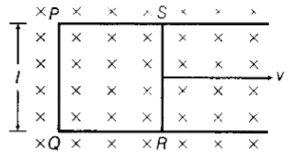
Figure shows a rectangular conducting loop PQRS in which arm RS of length I is movable. The loop is kept in a uniform magnetic field B directed downward perpendicular to the plane of the loop. The arm RS is moved with a uniform speed v.
Image

Deduce an expression for
i. the emf induced across the arm RS
ii. the external force required to move the arm and
iii. the power dissipated as heat.
Consider the situation of the previous problem. Define displacement resistance $\text{R}_\text{d}=\frac{\text{V}}{\text{i}_\text{d}}$ of the space between the plates, where V is the potential difference between the plates and id is the displacement current. Show that Rd varies with time as $\text{R}_\text{d}=\text{R}\big(\text{e}^{\text{t}/\tau}-1\big)$ 
A number of identical cells, n, each of emf E, internal resistance r connected in series are charged by a d.c. source of emf E', using a resistor R.
  1. Draw the circuit arrangement.
  2. Deduce the expressions for (a) the charging current and (b) the potential difference across the combination of the cells.
How is a galvanometer converted into a voltmeter and an ammeter? Draw the relevant diagrams and find the resistance of the arrangement in each case. Take resistance of galvanometer as G.
Write any two distinguishing features between conductors, semiconductors and insulators on the basis of energy band diagrams.
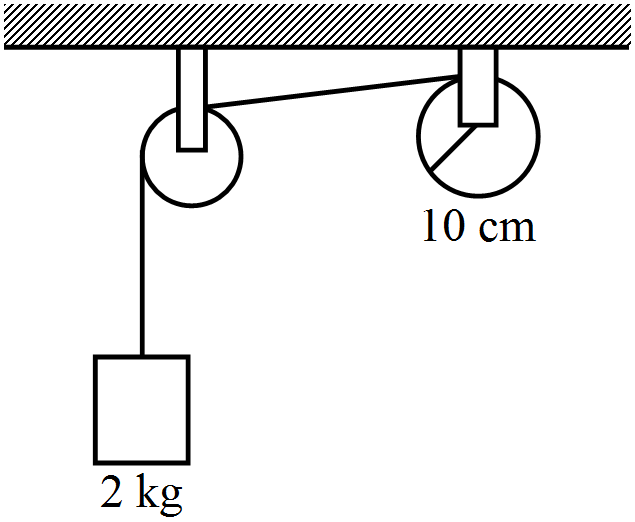
A string is wrapped on a wheel of moment of inertia 0.20kg-m2 and radius 10cm and goes through a light pulley to support a block of mass 2.0kg as shown in figure. Find the acceleration of the block.