MCQ
Which statement is not correct for nitrogen
  • A
    It has a small size
  • B
    It does not readily react with ${O_2}$
  • C
    It is a typical non-metal
  • $d$ - orbitals are available for bonding

Answer

Correct option: D.
$d$ - orbitals are available for bonding
d
(d) $N_7$ $\to$ $1s$ , $2s$ , $2p$

$d$ - orbitals are absent in nitrogen.

Need a full question paper?

Generate a complete, print-ready paper with questions like this in minutes — across 16+ boards, with answer keys.
Start Generating Free

Similar questions

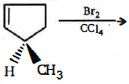
stereochemistry of the product is
Which is correct order of stability ?
Identify the major product obtained in the following reaction:
After how many seconds will the concentration of the reactants in a first order reaction be halved, if the decay constant is ${\rm{1}}{\rm{.155}} \times {\rm{1}}{{\rm{0}}^{{\rm{ - 3}}}}\,{\sec ^{ - 1}}$ ........... $\sec$
Consider the following statements :-

$(i)$ Increase in concentration of reactant increases the rate of a zero order reaction

$(ii)$ Rate constant $k$ is equal to $'A'$ if $E_a = 0$

$(iii)$ Rate constant $k$ is equal to $'A'$ if $E_a = \infty$

$(iv)$ $log_e k$  vs  $T$ is a straight line

$(v)$ $log_ek$  vs   $1/T$ is straight line
Correct statement are

The bond order in $O_2^ + $ is
$\begin{array}{*{20}{c}}
  {CH} \\ 
  {|||\,\,\,\,\,} \\ 
  {CH} 
\end{array}$ $\xrightarrow{{{O_3}/NaOH}}X\xrightarrow{{Zn/C{H_3}COOH}}Y$  ‘$Y$’ is
For depositing $1\,gm$ of $Cu$ in copper voltameter on passing $2\, amperes$ of current, the time required will be (For copper $Z= 0.00033\,gm/C$)
The number of moles of $KCl$ in $1000\,ml$ of $3\,molar$ solution is
Addition of $HCl$ to $3, 3$ -dimethyl- $1$ -butene yields two products, one of  which has a rearranged carbon skeleton. Among the following carbocations,  select the possible intermediates in that  reaction ?

$\mathop {{{(C{H_3})}_3}C\mathop C\limits^ +  HC{H_2}Cl}\limits_1 $         $\mathop {{{(C{H_3})}_3}C\mathop C\limits^ +  HC{H_3}}\limits_2 $             $\mathop {\begin{array}{*{20}{c}}
  {{{(C{H_3})}_2}C\mathop C\limits^ +  {{(C{H_3})}_2}} \\ 
  {|\,\,\,\,} \\ 
  {Cl\,\,\,} 
\end{array}}\limits_3 $              $\mathop {{{(C{H_3})}_2}\mathop C\limits^ +  CH{{(C{H_3})}_2}}\limits_4 $