MCQ
Which statement is true for cyclohexane
  • A
    It has two possible isomers
  • B
    It has three conformations
  • C
    Boat conformation is most stable
  • Chair and boat conformations differ in energy by $44$ $kJ/mol$
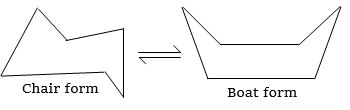
Answer

Correct option: D.
Chair and boat conformations differ in energy by $44$ $kJ/mol$
d
(d) Chair and boat form differ in energy by $44$ $kJ/mol.$

Need a full question paper?

Generate a complete, print-ready paper with questions like this in minutes — across 16+ boards, with answer keys.

Start Generating Free

Similar questions

Litharge is chemically
The enthalpy changes at $298\, K$ in successive breaking of $O -H$ bonds of $HOH$ are-
$H_2O (g) \to H(g) + OH (g), \Delta H = 498\, kJ \,mol^{-1}$
$OH (g) \to H(g) + O (g), \Delta H = 428\, kJ\, mol^{-1}$
The bond enthalpy of the $O-H$ bond is.....$kJ\, mol^{-1}$
The molar heat capacity of water at constant pressure is $75\,\,J\,{K^{ - 1}}\,mo{l^{ - 1}}$. When $ 1.0\, kJ $ of heat is supplied to $100 \,g$  of water which is free to expand the increase in temperature of water is......$K$
Arrange the following hydrogne halides in order of their decreasing reactivity with propene.
Assertion : Addition of $HBr$ on $2-$ butene gives two isomeric products.

Reason : Addition of $HBr$ on $2-$ butene follows Markovnikov rule.

The solution of $A$ and $B$ are $0.1$ and $0.2$ molar in a substance. If $100\ \ce{ML}$ of $'A\ '$ are mixed with $25\ mL$ of $B$ and there is no change in volume, then the final molarity of solution is :
Solubility product of a salt $AB $ is $1 \times {10^{ - 8}}$ in a solution in which concentration of $A$ is ${10^{ - 3}}\,M$. The salt will precipitate when the concentration of $B$  becomes more than
At $298\,K$, the solubility of silver chloride in water is $1.434 \times 10^{-3}\,g\,L ^{-1}$. The value of $-\log K _{ sp }$ for silver chloride is $........$ (Given mass of $Ag$ is $107.9\,g\,mol ^{-1}$ and mass of $Cl$ is $35.5\,g\,mol ^{-1}$ )
A quantity of $PC{l_5}$ was heated in a $10$ litre vessel at ${250\,^o}C$; $PC{l_5}_{(g)}$ $\rightleftharpoons$ $PC{l_3}_{(g)} + C{l_2}_{(g)}$. At equilibrium the vessel contains $0.1$ $mole$ of $PC{l_5}\,0.20$ $mole$ of $PC{l_3}$ and $0.2$ $mole$ of $C{l_2}$. The equilibrium constant of the reaction is
Select the $CORRECT$ statement if internuclear axis is $y-$ axis