MCQ
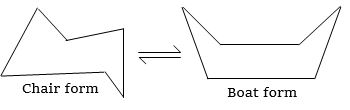
Which statement is true for cyclohexane
  • A
    It has two possible isomers
  • B
    It has three conformations
  • C
    Boat conformation is most stable
  • Chair and boat conformations differ in energy by $44$ $kJ/mol$
Answer

Correct option: D.
Chair and boat conformations differ in energy by $44$ $kJ/mol$
d
(d) Chair and boat form differ in energy by $44$ $kJ/mol.$

Need a full question paper?

Generate a complete, print-ready paper with questions like this in minutes — across 16+ boards, with answer keys.

Start Generating Free

Similar questions

Ratio of masses of proton and electron is
The correct order of increasing $s$ -character (in percentage) in the hybrid orbitals of  following molecules/ions is :-

$(I) \,CO_3^{-2}$                    $(II)\, XeF_4$

$(III)\, I^-_3$                         $(IV)\, NCl_3$

$(V)\, BeCl_2$

The $K _{\text {s }}$ of $Ag _2 CrO _4$ is $1.1 \times 10^{-12}$ at $298 K$. The solubility (in $mol / L$ ) of $Ag _2 CrO$, in a $0.1 M AgNO _2$, solution is
At $25^{\circ} C$ and $1\, atm$ pressure, the enthalpy of combustion of benzene$_{(l)}$ and acetylene$_{(g)}$ are $-3268 \,kJ\, mol ^{-1}$ and $-1300\, kJ\, mol ^{-1}$, respectively. The change in enthalpy for the reaction $3 C _{2} {H _{2}}_{(g)} \rightarrow C _{6} {H _{6}}_{(l)}$, is $.....\,kJ \,mol ^{-1}$
In an adiabatic process, no transfer of heat takes place between system and surroundings. Choose the correct option for free expansion of an ideal gas under adiabatic condition from the following
The mixing of one s and one p-orbital resulting in the formation of two equivalent sp- hybrid orbitals. Which of the following orbitals are- used for sp-hybridisation by convention.
The compound which could not act both as oxidising as well as reducing agent is
In the reaction $C{H_3}CH = C{H_2} + {H_2}O + \mathop {[O]}\limits_{Acid} $ $  \xrightarrow[Acid]{KMnO_4}  $  $\begin{array}{*{20}{c}}
  {C{H_3} - CH - C{H_2}} \\ 
  {\,\,\,\,\,\,\,\,\,\,\,\,\,\,|\,\,\,\,\,\,\,\,\,\,\,\,\,\,\,|\,\,} \\ 
  {\,\,\,\,\,\,\,\,\,\,\,\,\,\,OH\,\,\,\,\,\,\,\,OH} 
\end{array}$ $\xrightarrow{{[O]}}X + HCOOH$

$X$ is

$1\,g$ of a carbonate $\left( M _2 CO _3\right)$ on treatment with excess $HCl$ produces $0.01 mol$ of $CO _2$ The molar mass of $M _2 CO _3$ is $..........\,g\,mol ^{-1}$. (Nearest integer)
In the reaction between ozone and hydrogen peroxide, ${H_2}{O_2}$ acts as