MCQ
Which theory is confirmed by the Davisson – Germer experiment?
- Ade – Broglie theory
- BNewton’s theory
- CEinstein’s theory
- DPlanck’s theory
Explanation:
Davisson and Germer experiment proves the concept of wave nature of matter particles. The Davisson–Germer experiment provides a critically important confirmation of the de-Broglie hypothesis, which said that particles, such as electrons, are of dual nature.
Generate a complete, print-ready paper with questions like this in minutes — across 16+ boards, with answer keys.
If the current is halved in a coil, then the energy stored is how much times the previous value
|
(a) |
(b) |
(c) 2 |
(d) 4 |
Two short magnets with their axes horizontal and perpendicular to the magnetic meridian are placed with their centres 40 cm east and 50 cm west of magnetic needle. If the needle remains undeflected, the ratio of their magnetic moments  is
is
|
(a) 4 : 5 |
(b) 16 : 25 |
(c) 64 : 125 |
(d) 2 : |
In a Wheatstone’s bridge all the four arms have equal resistance R. If the resistance of the galvanometer arm is also R, the equivalent resistance of the combination as seen by the battery is
|
(a) |
(b) R |
(c) 2R |
(d) |
Four plates of equal area A are separated by equal distances d and are arranged as shown in the figure. The equivalent capacity is

|
(a) |
(b) |
(c) |
(d) |
A uniform but time-varying magnetic field B(t) exists in a circular region of radius a and is directed into the plane of the paper, as shown. The magnitude of the induced electric field at point P at a distance r from the centre of the circular region
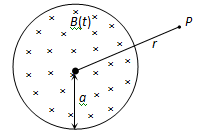
|
(a) Is zero |
(b) Decreases as |
(c) Increases as r |
(d) Decreases as |


