MCQ
Which thermodynamic property do systems have in comman when they are in thermal equilibrium?
  • A
    Pressure
  • Temperature
  • C
    Volume
  • D
    None of these

Answer

Correct option: B.
Temperature
B

Need a full question paper?

Generate a complete, print-ready paper with questions like this in minutes — across 16+ boards, with answer keys.
Start Generating Free

Similar questions

A rectangular block of mass m and area of cross section A floats in a liquid of density $\rho$ If it is given a small vertical displacement from equilibrium, it undergoes oscillations with a time period T, then:
A liquid of mass $M$ and specific heat $S$ is at a temperature $2t$. If another liquid of thermal capacity $1.5$ times, at a temperature of $\frac{t}{3}$ is added to it, the resultant temperature will be
A body falls freely under gravity. Its speed is $v$ when it has lost an amount $U$ of the gravitational energy. Then its mass is
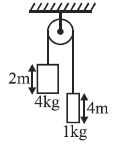
In figure shown, both blocks are released from rest. Find the time to cross each other ? ......... $\sec$
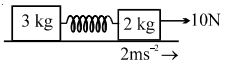
Find the acceleration of $3 kg$ mass when acceleration of $2 kg$ mass is $2 ms^{^{-2}}$ as shown in figure. ......... $ms^{-2}$
An electromagnetic wave going through vacuum is described by $\text{E}=\text{E}_0\sin(\text{kx}-\omega\text{t})$ which of the following is/are independent of the wavelength?

  1. $\text{k}$

  2. $\omega$

  3. $\frac{\text{k}}{\omega}$

  4. $\text{k}\omega$

A sample of $1$ mole gas at temperature $\mathrm{T}$ is adiabatically expanded to double its volume. If adiabatic constant for the gas is $\gamma=\frac{3}{2}$, then the work done by the gas in the process is:
When a train stops suddenly, passengers in the running train feel an instant jerk in the forward direction because
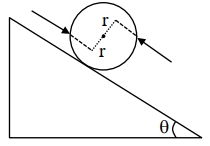
A solid sphere of mass $1 kg$ and radius $1 m$ rolls without slipping on a fixed inclined plane with an angle of inclination $\theta=30^{\circ}$ from the horizontal. Two forces of magnitude $1 N$ each, parallel to the incline, act on the sphere, both at distance $r=0.5 m$ from the center of the sphere, as shown in the figure. The acceleration of the sphere down the plane is. . . . $m s^{-2}$. (Take $g=10 ms ^{-2}$.)
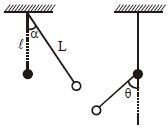
A simple pendulum consisting of a mass $M$ attached to a string of length $L$ is released from rest at an angle $\alpha$. $A$ pin is located at a distance $l$ below the pivot point. When the pendulum swings down, the string hits the pin as shown in the figure. The maximum angle $\theta$ which string makes with the vertical after hitting the pin is :-