MCQ
Which type of a physical quantity is electric current?
  • Scalar quantity
  • B
    Vector quantity
  • C
    Bipolar quantity
  • D
    Thermodynamic quantity

Answer

Correct option: A.
Scalar quantity

The electric current is a scalar quantity. Laws of ordinary algebra are used to add electric currents and the law of vector algebra are not applicable.

Need a full question paper?

Generate a complete, print-ready paper with questions like this in minutes — across 16+ boards, with answer keys.
Start Generating Free

Similar questions

A sphere of radius $1\,cm$ has potential of $8000\,V$, then energy density near its surface will be
Two coherent sources $S_1$ and $S_2$ are separated by a distance four times the wavelength $\lambda$ of the source. The sources lie along y axis whereas a detector moves along $+ x$ axis. Leaving the origin and far off points the number of points where maxima are observed is
The distance between charges $5  \times 10^{-11}C$ and $-2.7 \times 10^{-11}C$  is 0.2 m. The distance at which a third charge should be placed in order that it will not experience any force along the line joining the two charges is
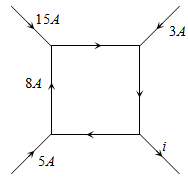
The figure shows a network of currents. The magnitude of currents is shown here. The current i will be

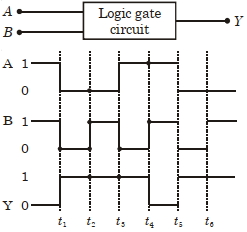
The following figure shows a logic gate circuit with two inputs $A$ and $B$ and the output $Y.$ The voltage waveforms of $A, B$ and $Y$ are as given.

The logic gate is

A particle $P$ is formed due to a completely inelastic collision of particles $x$ and $y$ having de -Broglie wavelengths ${\lambda _x}$ and ${\lambda _y}$ respectively. If $x$ and $y$ were moving in opposite directions, then the de -Broglie wavelength of $P$ is
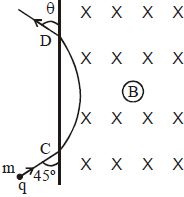
A particle of mass $m = 1.67 \times 10^{-27}\, kg$ and charge $q = 1.6 \times 10^{-19} \, C$ enters a region of uniform magnetic field of strength $1$ $tesla$ along the direction shown in the figure. The speed of the particle is $10^7\, m/s.$ The magnetic field is directed along the inward normal to the plane of the paper. The particle enters the field at $C$ and leaves at $D.$ Then the angle $\theta$ must be :-.........$^o$
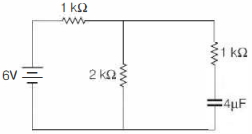
The circuit shown has been connected for a long time. The voltage across the capacitor is ............. $V$
Mark the correct statements :
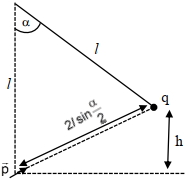
A point charge $q$ of mass $m$ is suspended vertically by a string of length $l$. A point dipole of dipole moment $\overrightarrow{ p }$ is now brought towards $q$ from infinity so that the charge moves away. The final equilibrium position of the system including the direction of the dipole, the angles and distances is shown in the figure below. If the work done in bringing the dipole to this position is $N \times( mgh )$, where $g$ is the acceleration due to gravity, then the value of $N$ is. . . . . . (Note that for three coplanar forces keeping a point mass in equilibrium, $\frac{F}{\sin \theta}$ is the same for all forces, where $F$ is any one of the forces and $\theta$ is the angle between the other two forces)