MCQ
Which waves are used by artificial satellites for communication?
  • A
    Infrared rays
  • Microwaves
  • C
    Radiowaves
  • D
    $X-$Rays

Answer

Correct option: B.
Microwaves

Microwaves are used by artificial satellites for communication.

Need a full question paper?

Generate a complete, print-ready paper with questions like this in minutes — across 16+ boards, with answer keys.
Start Generating Free

Similar questions

The photoelectric effect can be understood on the basis of:
In a compound microscope, if the objective produces an image $I_o$ and the eye piece produces an image $I_e$, then
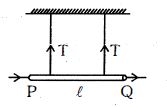
A conducting bar $PQ$ of length $l$ carrying current $I$ is suspended from a rigid support as shown in figure. A uniform magnetic field $B$ perpendicular to $PQ$ and directed away from the reader (inside the plane) is applied. If the mass of the bar is $M$ the tension in each string is
The binding energy of the innermost electron in tungsten is $40 keV$. To produce characteristic $X-$ rays using a tungsten target in an $X-$ rays tube the potential difference $V$ between the cathode and the anti-cathode should be
Two nearby objects are just resolved, if the principle maximum in the diffraction pattern of one coincides with:
Which of the following, the most suitable material for making permanent magnet is
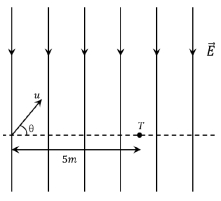
A uniform electric field, $\vec{E}=-400 \sqrt{3} \hat{y} NC ^{-1}$ is applied in a region. A charged particle of mass $m$ carrying positive charge $q$ is projected in this region with an initial speed of $2 \sqrt{10} \times 10^6 ms ^{-1}$. This particle is aimed to hit a target $T$, which is $5 m$ away from its entry point into the field as shown schematically in the figure. Take $\frac{ q }{ m }=10^{10} Ckg ^{-1}$. Then-

$(A)$ the particle will hit $T$ if projected at an angle $45^{\circ}$ from the horizontal

$(B)$ the particle will hit $T$ if projected either at an angle $30^{\circ}$ or $60^{\circ}$ from the horizontal

$(C)$ time taken by the particle to hit $T$ could be $\sqrt{\frac{5}{6}} \mu s$ as well as $\sqrt{\frac{5}{2}} \mu s$

$(D)$ time taken by the particle to hit $T$ is $\sqrt{\frac{5}{3}} \mu s$
Two long thin charged rods with charge density $\lambda$ each are placed parallel to each other at a distance $d$ apart. The force per unit length exerted on one rod by the other will be $\left(\right.$ where $\left.k=\frac{1}{4 \pi \varepsilon_0}\right)$
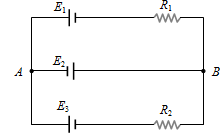
In the circuit shown here, $E_1=E_2=E_3=2 V$ and $R_1=R_2=4$ ohms. The current flowing between points A and B through battery $E_2$ is
A nucleus disintegrates into two nuclear parts, in such a way that ratio of their nuclear sizes is $1: 2^{1 / 3}$.Their respective speed have a ratio of $n: 1$. The value of $n$ is $.....$.