MCQ
The photoelectric effect can be understood on the basis of:
  • A
    Wave theroy of light only.
  • B
    Electromagnetic theory of light only.
  • Quantum theory of light only.
  • D
    None of these.

Answer

Correct option: C.
Quantum theory of light only.

Need a full question paper?

Generate a complete, print-ready paper with questions like this in minutes — across 16+ boards, with answer keys.

Start Generating Free

Similar questions

The transition from the state $n = 4$ to $n = 3$ in a hydrogen like atom results in ultraviolet radiation. Infrared radiation will be obtained in the transition from:
When electron beam passes through an electric field, they gain kinetic energy. If the same beam passes through magnetic field, then
Pick out the temperature at which iron becomes paramagnetic?
$V$ (stopping potential) is plotted against $\frac{1}{\lambda}$, where $\lambda$ is wavelength of incident radiations, for two metals
Light waves exhibit polarization but sound waves do not exhibit polarization because they are not:
The force of viscosity is:
The momentum of a photon is $2 \times {10^{ - 16}}gm-cm/sec$. Its energy is
The masses of neutron and proton are 1.0087 a.m.u. and 1.0073 a.m.u. respectively. If the neutrons and protons combine to form a helium nucleus (alpha particles) of mass 4.0015 a.m.u. The binding energy of the helium nucleus will be (1 a.m.u.= 931 MeV)
Two points $A$ and $B$ are situated at a distance $x$ and $2x$ respectively from the nearer pole of a magnet $2\ cm$ long. The ratio of magnetic field at $A$ and $B$ is:
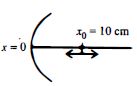
A particle is oscillating on the $X-$ axis with an amplitude $2\, cm$ about the point $x_0 = 10\, cm$ with a frequency $\omega $. A concave mirror of focal length $5\,
cm$ is placed at the origin ( see figure) Identify the correct statements

$(A)$ The image executes periodic motion

$(B)$ The image executes non-periodic motion

$(C)$ The turning points of the image are asymmetric w.r.t the image of the point at $x =10\,cm$

$(D)$ The distance between the turning points of the oscillation of the image is $\frac{{100}}{{21}}$