MCQ
While a collector to emitter voltage is constant in a transistor, the collector current changes by $8.2\, mA$ when the emitter current changes by $8.3\, mA.$ The value of forward current ratio hfe is
  • $82$
  • B
    $83$
  • C
    $8.2 $
  • D
    $8.3$

Answer

Correct option: A.
$82$
a
(a)${h_{fe}} = {\left( {\frac{{\Delta {i_c}}}{{\Delta {i_b}}}} \right)_{{V_{ce}}}} = \frac{{8.2}}{{8.3 - 8.2}} = 82$

Need a full question paper?

Generate a complete, print-ready paper with questions like this in minutes — across 16+ boards, with answer keys.
Start Generating Free

Similar questions

Current $I$ is flowing in conductor shaped as shown in the figure. The radius of the curved part is $r$ and the length of straight portion is very large. The value of the magnetic field at the centre $O$ will be
A parallel beam of monochromatic light of wavelength $5000 \mathring A$ is incident normally on a single narrow slit of width $0.001 \mathrm{~mm}$. The light is focused by convex lens on screen, placed on its focal plane. The first minima will be formed for the angle of diffraction of______________(degree).
In Young’s double slit experiment, the two slits act as coherent sources of equal amplitude A and wavelength l. In another experiment with the same set up the two slits are of equal amplitude A and wavelength l but are incoherent. The ratio of the intensity of light at the mid-point of the screen in the first case to that in the second case is
When a drop of oil is spread on a water surface, it displays beautiful colors in daylight because of:
In a potentiometer circuit a cell of $EMF$ $1.5\, {V}$ gives balance point at $36\, {cm}$ length of wire. If another cell of $EMF$ $2.5\, {V}$ replaces the first cell, then at what length of the wire, the balance point occurs ? (in $cm$)
In a common base mode of a transistor, the collector current is $5.488\ mA$ for an emitter current of $5.60\ mA$. The value of the base current amplification factor ($\beta$) will be
The needle of a deflection galvanometer shows a deflection of $60^o $ due to a short bar magnet at a certain distance in $\tan A$ position. If the distance is doubled, the deflection is
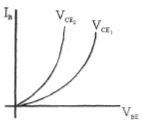
In an experiment input characteristics are shown for $CE$ configuration $n-p-n$ transistor for different output voltages. here
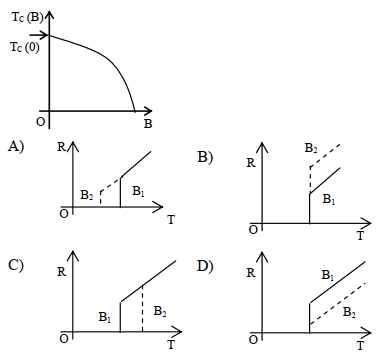
Electrical resistance of certain materials, known as superconductors, changes abruptly from a nonzero value to zero as their temperature is lowered below a critical temperature $T_c(0)$. An interesting property of superconductors is that their critical temperature becomes smaller than $T_c(0)$ if they are placed in a magnetic field, i.e., the critical temperature $T_c(B)$ is a function of the magnetic field strength $B$. The dependence of $T_c(B)$ on $B$ is shown in the figure. $Image$

$1.$ In the graphs below, the resistance $\mathrm{R}$ of a superconductor is shown as a function of its temperature $\mathrm{T}$ for two different magnetic fields $\mathrm{B}_1$ (solid line) and $\mathrm{B}_2$ (dashed line). If $\mathrm{B}_2$ is larger than $\mathrm{B}_1$ which of the following graphs shows the correct variation of $\mathrm{R}$ with $\mathrm{T}$ in these fields?

MCQ $Image$

$2.$ A superconductor has $T_C(0)=100 \mathrm{~K}$. When a magnetic field of 7.5 Tesla is applied, its $\mathrm{T}_{\mathrm{c}}$ decreases to $75 \mathrm{~K}$. For this material one can definitely say that when

$(A)$ $\mathrm{B}=5$ Tesla, $\mathrm{T}_{\mathrm{c}}(\mathrm{B})=80 \mathrm{~K}$

$(B)$ $\mathrm{B}=5$ Tesla, $75 \mathrm{~K}<\mathrm{T}_{\mathrm{c}}(\mathrm{B})<100 \mathrm{~K}$

$(C)$ $\mathrm{B}=10 \mathrm{Tesla}, 75 \mathrm{~K}<\mathrm{T}_{\mathrm{c}}<100 \mathrm{~K}$

$(D)$ $\mathrm{B}=10$ Tesla, $\mathrm{T}_{\mathrm{c}}=70 \mathrm{~K}$

Give the answer question $1, 2$
A paramagnetic substance in the form of a cube with sides $1\, cm$ has a magnetic dipole moment of $20 \times 10^{-6}\, J/T$ when a magnetic intensity of $60 \times 10^3\, A/m$ is applied. Its magnetic susceptibility is