MCQ
While opening a tap with two fingers, the forces applied by the fingers are:
  • A
    Equal in magnitude.
  • B
    Parallel to each other.
  • C
    Opposite in direction.
  • D
    All the above.

Answer

  1. All the above.

Explanation:

A couple has to be applied to the tap in order to open it. A couple is the combination of two equal and opposite parallel forces acting at different axes.

Need a full question paper?

Generate a complete, print-ready paper with questions like this in minutes — across 16+ boards, with answer keys.
Start Generating Free

Similar questions

The length of simple pendulum is increased by $44\%$. The percentage increase in its time period will be ..... $\%$
A machine gun fires a bullet of mass $40\, g$ with a velocity $1200\, ms^{-1}$. The man  holding it, can exert maximum force of $144\, N$ on the gun. How many bullets can he  fire per second at the most ?
When the body has the same temperature as that of surroundings
Water rise in a capillary upto an extension height such that upward force of surface tension balances the force of $75 \times 10^{-4}\,N$ due to weight of water. If surface tension of water is $12 \times 10^{-2}\,N/m$. The internal circumference of the capillary must be
A steel rod has a radius $10 \,mm$ and a length of $1.0 \,m$. A force stretches it along its length and produces a strain of $0.32 \%$. Young's modulus of the steel is $2.0 \times 10^{11} \,Nm ^{-2}$. What is the magnitude of the force stretching the rod is ........ $kN$
A disc of mass $3 \,kg$ rolls down an inclined plane of height $5 \,m$. The translational kinetic energy of the disc on reaching the bottom of the inclined plane is .......... $J$
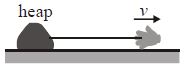
A heap of rope with mass density $\lambda $ (per unit length) lies on a table. You grab one end and pull horizontally with constant speed $v$ , as shown in figure. (Assume that the rope has no friction with itself in the heap.) The force that you must apply to maintain the constant speed $v$ is 
A particle starting from the origin $(0, 0)$ moves in a straight line in the $(x, y)$ plane. Its coordinates at a later time are $(\sqrt 3 , 3) .$ The path of the particle makes with the $x-$axis an angle of ......... $^o$
A sample of an ideal gas occupies a volume $V$ at a pressure $P$ and absolute temperature $T,$ the mass of each molecule is $m.$ The expression for the density of gas is ($k =$ Boltzmann’s constant)
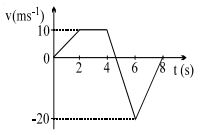
The figure shows a velocity-time graph of a particle moving along a straight line  The correct acceleration-time graph of the particle is shown as