Question
While studying the dependence of potential difference (V) across a resistor on the current (I) passing through it, in order to determine the resistance of the resistor, a student took 5 readings for different values of current and plotted a graph between V and I. He got a straight line graph passing through the origin. What does the straight line signify? Write the method of determining the resistance of the resister using this graph.
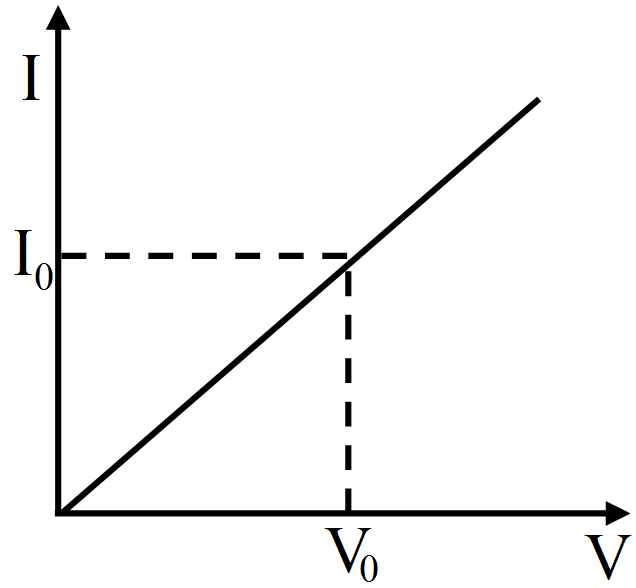 Straight line graph between potential difference (V) and current (I) shows that resistor is a linear element and follows Ohm's Law. Calculation of Resistance: At any point on the graph, resistance is given as, $\text{R}=\frac{\text{V}_0(\text{value of potential difference at that point})}{\text{I}_0(\text{value of current at that point})}$ In other word, the slope of the graph at any point gives the value $\frac{1}{\text{R}}$ Hence, Slope $=\frac{\text{I}_0}{\text{V}_0}=\frac{1}{\text{R}}$$\Rightarrow\ \text{R}=\frac{1}{\text{slope}}=\frac{\text{V}_0(\text{value of potential difference at that point})}{\text{I}_0(\text{value of current at that point})}$