Question 12 Marks
A piece of wire of resistance $R$ is cut into three equal parts. These parts are then connected in parallel. If the equivalent resistance of this parallel combination is $R_1$, what is the value of the ratio $R_1: R$ ?
Answer
View full question & answer→Resistance of each part is $\frac{R}{3} \Omega$ (as resistance is proportional to the length of the wire.)
$
\begin{aligned}
& \frac{1}{R_{ T }}=\frac{3}{R}+\frac{3}{R}+\frac{3}{R}=\frac{9}{R} \\
& \therefore R_1=\frac{R}{9} \therefore \frac{R_{ T }}{R}=\frac{1}{9}
\end{aligned}
$
$
\begin{aligned}
& \frac{1}{R_{ T }}=\frac{3}{R}+\frac{3}{R}+\frac{3}{R}=\frac{9}{R} \\
& \therefore R_1=\frac{R}{9} \therefore \frac{R_{ T }}{R}=\frac{1}{9}
\end{aligned}
$
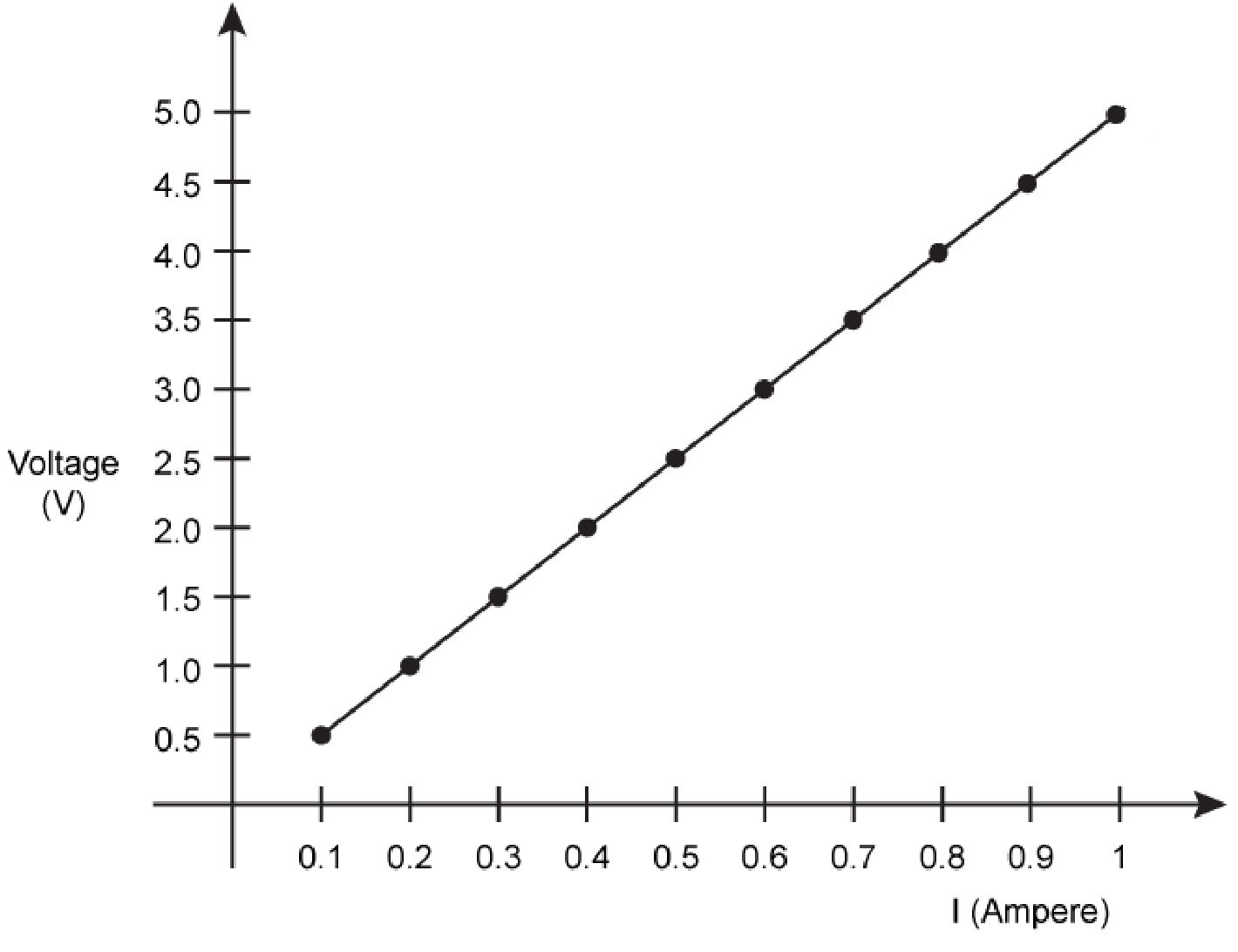 From the graph,
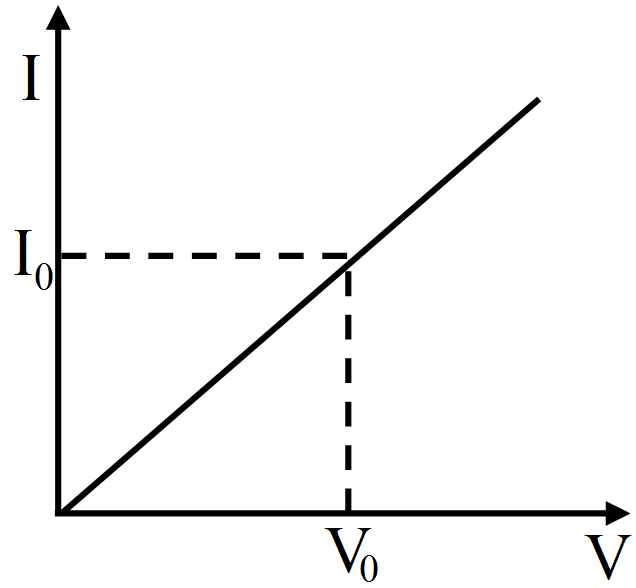 Straight line graph between potential difference (V) and current (I) shows that resistor is a linear element and follows Ohm's Law. Calculation of Resistance: At any point on the graph, resistance is given as, $\text{R}=\frac{\text{V}_0(\text{value of potential difference at that point})}{\text{I}_0(\text{value of current at that point})}$ In other word, the slope of the graph at any point gives the value $\frac{1}{\text{R}}$ Hence, Slope $=\frac{\text{I}_0}{\text{V}_0}=\frac{1}{\text{R}}$$\Rightarrow\ \text{R}=\frac{1}{\text{slope}}=\frac{\text{V}_0(\text{value of potential difference at that point})}{\text{I}_0(\text{value of current at that point})}$
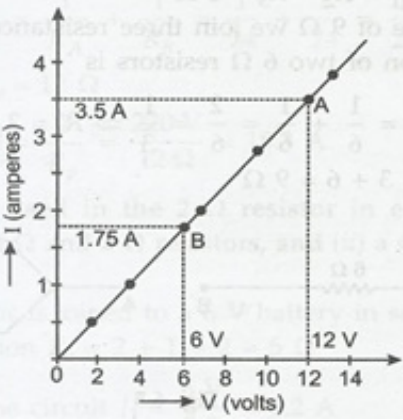 Resistance of resistor $(\text{R})=\frac{\text{V}_\text{A}-\text{V}_\text{B}}{\text{I}_\text{A}-\text{I}_\text{B}}=\frac{12\text{V}-6\text{V}}{3.6\text{A}-1.8\text{A}}$$= \frac{6\text{V}}{1.8 \text{A}} = 3.3\Omega$.