While working on a physics project at school physics lab, you require a $4 \,\mu F$ capacitor in a circuit across a potential difference of $1 \,kV$. Unfortunately, $4 \,\mu F$ capacitors are out of stock in your lab but $2 \,\mu F$ capacitors which can withstand a potential difference of $400 \,V$ are available in plenty. If you decide to use the $2 \,\mu F$ capacitors in place of $4 \,\mu F$ capacitor, minimum number of capacitors required are
Medium
Download our app for free and get started
(b)
$C_{A B}=\frac{2}{3}$
Total number of benches $=\frac{{ }^2 \not 4 \times 3}{\not 2}=6$
Total number of capacitors $=6 \times 3=18$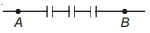

Download our appand get started for free
Experience the future of education. Simply download our apps or reach out to us for more information. Let's shape the future of learning together!No signup needed.*
Similar Questions
- 1A charge is spread non-uniformly on the surface of a hollow sphere of radius $R$, such that the charge density is given by $\sigma=\sigma_0(1-\sin \theta)$, where $\theta$ is the usual polar angle. The potential at the centre of the sphere isView Solution
- 2In a parallel plate capacitor of capacitance $C$, a metal sheet is inserted between the plates, parallel to them. If the thickness of the sheet is half of the separation between the plates. The capacitance will beView Solution
- 3View SolutionThe electric potential inside a conducting sphere
- 4Capacitance of an isolated conducting sphere of radius $R_{1}$ becomes $n$ times when it is enclosed by a concentric conducting sphere of radius $R_{2}$ connected to earth. The ratio of their radii $\left(\frac{ R _{2}}{ R _{1}}\right)$ is:View Solution
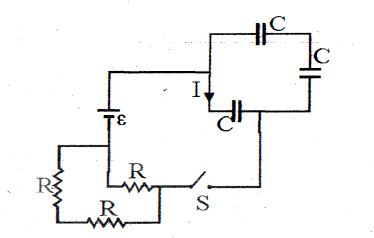
- 5In the given circuit switch $S$ is closed at $t = 0$ . The current $I$ in the figure at time $t$ isView Solution
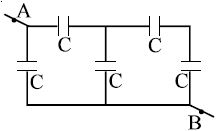
- 6What is the equivalent capacitance of the system of capacitors between $A$ $\&$ $B$View Solution
- 7There is a uniformly charged non conducting solid sphere made of material of dielectric constant one. If electric potential at infinity be zero, then the potential at its surface is $V$. If we take electric potential at its surface to be zero, then the potential at the centre will beView Solution
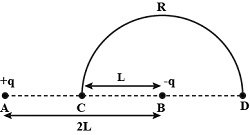
- 8Charges $+q$ and $-q$ are placed at points $A$ and $B$ respectively which are a distance $2\,L$ apart, $C$ is the midpoint between $A$ and $B.$ The work done in moving a charge $+Q$ along the semicircle $CRD$ isView Solution
- 9A thin-walled, spherical conducting shell $S$ of radius $R$ is given charge $Q$. The same amount of charge is also placed at its centre $C. $ Which of the following statements are correct ?View Solution
- 10View SolutionOn increasing the plate separation of a charged condenser, the energy