MCQ
Who among the following gave first the experimental value of $G$
  • Cavendish
  • B
    Copernicus
  • C
    Brook Teylor
  • D
    None of these

Answer

Correct option: A.
Cavendish
a
Henry cavendish performed an experiment to find the density of the Earth. The $G$ was not experimentally determined until nearly a century lateris $1798$ cavendish experimentally Proved it by using torsion balance.

Need a full question paper?

Generate a complete, print-ready paper with questions like this in minutes — across 16+ boards, with answer keys.
Start Generating Free

Similar questions

A particle is doing simple harmonic motion of amplitude $0.06 \mathrm{~m}$ and time period $3.14 \mathrm{~s}$. The maximum velocity of the particle is. . . . .. . $\mathrm{cm} / \mathrm{s}$.
Consider the motion of the tip of the minute hand of a clock. In one hour:
  1. The displacement is zero.
  2. The distance covered is zero.
  3. The average speed is zero.
  4. The average velocity is zero.
$110J$ of heat are added to a gaseous system and its internal energy increases by $40J,$ then the amount of work done is:
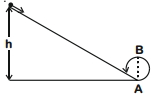
A body initially at rest and sliding along a frictionless track from a height $h$ (as shown in the figure) just completes a vertical circle of diameter $AB =D$ . The height $h$ is equal to 
The equation of displacement of two waves are given as ${y_1} = 10\sin \left( {3\pi t + \frac{\pi }{3}} \right)$; ${y_2} = 5(\sin 3\pi t + \sqrt 3 \cos 3\pi t)$. Then what is the ratio of their amplitudes
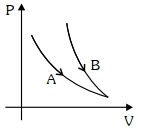
Choose the correct statement for processes $A$  & $B$ shown in figure.
Find the change in the entropy in the following process $100 \,gm$ of ice at $0°C$ melts when dropped in a bucket of water at $50°C$ (Assume temperature of water does not change) ..... $ cal/K$
Velocity of center of mass in the absence of external force
A compressive force, $F$ is applied at the two ends of a long thin steel rod. It is heated, simultaneously, such that its temperature increases by $\Delta T$. The net change in its length is zero. Let $l$ be the length of the rod, $A$ its area of cross- section, $Y$ its Young's modulus, and $\alpha $ its coefficient of linear expansion. Then, $F$ is equal to
Error in the measurement of radius of a sphere is $1\%$. The error in the calculated value of its volume is  ......... $\%$