MCQ
Whose dimensions is $M{L^2}{T^{ - 1}}$
  • A
    Torque
  • Angular momentum
  • C
    Power
  • D
    Work

Answer

Correct option: B.
Angular momentum
b
(b) Angular momentum = $mvr = ML{T^{ - 1}} \times L = M{L^2}{T^{ - 1}}$

Need a full question paper?

Generate a complete, print-ready paper with questions like this in minutes — across 16+ boards, with answer keys.
Start Generating Free

Similar questions

A particle performs simple harmonic motion with amplitude $A$. Its speed is trebled at the instant that it is at a distance $\frac{{2A}}{3}$ from equilibrium position. The new amplitude of the motion is
A thin uniform circular disc of mass $M$ and radius $R$ is rotating in a horizontal plane about an axis passing through its centre and perpendicular to the plane with angular velocity $\omega$. Another disc of same mass but half the radius is gently placed over it coaxially. The angular speed of the composite disc will be :
If the surface area of the soap solution is increased then its surface tension
The waves in which the particles of the medium vibrate in a direction perpendicular to the direction of wave motion is known as
Two spheres made of same material have radii in the ratio $1: 2$ Both are at same temperature. Ratio of heat radiation energy emitted per second by them is
At which temperature the r.m.s. velocity of a hydrogen molecule equal to that of an oxygen molecule at $47^{\circ} \mathrm{C}$ ?
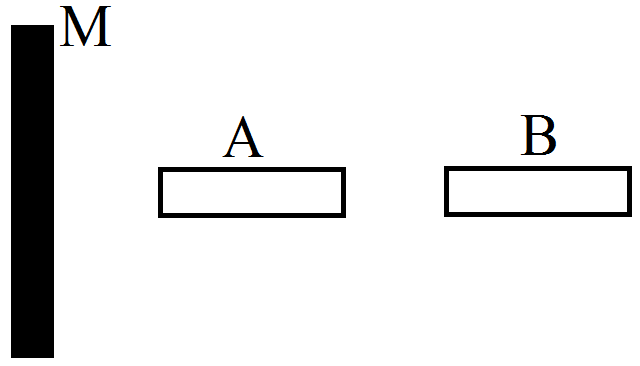
A large nonconducting sheet M is given a uniform charge density. Two uncharged small metal rods A and B are placed near the sheet as shown in figure:
  1. M attracts A.
  2. M attracts B.
  3. A attracts B.
  4. B attracts A.

The area of cross-section of a railway track is $0.01\, {m}^{2}$. The temperature variation is $10^{\circ} {C}$. Coefficient of linear expansion of material of track is $10^{-5} /{ }^{\circ} {C}$. The energy stored per meter in the track is ...... ${J} / {m} .$

(Young's modulus of material of track is $10^{11} \,{Nm}^{-2}$ ))
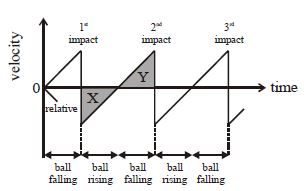
A steel ball is released from rest a distance above a rigid horizontal surface and bounces several time. The diagram shows how its velocity varies with time. Which statement correctly explains why the areas $X$ and $Y$ are equal?
A film of water is formed between two straight parallel wires of length $10\,cm$ each separated by $0.5\, cm$. If their separation is increased by $1\, mm$ while still maintaining their parallelism, how much work will have to be done (Surface tension of water = $7.2 \times {10^{ - 2}}\,N/m)$