Question
Why a compound in which hydroxyl group attached to an aromatic ring is more acidic than the one in which hydroxyl group attached to an alkyl group?
Answer

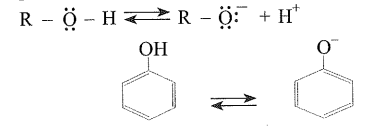
$\rightarrow$ The ionization of an alcohol and a phenol takes place as follows:
Image
$\rightarrow$ Due to the higher electronegativity of $sp^2$ hybridised carbon of phenol to which $-OH$ is attached, electron density decreases on oxygen. This increases the polarity of $O-H$ bond and results in an increase in ionization of phenols than that of alcohols.
$\rightarrow$ Now let us examine the stabilities of alkoxide and phenoxide ions. In alkoxide ion, the negative charge is localised on oxygen while in phenoxide ion, the charge is delocalised.
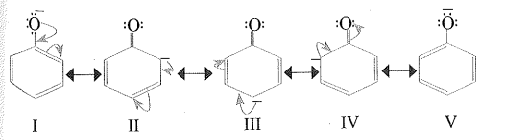
$\rightarrow$ The delocalisation of negative charge $($structures $I-V)$ makes phenoxide ion more stable and favours the ionization of phenol.
$\rightarrow$ Although there is also charge delocalisation in phenol, its resonance structures have charge separation due to which the phenol molecule is less stable than phenoxide ion.
Image

Need a full question paper?

Generate a complete, print-ready paper with questions like this in minutes — across 16+ boards, with answer keys.
Start Generating Free

Similar questions

How will you convert fructose into glucose?
Give reasons for the following:
  1. Measurement of osmotic pressure method is preferred for the determination of molar masses of macromolecules such as proteins and polymers.
  2. Aquatic animals are more comfortable in cold water than in warm water.
  3. Elevation of boiling point of $1M\ KCl$ solution is nearly double than that of $1M$ sugar solution.
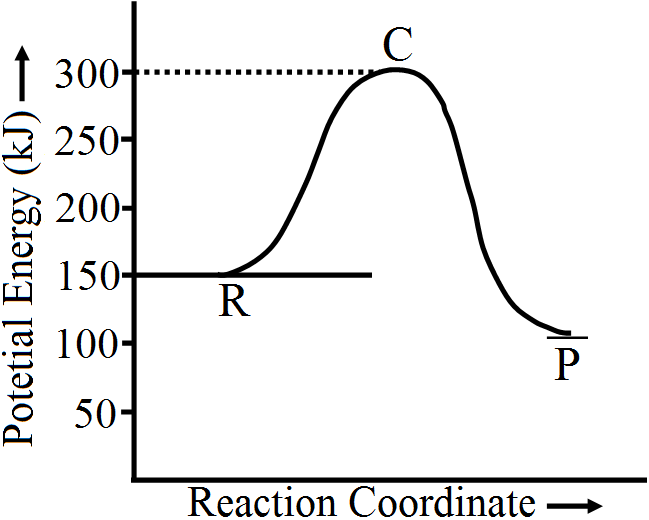
Answer the following questions on the basis of the given plot of potential energy vs reaction coordinate$:$
  1. What is the threshold energy for the reaction?
  2. What is the activation energy for forward reaction?
  3. What is the activation energy for backward reaction?
  4. What is enthalpy change for the forward reaction?
Explain kohlrausch Law with example.
Tert-Butylbromide reacts with aq. $NaOH$ by $S_N1$ mechanism while n-butylbromide reacts by $SN_2$ mechanism. Why?
Define the following terms with example:
(i) Polyester, (ii) Polyamide.
Vapour pressures of pure acetone and chloroform at $328\ K$ are $741.8\ mm\ Hg$ and $632.8\ mm\ Hg$ respectively. Assuming that they form ideal solution over the entire range of composition, plot $p_{total}, p_{chloroform},$ and $p_{acetone}$ as a function of $x_{acetone}.$ The experimental data observed for different compositions of mixture is:
$100 \times x_{acetone}$ $0$ $11.8$ $23.4$ $36.0$ $50.8$ $58.2$ $64.5$ $72.1$
$p_{acetone}/ mm\ Hg$ $0$ $54.9$ $110.1$ $202.4$ $322.7$ $405.9$ $454.1$ $521.1$
$p_{chloroform}/ mm\ Hg$ $632.8$ $548.1$ $469.4$ $359.7$ $257.7$ $193.6$ $161.2$ $120.7$
Plot this data also on the same graph paper. Indicate whether it has positive deviation or negative deviation from the ideal solution.
Identify the compounds A, B and C in the following reaction:
$\text{CH}_3-\text{Be}\ \xrightarrow{\ \ \text{Mg/ Ether}}\ \text{(A)}\ \xrightarrow[\text{(ii)}\text{Water}]{\ \ \text{CO}_2}\ \text{(B)}\ \xrightarrow[\triangle]{\ \ \text{CH}_3\text{OH}/\text{H}^+}\ \text{(C)}$
What are enzymes?
Write a note on halogenation of phenol.