MCQ
Why a $DVD$ stores almost $30$ times more information than a $CD$?
  • $DVD$ uses shorter - wavelength lasers of $6350 \,\mathring A$ but $CD$ uses an infrared laser of $7800 \,\mathring A$
  • B
    $CD$ uses shorter wavelength laser compared to a $DVD$
  • C
    $CD$ works on the principle of diffraction
  • D
    $DVD$ works on diffraction of light

Answer

Correct option: A.
$DVD$ uses shorter - wavelength lasers of $6350 \,\mathring A$ but $CD$ uses an infrared laser of $7800 \,\mathring A$
a
(a)

We know that two separate wave front originating from two whereas sources produce interference,Secondary wavelets originating from different parts of same wave front constitute diffraction. So given statement on option $(A)$ is valid.

Need a full question paper?

Generate a complete, print-ready paper with questions like this in minutes — across 16+ boards, with answer keys.

Start Generating Free

Similar questions

A long solenoid carrying a current produces a magnetic field $B$ along its axis. If the current is doubled and the number of turns per cm is halved, the new value of the magnetic field is
We consider the radiation emitted by the human body. Which of the following statements is true
Consider two solid spheres $\mathrm{P}$ and $\mathrm{Q}$ each of density $8 \mathrm{gm} \mathrm{cm}^{-3}$ and diameters $1 \mathrm{~cm}$ and $0.5 \mathrm{~cm}$, respectively. Sphere $\mathrm{P}$ is dropped into a liquid of density $0.8 \mathrm{gm} \mathrm{cm}^{-3}$ and viscosity $\eta=3$ poiseulles. Sphere $Q$ is dropped into a liquid of density $1.6 \mathrm{gm} \mathrm{cm}^{-3}$ and viscosity $\eta=2$ poiseulles. The ratio of the terminal velocities of $\mathrm{P}$ and $\mathrm{Q}$ is 
The surface tension of a liquid
Two charges each of magnitude $0.01\,C$ and separated by a distance of $0.4\,mm$ constitute an electric dipole. If the dipole is placed in an uniform electric field ' $\vec{E}$ ' of $10\,dyne/C$ making $30^{\circ}$ angle with $\overrightarrow{ E }$, the magnitude of torque acting on dipole is :
The output voltage (taken across the resistance) of a $L-C-R$ series resonant circuit falls to half its peak value at a frequency of $200 \,Hz$ and again reaches the same value at $800 \,Hz$. The bandwidth of this circuit is ............. $\,Hz$
Work done by a Carnot engine operating between temperatures $127^{\circ}\,C$ and $27^{\circ}\,C$ is $2\,kJ$. The amount of heat transferred to the engine by the reservoir is $........\,kJ$
The ends $\mathrm{Q}$ and $\mathrm{R}$ of two thin wires, $\mathrm{PQ}$ and $RS$, are soldered (joined) togetker. Initially each of the wires has a length of $1 \mathrm{~m}$ at $10^{\circ} \mathrm{C}$. Now the end $\mathrm{P}$ is maintained at $10^{\circ} \mathrm{C}$, while the end $\mathrm{S}$ is heated and maintained at $400^{\circ} \mathrm{C}$. The system is thermally insulated from its surroundings. If the thermal conductivity of wire $\mathrm{PQ}$ is twice that of the wire $RS$ and the coefficient of linear thermal expansion of $P Q$ is $1.2 \times 10^{-5} \mathrm{~K}^{-1}$, the change in length of the wire $\mathrm{PQ}$ is
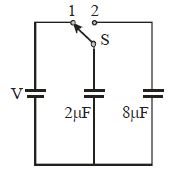
A $2\,\mu F$ Capacitor is charged as shown in the figure. The percentage of its store energy dissipated after the switch $S$ is turned to position $2$, is.....$\%$
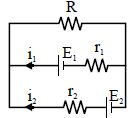
See the electrical circuit shown in the adjoining figure. Which of the following equation is a correct equation for it