MCQ
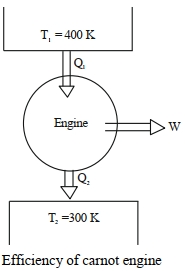
Work done by a Carnot engine operating between temperatures $127^{\circ}\,C$ and $27^{\circ}\,C$ is $2\,kJ$. The amount of heat transferred to the engine by the reservoir is $........\,kJ$
  • A
    $4$
  • B
    $2$
  • $8$
  • D
    $2.67$

Answer

Correct option: C.
$8$
c
$\eta=1-\frac{ T _2}{ T _1}=\frac{ W }{ Q _1}$

$\Rightarrow \frac{ W }{ Q _1}=1-\frac{300}{400}=\frac{1}{4}$

$\Rightarrow \frac{2 kJ }{ Q _1}=\frac{1}{4}$

$\Rightarrow Q _1=8\,kJ$
Need a full question paper?

Generate a complete, print-ready paper with questions like this in minutes — across 16+ boards, with answer keys.
Start Generating Free

Similar questions

An electromagnetic wave going through vacuum is described by $E = {E_0}\sin (kx - \omega \,t)$; $B = {B_0}\sin (kx - \omega \,t)$. Which of the following equation is true
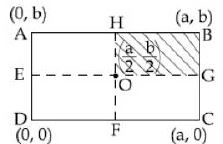
A uniform rectangular thin sheet $ABCD$ of mass $M$ has length $a$ and breadth $b$, as shown in the figure. If the shaded portion $HBGO$ is cut off, the coordinates of the centre of mass of the remaining portion will be
An incandescent bulb has a thin filament of tungsten that is heated to high temperature by passing an electric current. The hot filament emits black-body radiation. The filament is observed to break up at random locations after a sufficiently long time of operation due to non-uniform evaporation of tungsten from the filament. If the bulb is powered at constant voltage, which of the following statement($s$) is(are) true?

($A$) The temperature distribution over the filament is uniform

($B$) The resistance over small sections of the filament decreases with time

($C$) The filament emits more light at higher band of frequencies before it breaks up

($D$) The filament consumes less electrical power towards the end of the life of the bulb
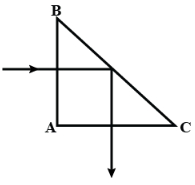
Light enters an isosceles right triangular prism at normal incidence through face $A B$ and undergoes total internal reflection at face $B C$ as shown below.The minimum value of the refractive index of the prism is close to
A particle of mass $m$ is tied to one end of $a$ string of length $l$. The particle is held horizontal with the string $mg$ taut. It is then projected upward with $a$ velocity $u$. The tension in the string is $\frac{{mg}}{2}$ when it is inclined at an angle $30^o$ to the horizontal. The value of $u$ is
In an experiment with Vernier callipers of least count $0.1\,mm$, when two jaws are joined together the zero of Vernier scale lies right to the zero of the main scale and $6^{\text {th }}$ division of Vernier scale coincides with the main scale division. While measuring the diameter of a spherical bob, the zero of vernier scale lies in between $3.2\,cm$ and $3.3\,cm$ marks, and $4^{\text {th }}$ division of vernier scale coincides with the main scale division. The diameter of bob is measured as $.......\,cm$
A solenoid is tightly wound with wire of diameter $0.10\,cm$ , has a cross-sectional area $\frac {1}{\pi }\,cm^2$ and is $40\,cm$ long. If current through the solenoid decreases uniformly from $10\,A$ to $0\,A$ in $0.10\,s$ . Then $emf$ induced inside the solenoid is.....$mV$
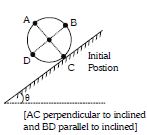
A solid sphere of mass $m$ , radius $R$ is released from rest on sufficient rough long inclined plane of inclination $\theta $ . Consider four points $A$ , $B$ , $C$ and $D$ on the sphere. After one revolution
What is the stopping potential when the metal with work function $0.6 eV$ is illuminated with the light of $2 eV$ ............ $V$
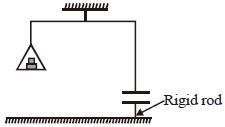
The lower plate of a parallel plate capacitor is supported on a rigid rod. The upper plate is suspended from one end of a balance. The two plates are joined together by a thin wire and subsequently disconnected. The balance is then counterpoised. Now a voltage $V = 5000\, volt$ is applied between the plates. The distance between the plates is $d =5\, mm$ and the area of each plate is $A = 100 cm^2.$ Then find out the additional mass placed to maintain balance.......$g$ [All the elements other than plates are massless and nonconducting] :-