Questions

[5 Mark Question Answer]

🎯

Test yourself on this topic

15 questions · timed · auto-graded

Question 15 Marks
Taking $MgCl _2$ as an electrovalent compound, $CCl _4$ as a covalent compound, give four difference between electrovalent and covalent compounds
Answer
$MgCl_2$ - Electrovalent compound $CCl_4$ - Covalent compound
They are hard crystalline solids consisting of ions. These are gases or liquids or soft solids.
They have high melting and boiling points. They have low melting and boiling points.
They conduct electricity in the fused or aqueous state. They do not conduct electricity in the solid, molten or aqueous state.
These are soluble in inorganic solvents but insoluble in organic solvents. These are insoluble in water but dissolve in organic solvents.
View full question & answer
Question 25 Marks
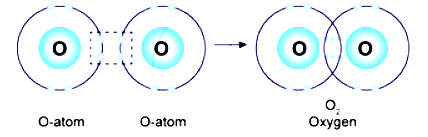
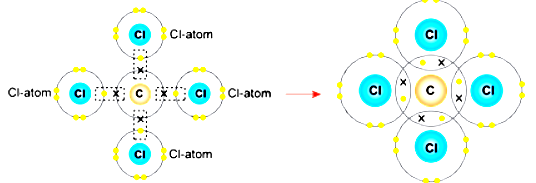
In the formation of (i) oxygen molecule (ii) carbon tetrachloride molecule, state the following:
  1. Electronic configuration of nearest inert gas attained.
  2. How many electrons are shared/transferred in bond formation
  3. Which type of bonds these compounds form?
  4. Draw their orbital diagrams.
Answer
In the formation of
Oxygen molecule
Neon (10) 2,8
Two pairs of electrons are shared.
Covalent bond
Orbital Diagram:

Carbon tetrachloride molecule
Neon (10) 2,8
Four pairs of electrons are shared.
Covalent bond
Orbital Diagram:
View full question & answer
Question 35 Marks
An element $X$ has $2$ electrons in its $M$ shell, it forms a bond with an element $Y$ which has $7$ electrons in its third orbit.
  1. Write the formula of the compound formed.
  2. Which nearest inert gas electronic configuration will element $X$ and $Y$ acquire.
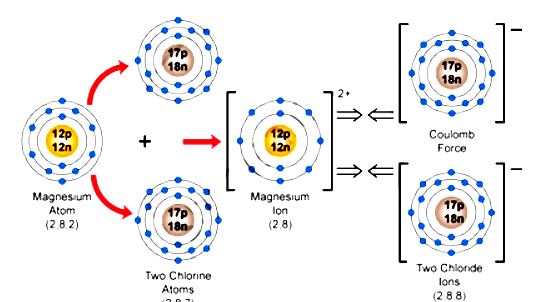
  3. Show by orbital diagram the formation of the compound between $X$ and $Y.$
Answer
Element $X$ has $2$ electrons in its M shell.The electronic configuration would be $2, 8, 2$.So, element X is Mg ($12$).Element Y has $7$ electrons in its third orbit.The electronic configuration would be $2, 8, 7$.So, element $Y$ is $Cl (17)$.
  1. $MgCl_2$
  2. The nearest inert gas electronic configuration for element $X$ is $2,8$, while that for element $Y$ is $2,8,8.$
  3. Orbital diagram showing the formation of the compound between $X$ and $Y:$
Magnesium chloride:
View full question & answer
Question 55 Marks
Compare :
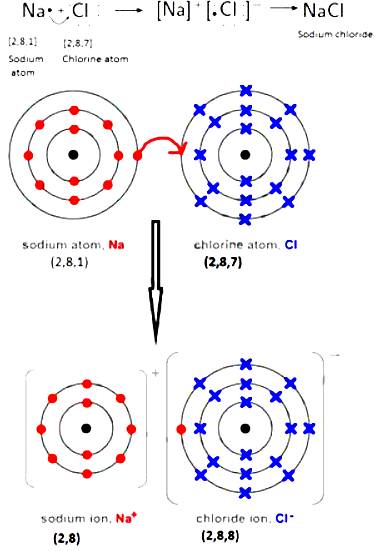
Sodium atom and sodium ion
Answer

Sodium atom

Sodium-ion

Sodium atom is electrically neutral.

Sodium-ion is positively charged.

In sodium atom, there are 11 protons and 11 electrons, i.e. an equal number of protons and electrons.

In sodium-ion, there are 11 protons but 10 electrons, i.e. sodium ion contains a lesser number of electrons.

The sodium atom has only one electron in its valence shell.

Sodium-ion has 8 electrons in its valence shell.

The size of a sodium atom is larger than a sodium ion.

The size of a sodium ion is smaller than a sodium atom.

View full question & answer
Question 65 Marks
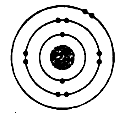
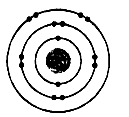
Draw diagrams representing the atomic structures of the following:
  1. Sodium atom
  2. Chlorine ion
  3. Carbon atom
  4. Oxygen ion
View full question & answer
Question 75 Marks
Match the atomic numbers 4, 14, 8, 15 and 19 with each of the following:
  1. A solid non-metal of valency 3.
  2. A gas of valency 2.
  3. A metal of valency 1.
  4. A non-metal of valency 4.
Answer
Name with valency Atomic Number
1. A solid non-metal of valency 3 15
2. A gas of valency 2 8
3. A metal of valency 1 19
4. A non-metal of valency 4 14

Explanation:

  1. As atomic number 15 has an electronic configuration [2, 8, 5], it is a non-metal having 5 electrons in the valence shell and needs three electrons to complete its octet so it has a valency of 3.

  2. As atomic number is 8, so it has the electronic configuration of [2, 6] and it needs 2 electrons to complete its octet hence, it is a gas of valency 2.

  3. As atomic number 19 has an electronic configuration [2, 8, 8, 1], so it is a metal having 1 electron in the valence shell and donates its one electron to complete its octet so it has a valency 1.

  4. As atomic number 14 has electronic configuration [2, 8, 4], so it is a non-metal having 4 electrons in the valence shell and needs four electrons to complete its octet so it has a valency 4.

View full question & answer
Question 85 Marks
An element A atomic number 7 mass numbers 14
B electronic configuration 2,8,8
C electrons 13, neutrons 14
D Protons 18 neutrons 22
E Electronic configuration 2,8,8,1 State Valency of each element An element A atomic number 7 mass numbers 14 B electronic configuration 2,8,8 C electrons 13, neutrons 14 D Protons 18 neutrons 22 E Electronic configuration 2,8,8,1 State (i) Valency of each element (ii) which one is a metal (iii) which is non-metal (iv) which is an inert gas
Answer
(i) Element A
Atomic number = 7 = Number of electrons = 2, 5
Valency of A = 8 - 5 = 3
Element B
Electronic configuration 2, 8, 8
Valency of B = Zero
Element C has 13 electrons
Electronic configuration = 2, 8, 3
Valency of C = 3
Element D
Protons = 18 = Electrons = 2, 8, 8
Valency of D = Zero
Element E
Electronic configuration = 2, 8, 8, 1
Valency of E = 1
(ii) C and E are metals.
(iii) A is a non-metal.
(iv) A, C and E are not inert gases.
View full question & answer
Question 95 Marks
How does the Modern atomic theory contradict and correlate with Dalton's atomic theory?
Answer
The latest research on the atom has proved that most of the postulates of Dalton's atomic theory contradict. However, Dalton was right that atoms take part in chemical reactions. Comparisons of Dalton's atomic theory with the modern atomic theory. Dalton's atomic theory:
  1. Atoms are indivisible.
  2. Atoms of the same element are similar in every respect.
  3. Atoms combine in a simple whole-number ratio to form molecules.
  4. Atoms of different elements are different.
  5. Atoms can neither be created nor be destroyed.
Modern atomic theory:
  1. Atoms are no longer indivisible and consist of electrons, protons, neutrons and even more sub-particles.
  2. Atoms can be changed in energy.
  3. Atoms of the same element may differ from one another called isotopes. i.e.$ ^{12}_6C ^{13}_6C ^4_6C.$
  4. Atoms of different elements may be similar called isobars.
  5. Atoms combine in a ratio which is not a simple whole-number ratio; e.g. in sugar, the $C_{12}H_{22}O_{11}$​​​​​​​ ratio is not a whole number ratio.
View full question & answer
Question 105 Marks
${ }_{12}^{24} \mathrm{Mg}$ and ${ }_{12}^{26} \mathrm{Mg}$ are symbols of isotopes of magnesium.
(a) Compare the atoms of these isotopes with respect to:
i. the composition of their nuclei
ii. their electronic configurations
(b) Give reasons why the two isotopes of magnesium have different mass numbers.
Answer
(a) i.
$\ce{^24_12Mg}$$\ce{^26_12Mg}$
No. of electrons1212
No. of protons1212
No. of neutrons24 - 12 = 1226 - 12 = 14
Hence, the composition of nuclei
$ { }_{12} \mathrm{Mg}^{24} \longrightarrow(\mathrm{P}, \mathrm{n}),(12+12){ }_{12} \mathrm{Mg}^{26} \longrightarrow(\mathrm{p}, \mathrm{n})(12+14) $
ii. Electronic configuration $=2,8,2$
(b) Mass numbers of two isotopes of magnesium are different because of the different number of neutrons, i.e. 12 and 14, respectively.
View full question & answer
Question 115 Marks
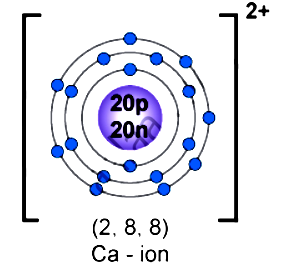
Draw the orbital diagram of ${ }_{20}^{40} \mathrm{Ca}^{2+}$ ion and state the number of three fundamental particles present in it.
Answer
Orbital diagram of ${ }_{20}^{40} \mathrm{Ca}^{2+}$
Atomic number of $\mathrm{Ca}^{2+}$ is 18 .
Electronic configuration of $\mathrm{Ca}^{2+}$ is 2, 8, 8.

Number of three fundamental particles of $\mathrm{Ca}^{2+}$ :
Protons: 18
Electrons: 18
Neutrons: $40-18=22$
View full question & answer
Question 125 Marks
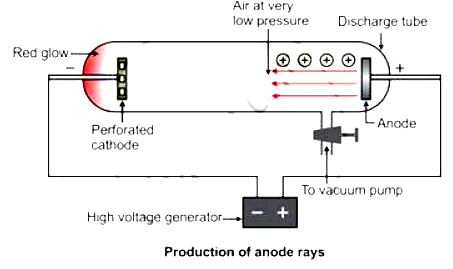
Why are anode rays also called as 'canal rays'?
Answer
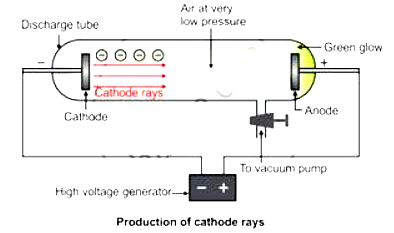
When perforated rays were used in the discharge tube, another set of rays travelling in a direction opposite to that of the cathode rays, i.e. from the anode towards the cathode, is seen, as in the figure below. These rays are called canal rays because they passed through the holes or canals in the cathode. These rays were named positive rays or anode rays.
View full question & answer
Question 135 Marks
What are cathode rays? How are these rays formed?
Answer
Cathode rays are the beam of electrons which travel from the negatively charged end (i.e. cathode to anode) of a vacuum tube, across a voltage difference between the electrodes placed at each end. Formation of cathode rays: Generally gases are poor conductors of electricity. However, when a high voltage charge from an induction coil is applied to tubes filled with gases at very low pressure (0.01 mm of mercury), the gases become good conductors of electricity and begin to flow in the form of rays. These rays are called cathode rays and they travel from the cathode towards the anode. 
View full question & answer
Question 145 Marks
Give the postulates of Bohr's atomic model
Answer
Atom has a central nucleus surrounded by electrons.
The electrons revolve around the nucleus in definite circular paths called orbits.
Each orbit has fixed energy. Therefore, these orbits are also known as energy levels or energy shells.
These orbits or energy levels are represented either by a number 1, 2, 3,... known as the principal quantum number (n) of the orbit or by K, L, M,....
There is no change of energy of electrons as long as they keep revolving in the same energy level and the atom remains stable. Electrons can jump from the higher orbit to the lower orbit when they lose energy and jump to the next when they gain energy.
View full question & answer
Question 155 Marks
On the basis of Thomson's model of an atom explain how an atom as a whole is neutral.
Answer
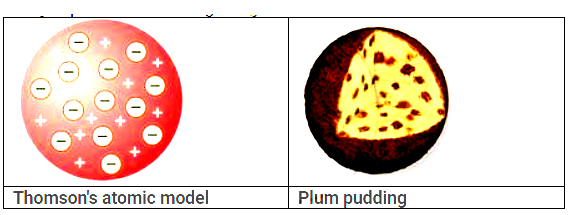
Thomson's Atomic Model: According to Thomson's atomic model, an atom is made of positively charged substances in the form of a sphere. Electrons are embedded into this sphere, and the total positive charge of the sphere is equal to the total negative charge of electrons, and hence, the atom remained electrically neutral. This model was not accepted because it was unable to explain how positively charged particles were shielded from negatively charged particles without getting neutralised. 
View full question & answer
[5 Mark Question Answer] - CHEMISTRY STD 9 Questions - Vidyadip