Question
  1. Why are coherent sources necessary to produce a sustained interference pattern?
  2. In Young's double slit experiment using monochromatic light of wavelength$\lambda,$ the intensity of light at a point on the screen where path difference is$\lambda,$ is K units. Find out the intensity of light at a point where path difference is $\lambda/3.$
Answer

  1. Coherent sources are needed to ensure that the positions of maxima and minima do not change with time.
Alternate Answer
Coherent sources have constant phase difference and, therefore, produce a sustained interference pattern.
  1. $\text{I} = \text{I}_{1} + \text{I}_{2} + 2 \sqrt{\text{I}_{1}\text{I}_{2}}\cos\theta$
For path difference $\lambda,$ phase difference
$\Phi = 2\pi$
$\text{Hence}, \text{k} = 4\text{I}_{0}\cos^{2}\pi =4 \text{ I}_{0}$
For path difference $\lambda\big/3$
Phase difference $\Phi = 2\pi\big/3$
Intensity
$\text{I}' = 4\text{I}_{0}\cos^{2}\pi\big/3$
$ = 4\text{I}_{0}\bigg(\frac{1}{2}\bigg)^{2} = \text{I}_{0}$
Therefore, $\text{I}' = \frac{\text{k}}{4}.$

Need a full question paper?

Generate a complete, print-ready paper with questions like this in minutes — across 16+ boards, with answer keys.

Start Generating Free

Similar questions

Calculate the energy that can be obtained from $1\ kg$ of water through the fusion reaction
$^2H + ^2H \rightarrow ^3H + p.$
Assume that $1.5 \times 10^{-2}\%$ of natural water is heavy water $D_2O ($by number of molecules$)$ and all the deuterium is used for fusion.
A spherical volume contains a uniformly distributed charge of density $2.0 \times 10^{-4}Cm^{-3}.$ Find the electric field at a point inside the volume at a distance $4.0\ cm$ from the centre.
Light of wavelength $488\ nm$ is produced by an argon laser which is used in the photoelectric effect. When light from this spectral line is incident on the emitter, the stopping $($cut$-$off$)$ potential of photoelectrons is $0.38 V.$ Find the work function of the material from which the emitter is made.
How many time constants will elapse before the charge on a capacitors falls to 0.1% of its maximum value in a discharging RC circuit?
Define magnetic susceptibility of a material. Name two elements, one having positive susceptibility and the other having negative susceptibility. What does negative susceptibility signify
What potential difference should be applied across an X-ray tube to get X-ray of wavelength not less than 0.10nm? What is the maximum energy of a photon of this X-ray in joule?
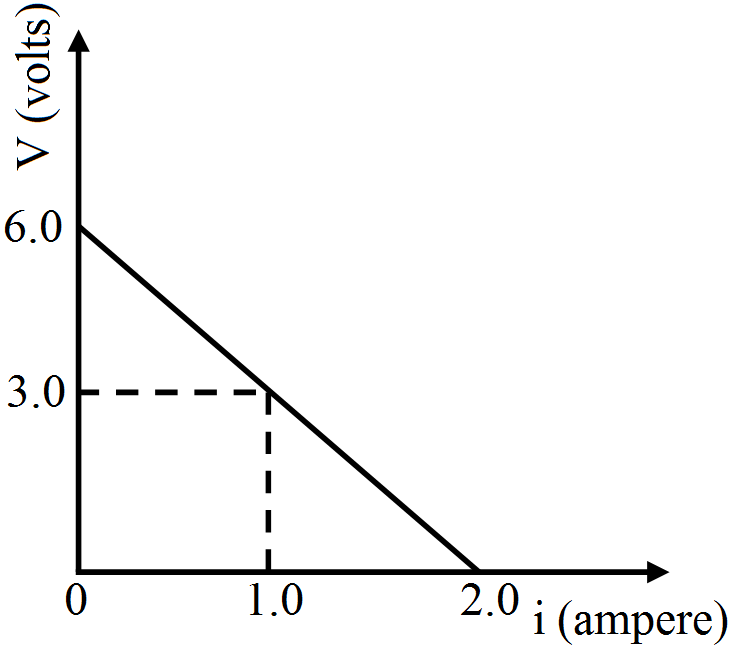
The graph shown here shows the variation of terminal potential difference V, across a combination of three cells in series to a resistor, versus current i:
  1. Calculate the emf of each cell.
  2. For what current i, will the power dissipation of the circuit be maximum?
There are energy bands in a solid. Do we have really continuous energy variation in a band or do we have very closely spaced but still discrete energy levels?
In a photodiode, the conductivity increases when the material is exposed to light. It is found that the conductivity changes only if the wavelength is less than 620nm. What is the band gap?
  1. Write the process of $\beta$ decay. How can radioactive nuclei emit $\beta$-particles even though they do not contain them? Why do all electrons emitted during $\beta$-decay not have the same energy? 
  2. A heavy nucleus splits into two lighter nuclei. Which one of the two - parent nucleus or the daughter nuclei has more binding energy per nucleon?