- Colour blindness and thalassaemia are categorised as Mendelian disorders because they occur by mutation in a single gene. Their mode of inheritance follows the principles of Mendelian genetics. Mendelian disorders can be
- autosomal dominant (muscular dystrophy)
- autosomal recessive (thalassaemia)
- sex linked (colour blindness)
Symptoms of Thalassaemia:
- Thalassaemia minor results only in mild anaemia, characterised by low haemoglobin level.
- Thalassaemia major is also known as Cooley's anaemia. In this disease, affected infants are normal but as they reach 6 to 9 months of age, they develop severe anaemia, skeletal deformities, jaundice, fatigue, etc.
Symptoms of Colour Blindness:
- Poor vision
- Inability to distinguish between red and green colour
- Inability to tolerate bright light.
- Colour blindness is a X-linked recessive disorder. Compared to females, males have higher chances of getting affected because females have two X chromosomes (XX) while males have only one X with Y chromosome. Thus, for a female to get affected by colour blindness, she has to have the mutant gene on both the X chromosomes while males can be affected if they carry it on the single X chromosome.
Conditions for colour blindness:
XY; XX: Normal
XCY: Colour-blind male
XCXC: Colour-blind female
XCX: Carrier female
Let us assume that a carrier female (XCX) is married to a normal male.
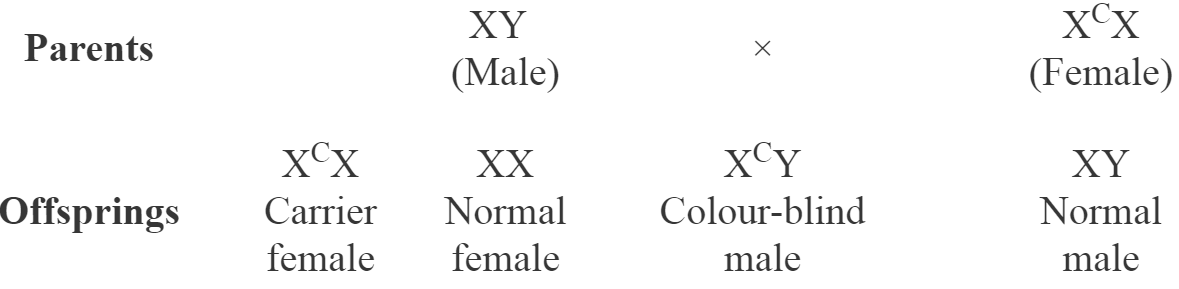
From the given table, it can be concluded that females have very less probability of getting this disease as compared to males. Females will be colour-blind only when either both parents are affected or male is affected and female is carrier, while males can be colour-blind even if female is carrier and male is normal.