Question
Why are $Fe^{2+}$ compounds easily oxidises to $Fe^{3+}$ as compared to $Mn^{+2}$ compounds.

Answer

$Mn^{2+}$ compounds are less readily converted to its $+3$ oxidation state $(Mn^{3+})$ as compared to $Fe^{2+}$ because $Mn^{2+}\ (3d^5)$ is more stable than $Mn^{3+}\ (3d^4)$ due to stable half filled d-orbital electronic configuration. Whereas $Fe^{3+}\ (3d^5)$ is more stable than $Fe^{2+}\ (3d^6)$ due to half filled d-orbitals therefore $Fe^{2+}$ gets easily converted to $Fe^{3+}$​​​​​​​

Need a full question paper?

Generate a complete, print-ready paper with questions like this in minutes — across 16+ boards, with answer keys.

Start Generating Free

Similar questions

Give primary information about the protein compounds.
Predict all the alkenes that would be formed by dehydrohalogenation of the halides with sodium ethoxide in ethanol and identify the major alkene :
2-Chloro-2-methylbutane
For $M^{2+}/M$ and $M^{3+}/M^{2+}$ systems the  values for some metals are as follows:
$Cr^{2+}/Cr$ $- 0.9 V$ $Cr^3/Cr^{2+}$ $- 0.4 V$
$Mn^{2+}/Mn$ $- 1.2 V$ $Mn^{3+}/Mn^{2+}$ $+ 1.5 V$
$Fe^{2+}/Fe$ $- 0.4 V$ $Fe^{3+}/Fe^{2+}$ $+ 0.8 V$
Use this data to comment upon:
  1. The stability of $Fe^{3+}$ in acid solution as compared to that of $Cr^{3+}$ or $Mn^{3+}.$
  2. The ease with which iron can be oxidised as compared to a similar process for either chromium or manganese metal.
Which alkyl halide from the following pairs would you expect to react more rapidly by an $\ce{S_N2}$ mechanism? Explain your answer.
$\text{CH}_3\text{CH}_2\text{CH}_2\text{CH}_2\text{Br}\ \text{or}\ \text{CH}_3\text{CH}_2\text{CH}\text{CH}_3\\\ \ \ \ \ \ \ \ \ \ \ \ \ \ \ \ \ \ \ \ \ \ \ \ \ \ \ \ \ \ \ \ \ \ \ \ \ \ \ \ \ \ \ \ \ \ \ \ \ \ \ \ \ \ \ \ \mid\\\ \ \ \ \ \ \ \ \ \ \ \ \ \ \ \ \ \ \ \ \ \ \ \ \ \ \ \ \ \ \ \ \ \ \ \ \ \ \ \ \ \ \ \ \ \ \ \ \ \ \ \ \ \ \ \text{Br}$
How are alcohol compounds prepared by reduction of carboxylic acids and esters? Explain.
Calculate the value of $\text{EMF}$ for the cell reaction :
$Cu_{(s)}+2 Ag_{(aq)}^{+} \rightarrow Cu_{(aq)}^{2+}+2 Ag_{(s)}$
$E_{Cu^{+2} / Cu}^{o}=0.34 V \text { and } E_{Ag^{+} / Ag}^{o}=0.80 V$
Write equations of the following chemical reactions:
(i) Phenol reacts with conc. $ HNO_{3} $
(ii) Phenol reacts with Zinc dust
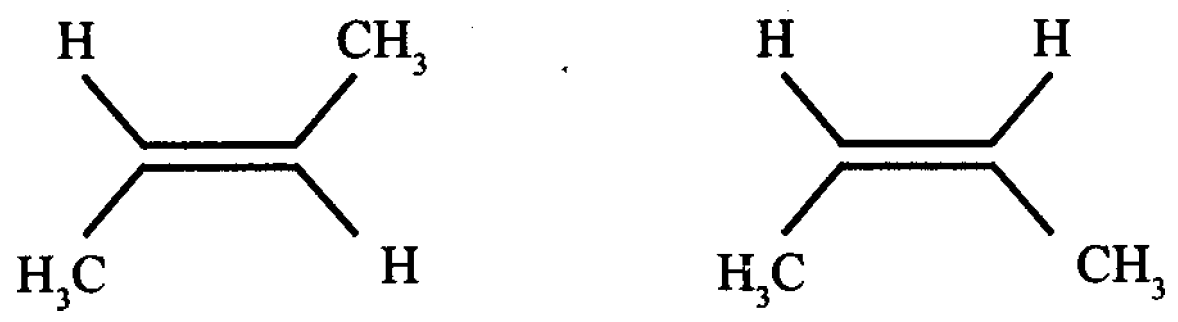
Identify whether the following pairs of compounds are structural or geometrical isomers:
  1.  
  1.  
Why can we not determine the order of a reaction by taking into consideration the balanced chemical equation?
Explain Rosenmund reduction in brief.