Questions

2 Marks Questions

Take a timed test

6 questions · self-marked practice — reveal the answer and mark yourself.

Question 12 Marks
Calculate the temperature at which the solution containing $54\ g$ of glucose, $\ce{C_6H_{12}O_6}$ in $250\ g$ of water will freeze. $(K_b$ for water $= 1.86\ K \ kg\ mol^{-1})$
Answer
Molecular mass of glucose
$M_B=72+12+96=180\ g\ mol^{-1}$
$\Delta T_f=\frac{K_f \times w_B \times 1000}{M_B \times w_A}$
$=\frac{1.86 \times 54 \times 1000}{180 \times 250}=2.23 K$
Freezing point of solution $= T _{ f }^0-\Delta T f=273-2.23=270.77 K$
View full question & answer
Question 22 Marks
Why are $Fe^{2+}$ compounds easily oxidises to $Fe^{3+}$ as compared to $Mn^{+2}$ compounds.
Answer
$Mn^{2+}$ compounds are less readily converted to its $+3$ oxidation state $(Mn^{3+})$ as compared to $Fe^{2+}$ because $Mn^{2+}\ (3d^5)$ is more stable than $Mn^{3+}\ (3d^4)$ due to stable half filled d-orbital electronic configuration. Whereas $Fe^{3+}\ (3d^5)$ is more stable than $Fe^{2+}\ (3d^6)$ due to half filled d-orbitals therefore $Fe^{2+}$ gets easily converted to $Fe^{3+}$​​​​​​​
View full question & answer
Question 32 Marks
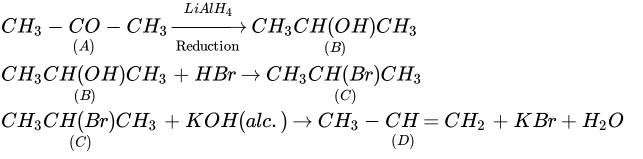
An organic compound $'A\ ' ($molecular formula $C_3H_6O)$ is resistant to oxidation but forms a compound $'B\ ' (C_3H_8O)$ on reduction. $'B\ '$ reacts with $HBr$ to form a bromide $'C\ '$ which on treatment with alcoholic $KOH$ forms an alkene $'D\ ' (C_3H_6).$ Deduce the structures of $A, B, C$ and $D.$
Answer
Structure of $A, B, C$ and $D$ are deduced in the following manner.
Image
View full question & answer
Question 42 Marks
Define the terms Mass percentage.
Answer
Mass percentage: The mass percentage of a component in a given solution is defined as the mass of the component per 100g of the solution.
Mass $\%$ of a component $=\frac{\text { Mass of the component in the solution }}{\text { Total mass of the solution }} \times 100$
View full question & answer
Question 52 Marks
Answer the following:
$(a)\ a.$ Write the mathematical relation between rate constant and half-life of a first order reaction.
$b.$ What is collision frequency?
$(b)$ If the rate equation is given below:
Rate $= k[A]^2[B]$
then what will be the unit of its rate and rate constant?
Answer
$a.\ t _{1 / 2}=\frac{0.693}{k}$
$b.$ The number of collisions per second per unit volume of the reaction mixture.
$\text { (ii) Unit of rate }=mol L^{-1} s^{-1}$
$\text { Unit of rate constant }(k)=\frac{\text { Unit of rate }}{\text { Unit of }\left[A^2\right] \times \text { Unit of }[B]}$
$=\frac{molL^{-1} s^{-1}}{\left(molL^{-1}\right)^2\left(molL^{-1}\right)}$
$=mol^{-2} L^2 s^{-1}$
View full question & answer
Question 62 Marks
Write the formulae for the following coordination compounds:
i. Potassium tetrahydroxo sincate (II)
ii. Potassium trioxalatoaluminate (III)
iii. Dichloridobis cobalt III (ethane - 1, 2 diamine)
Answer
i. $K _2\left[ Zn ( OH )_4\right]$
ii. $K _3\left[ Al \left( C _2 O _4\right)_3\right]$
iii. $\left[ CoCl _2( en )_2\right]^{+}$
View full question & answer