MCQ
Why are liquids and gases termed as fluids? Because:
  • A
    They have irregular shape
  • B
    They have randomly moving particles
  • C
    They are compressible
  • They can flow

Answer

Correct option: D.
They can flow

Need a full question paper?

Generate a complete, print-ready paper with questions like this in minutes — across 16+ boards, with answer keys.
Start Generating Free

Similar questions

A ball of mass $1 \;kg$ is thrown vertically upwards and returns to the ground after $3\; seconds$. Another ball, thrown at $60^{\circ}$ with vertical also stays in air for the same time before it touches the ground. The ratio of the two heights are
A person is observing two trains one coming towards him and other leaving with the same  speed $4\, m/s$. If their whistling frequencies are $240\, Hz$ each, then the number of  beats per second heard by the person will be:(if velocity of sound is $320\, m/s$)
A solid cylinder rolls down an inclined plane from a height $h$. At any moment the ratio of rotational kinetic energy to the total kinetic energy would be 
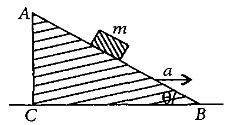
A block of mass $m$ is placed on a smooth inclined wedge $ABC$ of  inclination $\theta$ as shown in the figure. The wedge is given an acceleration $a$ towards the right. The relation between $a$ and $\theta$ for the block to remain stationary on the wedge is
The centre of mass of a system of particles is at the origin. It follows that:
A rectangular block is $10 \,cm \times 10 \,cm \times 15 \,cm$ in size is floating in water with $10 \,cm$ side vertical. If it floats with $15 \,cm$ side vertical, then the level of water will ..........
Cofficient of performance of refigerator is
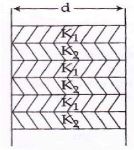
A wall consists of alternating blocks of length $d$ and coefficient of thermal conductivity $K_{1}$ and $K_{2}$ respectively as shown in figure. The cross sectional area of the blocks are the same. The equivalent coefficient of thermal conductivity of the wall between left and right is
The angular acceleration of a body, moving along the circumference of a circle, is :
A body of mass $2 \ kg$ travels according to the law $\mathrm{x}(\mathrm{t})=\mathrm{pt}+\mathrm{qt}^2 \mathrm{rt}^3$ where $\mathrm{p}=3 \mathrm{~m} \mathrm{~s}^{-1}, \mathrm{q}=4 \mathrm{~m} \mathrm{~s}^{-2}$ and $\mathrm{r}=5 \mathrm{~m} \mathrm{~s}^{-3}$. The force acting on the body at $t=2$ seconds is.