Question
Why are the springs made of steel and not of copper?

Answer

A spring will be better one if a large restoring force is set up in it on being deformed, which in turn depends upon the elasticity of the material of the spring. Since the Young's modulus of elasticity of steel is more than that of copper, hence steel is preferred in making the springs.

Need a full question paper?

Generate a complete, print-ready paper with questions like this in minutes — across 16+ boards, with answer keys.
Start Generating Free

Similar questions

Two bodies of different masses m, and m, are dropped from two different heights 'a' and 'b'. What is the ratio of time taken by the two to drop through these distances?
A sonometer wire having a length of $1.50m$ between the bridges vibrates in its second harmonic in resonance with a tuning fork of frequency $256Hz$. What is the speed of the transverse wave on the wire?
Answer the following questions:A man with a wristwatch on his hand falls from the top of a tower. Does the watch give correcttime during the free fall?
A barometer tube is 80cm long (above the mercury reservoir). It reads 76cm on a particular day. A small amount of water is introduced in the tube and the reading drops to 75.4cm. Find the relative humidity in the space above the mercury column if the saturation vapour pressure at the room temperature is 1.0cm.
When a 200 gm piece of metal is weighed in pure water, its weight is 160 gm. Find the relative density of the metal and the volume of the piece.
Suppose the platform of the previous problem is brought to rest with the ball in the hand of the kid standing on the rim. The kid throws the ball horizontally to his friend in a direction tangential to the rim with a speed v as seen by his friend. Find the angular velocity with which the platform will start rotating.
Prove that the angular momentum of a single particle moving with a constant velocity around a point remains constant throughout its motion.(NCERT)
If two waves of the same frequency but of different amplitudes travelling in opposite directions through a medium superpose upon each other, will they form stationary wave? Is energy transferred? Are there any nodes?
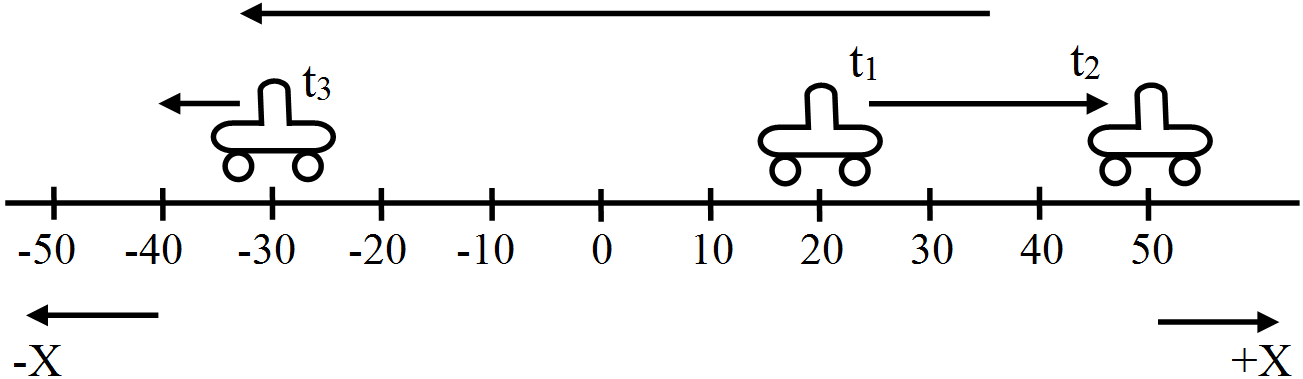
For the motion shown in the figure, find the displacement of car between the time intervals $t_1$ and $t_3$.
Does a vibrating source always produce sound?