Questions

[5 Mark Question Answer]

🎯

Test yourself on this topic

15 questions · timed · auto-graded

Question 15 Marks
How does the two sounds of same loudness and same pitch produced by different instruments differ? Draw diagrams to illustrate your answer.
Answer
The two sounds of same loudness and same pitch produced by different instruments differ due to their different waveforms.
The waveforms depend on the number of the subsidiary notes and their relative amplitude along with the principal note.
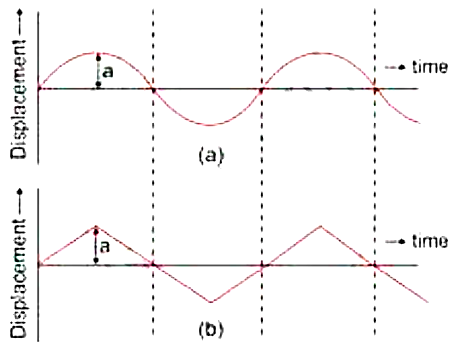
Diagram below shows the wave patterns of two sounds of same loudness and same pitch but emitted by two different instruments. They produce different sensation to ears because they differ in waveforms: one is a sine wave, while the other is a triangular wave.
View full question & answer
Question 25 Marks
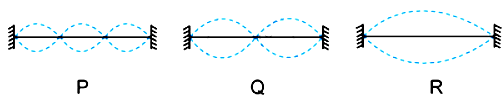
The diagram below shows three different modes of vibration P, Q and R of the same string of a
givens length.


(a) Which vibration will produce a louder sound and why?
(b) Which vibration will produce sound of maximum shrillness (or pitch) and why?
(c) What is the ratio of wavelength of vibrations P and R?
Answer
(a) $R$ will produce maximum sound because it has maximum amplitude.
(b) P will produce maximum shrillness because it has maximum frequency.
(c) Lets suppose string has length I
Then wavelength of $P=\frac{21}{3}$
Wavelength of $R =2 I$
$
\frac{\lambda_{ P }}{\lambda_{ R }}=\frac{\frac{21}{3}}{2 l }=\frac{1}{3}
$
View full question & answer
Question 35 Marks
Comment on the statement ‘loudness of sound is a subjective quantity, while intensity is an objective quantity.
Answer
The intensity at any point of the medium is the amount of sound energy passing per second normally through unit area at that point.
The loudness of a sound depends on the energy conveyed by the sound wave near the eardrum of the listener. Loudness, being a sensation, also depends on the sensitivity of the ears of the listener. Thus the loudness of sound of a given intensity may differ from listener to listener. Further, two sounds of the same intensity but of different frequencies may differ in loudness even to the same listener because of the sensitivity of ears is different for different frequencies. So, loudness is a subjective quantity while intensity being a measurable quantity is an objective quantity for the sound wave.
View full question & answer
Question 45 Marks
How do you tune your radio set to a particular station?
Answer
When we tune a radio receiver, we merely adjust the values of the electronic components to produce vibrations of frequency equal to that of the radio waves which we want to receive. When the two frequencies match, due to resonance the energy of the signal of that particular frequency is received from the incoming waves. The signal received is then amplified in the receiver set.
View full question & answer
Question 55 Marks
Why are the stringed instruments like guitar provided with a hollow sound box?
Answer
The sound box is constructed such that the column of the air inside it, has a natural frequency which is the same as that of the strings stretched on it, so that when the strings are made to vibrate, the air column inside the box is set into forced vibrations. Since the sound box has a large area, it sets a large volume of air into vibration, the frequency of which is same as that of the string. So, due to resonance a loud sound is produced.
View full question & answer
Question 65 Marks
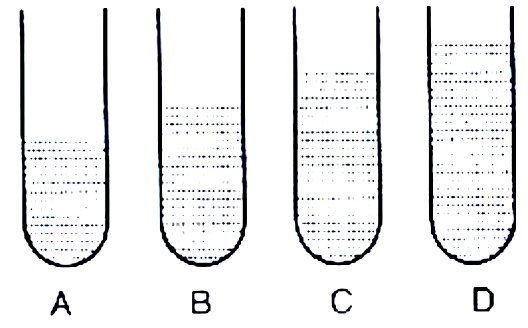
In following figure shows A, B , C and D represent test tube each of height 20 cm which are filled with water up to heights of 12 cm, 14 cm, 16cm and 18cm respectively. If a vibrating tuning fork is placed over the mouth if test tube D, a loud sound is heard.


(a) Describe the observations with the tubes A, B and C when the vibrating tuning fork is placed over the mouth of these tubes.
(b) Give the reason for your observation in each case.
(c) State the principle illustrated by the above experiment.
Answer
(a) No loud sound is heard with the tubes A and C, but a loud sound is heard with the tube B.
(b) Resonance occurs with the air column in tube B whereas no resonance occurs in the air column of tubes A and C. The frequency of vibrations of air column in tube B is same as the frequency of vibrations of air column in tube D because the length of the air column intube D is 20-18 = 2cm and that in tube B is 20-14 = 6 cm (3 times). On the other hand, the frequency of vibrations of air column in tubes A and C is not equal to the frequency vibrations of air column in tube B.
(c) When the frequency of vibrations of air column is equal to the frequency of the vibrating tuning fork, resonance occurs.
View full question & answer
Question 75 Marks
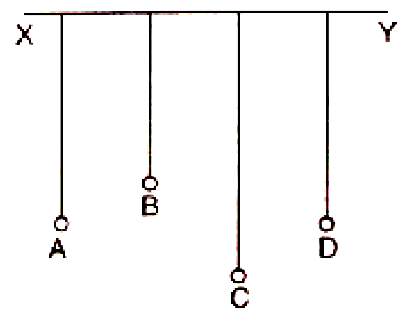
In following figure shows A, B, C and D are four pendulums suspended from the same elastic string XY. Lengths of pendulum A and D are equal, while the length of pendulum B is smaller and the pendulum C is longer. The pendulum A is set into vibration.
(a) what is your observation? (b) Give reason for your observation.

Answer
(a) Set the pendulum A into vibration by displacing it to one side, normal to its length. It is observed that pendulum D also starts vibrating initially with a small amplitude and ultimately it acquires the same amplitude as the pendulum A initially had. When the amplitude of the pendulum D becomes maximum, the amplitude of the pendulum A becomes minimum since the total energy is constant. After some time the amplitude of the pendulum D will decreases and amplitude of A increases. The exchange of energy takes place only between the pendulums A and D because their natural frequencies are same. The pendulums B and C also vibrate, but with very small amplitudes.

(b) The vibrations produced in pendulum A are communicated as forced vibrations to the other pendulums B, C and D through XY. The pendulums B and C remain in the state of forced vibrations, while the pendulum D comes in the state of resonance.

View full question & answer
Question 85 Marks
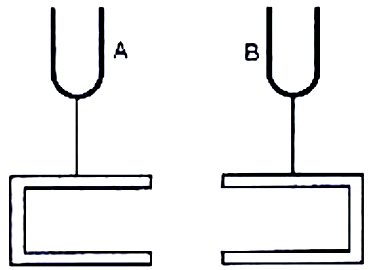
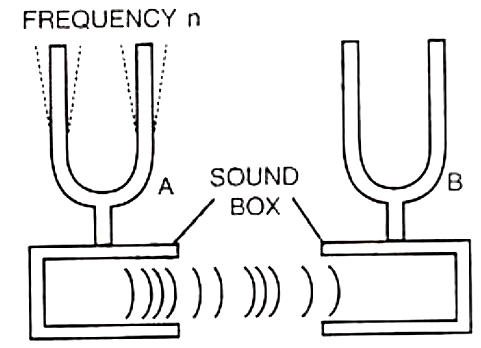
In following figure shows two tuning forks A and B of the same frequency mounted on separate sound boxes with their open ends facing each other. The fork A is set into vibration. (a) Describe your observation. (b) state the principle illustrated by this experiment.

Answer
(a) The vibrating tuning fork A produces the forced vibrations in the air column of its sound box. These vibrations are of large amplitude because of the large surface area of air in the sound box. They are communicated to the sound box of the fork B. The air column of B starts vibrating with the frequency of the fork A. Since the frequency of these vibrations is same as the natural frequency of the fork B, the fork B picks up these vibrations and starts vibrating due to resonance.

(b) On putting the tuning fork A to vibrate, the other tuning fork B will also start vibrating. The vibrations produced in the second tuning fork B are due to resonance.

View full question & answer
Question 95 Marks
Describe a simple experiment to illustrate the phenomenon of resonance and explain it.
Answer
Mount two identical tuning forks A and B of same frequency upon two separate sound boxes such that their open ends face each other as shown.


If the prong A is struck on a rubber pad, it starts vibrating. On putting A on its sound box, tuning
fork B also starts vibrating and a loud sound is heard. The vibrations produced in B are due to
resonance.
View full question & answer
Question 105 Marks

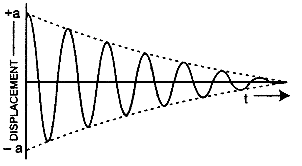
The following diagram shows the displacement – time graph of the vibrating body.


(i) name the kind of vibrations
(ii) Give one example of such vibrations
(iii) why is the amplitude of vibrations gradually decreasing?
(iv) what happens to the vibrations of the body after some time?

Answer
(i) Damped vibrations
(ii) Example: When a slim branch of a tree is pulled and then released, it makes damped vibrations.
(iii) The amplitude of vibrations gradually decreases due to the frictional (or resistive) force which the surrounding medium exerts on the body vibrating in it. As a result, the vibrating body continuously loses energy in doing work against the force of friction causing a decrease in its amplitude.
(iv) After some time, the vibrating body loses all of its energy and stops vibrating.
View full question & answer
Question 115 Marks
What are damped vibrations? How do they differ from free vibrations? Give one example of each.
Answer
The periodic vibrations of a body of decreasing amplitude in the presence of resistive force are called the damped vibrations.
The amplitude of the free vibrations remains constant and vibrations continue forever. But, the amplitude of damped vibrations decreases with time and ultimately the vibrations ceases.
For eg, When a slim branch of a tree is pulled and then released, it makes damped vibrations.
A tuning fork vibrating in air excute damped vibrations.
View full question & answer
Question 125 Marks
A radar sends a signal to an aeroplane at a distance $45 \ km$ away with a speed of $3 \times 10^8 m s^{-1}$. After how much time is the signal received back from the aeroplane?
Answer
Speed of sound transmitted from RADAR $=3 \times 10^8 M / S$
Distance at which the signal is transmitted $=300 km =300000 m$
Since, the signal travells twice, that is , when transmitted
and when it is being received by the RADAR, the distance is calculated twice.
Total distancethe signal travels $=2 \times 300000 m$
Time taken to receive the signal back after reflecting from the aeroplane
$t=\frac{d}{s}$
$t=\frac{2 \times 3 \times 10^5}{3 \times 10^8}$
$t=0.002 sec$
Thus, after $0.002 s$, the signal is received back after reflecting from the aeroplane.
View full question & answer
Question 135 Marks
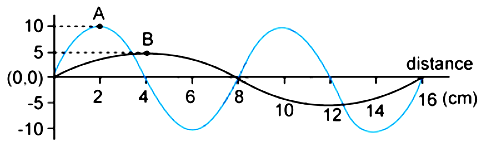
Figure below shows the distance-displacement graph of two waves A and B. Compare (i) the amplitude, (ii) the wavelength of the two waves.

Answer
Amplitude is the maximum displacement from the mean position. For A the maximum displacement $=10 cm$ and for $B$ the maximum displacement $=5 cm$.
The ratio of maximum amplitude is $\frac{ A _1}{ A _2}=\frac{10}{5}=2: 1$
Wavelength of $A=8 cm$
Wavelength of $B=16 cm$
The ratio of wavelength is $\frac{\lambda_1}{\lambda_2}=\frac{8}{16}=1: 2$
View full question & answer
Question 145 Marks
A person standing at a distance x in front of a cliff fires a gun. Another person B standing behind the person A at a distance y from the cliff hears two sounds of the fired shots after 2s and 3s respectively. Calculate x and y(take speed of sound 320m/s).
Answer
The person B hears two of the fired shots, the first one is direct from the gun while other sound comes after reflection from the cliff
Speed of sound $320 m / s$
Time taken by the sound to reach from A to B directly
$
\text { speed }=\frac{\text { distance }}{\text { time }}
$
$320=\frac{y-x}{2}$
$y-x=640 \quad \ldots . . .(1)$
After reflection from the cliff
$
320=\frac{y+x}{3}
$
$y+x=960 \ldots . . .(2)$
adding equation (1) and (2)
$
2 y=1600
$
$
y=800 m
$
$
x=160 m
$
View full question & answer
Question 155 Marks
What do you mean by reflection of sound? State one condition for the reflecton of a sound wave. Name a device in which reflection of sound wave is used.
Answer
(1) Just as rays of light, sound waves travel back in the opposite direction on hitting an obstacle.

(2) This is called the reflection of sound.

(3) The laws of reflection for sound are the same as those for light.

(4) Repetition of sound caused by reflection of sound waves from an obstacle is known as an echo.

(5) A hearing aid is one such device used by people who are hard of hearing. Here, sound waves, which are received by the hearing aid, are reflected into a narrower area leading to the ear.

View full question & answer
[5 Mark Question Answer] - Physics STD 10 Questions - Vidyadip