Question
Why do eclipses not occur every month?

Answer

Eclipses do not occur every month because the Moon's orbit around the Earth is tilted at an angle of about 5 degrees relative to the Earth's orbit around the Sun. This tilt means that the Sun, Earth, and Moon only align in a straight line (or nearly so) a few times each year, which is when eclipses can occur.

Need a full question paper?

Generate a complete, print-ready paper with questions like this in minutes — across 16+ boards, with answer keys.
Start Generating Free

Similar questions

What is the function of $RBC$?
Differentiate between nutrients and nutrition.
A train travels 180 km in 3 h. Find its speed in:
(i) km/h
(ii) m/s
(iii) What distance will it travel in 4h if it maintains the same speed throughout the journey?
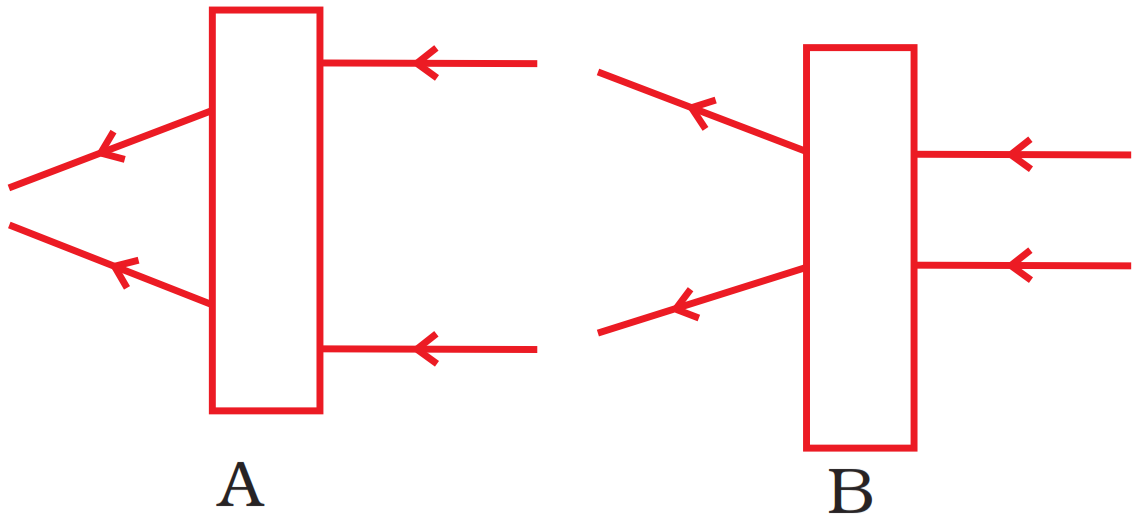
Observe the figures given as Figure $15.1$ carefully.

The given figures show the path of light through lenses of two different types, represented by rectangular boxes $A$ and $B$. What is the nature of lenses $A$ and $B$?
The swallowed food moves downwards in the alimentary canal. Explain.
It was observed that when the distance between an object and a lens decreases, the size of the image increases. What is the nature of this lens? If you keep on decreasing the distance between the object and the lens, will you still able to obtain the image on the screen? Explain.
A goat eats away all the leaves of a small plant (balsam). However, in a few days, new leaves could be seen sprouting in the plant again. How did the plant survive without leaves?
What do tornadoes look like?
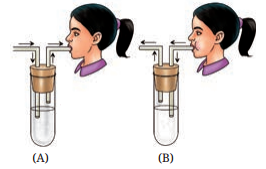
Rakshita designed an experiment taking two clean test tubes, A and B and filled them with lime water as shown in the figure. In test tube A, the surrounding air that we inhale was passed on by sucking air from the pipe, and in test tube B, the exhaled air was blown through the pipe (Fig.). What do you think she is trying to investigate? How can she confirm her findings?
Image
The image formed by a lens is always virtual, erect and smaller in size for an object kept at different positions in front of it. Identify the nature of the lens.