Question
Why do semiconductors obey Ohm's law for only low fields?

Answer

The drift velocity of a charge carrier is proportional to electric field $E$ .
$v=\frac{e E}{m} \tau$ i.e., $v \propto E$
But $v$ cannot be increased indefinitely by increasing $E$.
At high speeds, relaxation time $\tau$ begins to decrease due to the increase in collision frequency.
So drift velocity saturates at the thermal velocity $\left( v _{ th }=10^5 ms^{-1}\right)$ and becomes independent of the electric field at higher values of $E$. At $300 K,$
$v_{t h}=\left(\frac{3 k_B T}{m}\right)^{1 / 2}$
$=10^5 ms^{-1}$
$\tau=10^{-12} s$
An electric field of $10^6 Vm ^{-1}$ causes saturation of drift velocity.
Hence semiconductors obey Ohm's law for low electric fields (E $<10^6 Vm ^{-1}$ ) and above this field $,I$ become independent of $V$ .

Need a full question paper?

Generate a complete, print-ready paper with questions like this in minutes — across 16+ boards, with answer keys.
Start Generating Free

Similar questions

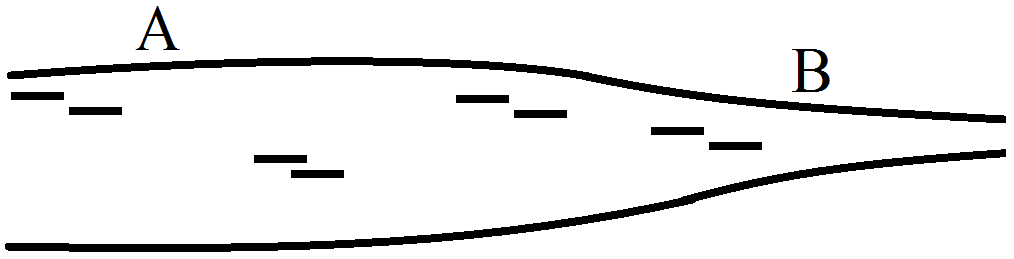
Water flows through a horizontal tube of variable cross$-$section. The area of cross-section at $A$ and $B$ are $4\ mm^2$ and $2\ mm^2$ respectively. If $1cc$ of water enters per second through $A,$ find,
  1. The speed ofwater at $A.$
  2. The speed of water at $B.$
  3. Thepressure difference $P_A- P_{B.}$
A wire-loop confined in a plane is rotated in its own plane with some angular velocity. A uniform magnetic field exists in the region. Find the emf induced in the loop.
Assume that each iron atom has a permanent magnetic moment equal to $2$ Bohr magnetons $(1$ bohr magneton equals $9.27 \times 10^{-24}A-m^2).$ The density of atoms in iron is $8.52 \times 10^{28}$ atoms/$m^3.$
  1. Find the maximum magnetization $I$ in a long cylinder of iron.
  2. Find the maximum magnetic field $B$ on the axis inside the cylinder.
Explain diamagnetism and diamagnetic material.
The gravitational field in a region is given by $\overrightarrow{\text{E}}=(5\text{N/kg})\overrightarrow{\text{i}}+(12\text{N/kg})\overrightarrow{\text{j}}.$
  1. Find the magnitude of the gravitational force acting on a particle of mass 2kg placed at the origin.
  2. Find the potential at the points (12m, 0) and (0, 5m) if the potential at the origin is taken to be zero.
  3. Find the change in gravitational potential energy if a particle of mass 2kg is taken from the origin to the point (12m, 5m).
  4. Find the change in potential energy if the particle is taken from (12m, 0) to (0, 5m).
Can you think of two particles which do not exert gravitational force on each other?
Suggest a method to produce a rainbow in your house.
A parallel beam of light of $500 \ nm$ falls on a narrow slit and the resulting diffraction pattern is observed on a screen $1 \ m$ away. It is observed that the first minimum is at a distance of $2.5 \ mm$ from the centre of the screen. Calculate the width of the slit.
A park has a radius of 10m. If a vehicle goes round it at an average speed of 18km/ hr, what should be the proper angle of banking?
Estimate the speed of vertically falling raindrops from the following data. Radius of the drops $= 0.02\ cm,$ viscosity of air $= 1.8 \times 10^{-4}$ poise$, g = 9.9\ m/s^2$ and density of water $= 1000\ kg/m^3$.