Questions

2 Marks Questions

Take a timed test

6 questions · self-marked practice — reveal the answer and mark yourself.

Question 12 Marks
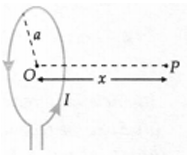
A student records the following data for the magnitudes $(B)$ of the magnetic field at axial points at different distances $x$ from the centre of a circular coil of radius a carrying a current $I$. Verify $($for any two$)$ that these observations are in good agreement with the expected theoretical variation of $B$ with $x$.
Image
$x \rightarrow$ $x = 0$ $x - a$ $x = 2 a$ $x = 3a$
$y \rightarrow$ $B _0$ $0.25 \sqrt{2} B_0$ $0.039 \sqrt{5} B_0$ $0.010 \sqrt{10} B_0$

 
Answer
The magnetic field at an axial point at distance $x$ from the centre of the circular current loop is given by
$B=\frac{\mu_0 I a^2}{2\left(a^2+x^2\right)^{3 / 2}}=\frac{\mu_0 I}{2 a\left(1+x^2 / a^2\right)^{3 / 2}}$
$i.$ At $x =0 B=\frac{\mu_0 I}{2 a}=B_0$
$ii.$ At $x=a$
$B=\frac{\mu_0 I}{2 a\left(1+\frac{a^2}{a^2}\right)^{3 / 2}}=\frac{\mu_0 I}{2 a(2)^{3 / 2}}$
$=\frac{B_0}{2 \sqrt{2}}=\frac{\sqrt{2}}{4} B_0=0.25 \sqrt{2} B_0$
$iii.$ At $x =2 a , B=\frac{\mu_0 I}{2 a\left(1+\frac{4 a^2}{a^2}\right)^{3 / 2}}$
$=\frac{B_0}{5^{3 / 2}}=\frac{\sqrt{5}}{25} B_0=0.04 \sqrt{5} B_0$
iv. At $x =3 a, B=\frac{\mu_0 I}{3 a\left(1+\frac{9 a^2}{a^2}\right)^{3 / 2}}$
$=\frac{B_0}{10^{3 / 2}}=\frac{\sqrt{10}}{100} B_0=0.01 \sqrt{10} B_0$
View full question & answer
Question 22 Marks
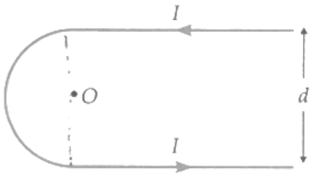
In the given figure, the curved portion is a semi-circle and the straight wires are long. Find the magnetic field at point O. 
Image
Answer
Magnetic field at point O due to any current element is perpendicular to and points out of the plane of paper. Magnetic field at O due to the upper straight wire is 
$B _1=\frac{1}{2} \times \frac{\mu_0 I}{2 \pi\left(\frac{d}{2}\right)}=\frac{\mu_0 I}{2 \pi d}$
Similarly, field at O due to lower straight wire is 
$B _2=\frac{\mu_0 I}{2 \pi d}$
Field at O due to the semicircle of radius $\frac{d}{2}$ is
$B _3=\frac{1}{2} \times \frac{\mu_0 I}{2\left(\frac{d}{2}\right)}=\frac{\mu_0 I}{2 d}$
Resultant field at O, 
$B = B _1+ B _2+ B _3=\frac{\mu_0 I}{2 d}\left[1+\frac{2}{\pi}\right]$
View full question & answer
Question 32 Marks
i. Define the terms: impact parameter and distance of closest approach for an -particle in the GeigerMarsden scattering experiment.
ii. What will be the value of the impact parameter for scattering angle (I) $\theta=0^{\circ}$ and (II) $\theta=180^{\circ}$ ?
Answer
i. IMPACT PARAMETER: It is the perpendicular distance from the centre of the nucleus of the initial velocity vector of the alpha particle.
Distance of closest approach: It is the distance of the alpha particle from the nucleus when the kinetic energy of alpha particle becomes equal to electrical potential energy between nucleus and alpha particle.
ii. Impact parameter $b=\frac{z_1 z_2 e^2}{8 \pi \varepsilon_0 k} \cot \frac{\theta}{2}$.
I. if $\theta=0^{\circ}[b=0]$
II. if $\theta=180^{\circ}[ b =\infty]$
View full question & answer
Question 42 Marks
Why do semiconductors obey Ohm's law for only low fields?
Answer
The drift velocity of a charge carrier is proportional to electric field $E$ .
$v=\frac{e E}{m} \tau$ i.e., $v \propto E$
But $v$ cannot be increased indefinitely by increasing $E$.
At high speeds, relaxation time $\tau$ begins to decrease due to the increase in collision frequency.
So drift velocity saturates at the thermal velocity $\left( v _{ th }=10^5 ms^{-1}\right)$ and becomes independent of the electric field at higher values of $E$. At $300 K,$
$v_{t h}=\left(\frac{3 k_B T}{m}\right)^{1 / 2}$
$=10^5 ms^{-1}$
$\tau=10^{-12} s$
An electric field of $10^6 Vm ^{-1}$ causes saturation of drift velocity.
Hence semiconductors obey Ohm's law for low electric fields (E $<10^6 Vm ^{-1}$ ) and above this field $,I$ become independent of $V$ .
View full question & answer
Question 52 Marks
A ball of superconducting material is dipped in liquid nitrogen and placed near a bar magnet.
i. In which direction will it move?
ii. What will be the direction of its magnetic moment?
Answer
(i) Away from the magnet
(ii) The direction of the magnetic moment is opposite to that of the magnetic field applied. 
Explanation:
Now considering both superconducting material and liquid nitrogen are diamagnetic in nature, thereby after dipping the ball in liquid nitrogen it will come out as a diamagnetic material. The ball has acquired diamagnetic properties, when in contact with a magnet will form magnetic poles in opposite direction of the magnet kept thereby, repelling the ball away.
As the ball is repelled away it can be said that the magnetic moment will form opposite in direction to the magnetic field applied. 
View full question & answer
Question 62 Marks
Given: Wavelength of light in mercury is $5.5 \times 10^{-5} cm$.
i. Calculate its frequency and period.
ii. What is the wavelength of the light in the glass, if the refractive index of glass is 1.5 ?
Answer
Given: Wavelength, $\lambda=5.5 \times 10^{-5} cm=5.5 \times 10^{-7} m$
1. Frequency, $\nu=\frac{c}{\lambda}=\frac{3 \times 10^8 m / s }{5.5 \times 10^{-7} m}=5.45 \times 10^{14} Hz=5.45 \times 10^8 MHz$
Time period, $T=\frac{1}{\nu}=\frac{1}{5.45 \times 10^8}=1.83 \times 10^{-9} \mu s$
2. Wavelength of the light in the glass, $\lambda_g=\frac{\lambda}{\mu}=\frac{5.5 \times 10^{-7}}{1.5}=3.67 \times 10^{-7} m$
View full question & answer