Question
  1. Why do transition elements show variable oxidation states?
  1. Name the element showing maximum number of oxidation states among the first series of transition metals form Sc (Z=21) to Zn (Z=30).
  2. Name the element which shows only +3 oxidation state.
  1. What is lanthanoid contraction? Name an important alloy which contains some of the lanthanoid metals.
Answer

  1. Because of incomplete filling of d-orbitals.
  1. Mn.
  2. Scandium (Sc).
  1. There is a steady decrease in the size of atoms/ions with increase in atomic number in lanthanoid. Misch metal.

Need a full question paper?

Generate a complete, print-ready paper with questions like this in minutes — across 16+ boards, with answer keys.

Start Generating Free

Similar questions

Account for the following: Give the formula and describe the structure of a noble gas species which is isostructural with $\text{IBr}^-_2.$
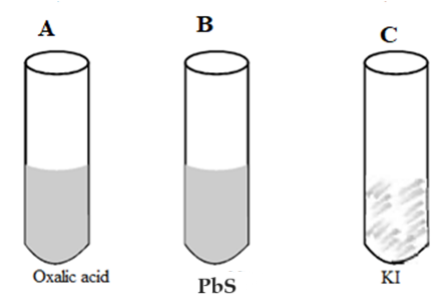
$(a).$ A purple colour compound $A,$ which is a strong oxidising agent and used for bleaching of wool, cotton, silk and other textile fibres was added to each of the three test tubes along with $H_2SO_4.$ It was followed by strong heating.
Image
In which of the above test tubes; $A, B$ or $C:$
$(i)$ Violet vapours will be formed
$(ii)$ The bubbles of gas evolved will extinguish a burning matchstick. Write an equation for each of the above observations.
$b.$ A metal ion $M^{n+}$ of the first transition series having $d^5$ configuration combines with three didentate ligands. Assuming $\Delta_0< P:$
$(i)$ Draw the crystal field energy level diagram for the $3d$ orbital of this complex.
$(ii)$ What is the hybridisation of $Mnt$ in this complex and why?
$(iii)$ Name the type of isomerism exhibited by this complex.
Explain with two examples each of the following: Coordination entity, ligand coordination number, coordination polyhedron, homoleptic and heteroleptic.
Which forces are responsible for the stability of $\alpha-\text{helix}?$ Why is it named as $3.6_{13}$ helix?
Match the items given in Column I with the type of solutions given in Column II.
 
Column I
 
Column II
i.
Soda water
a.
A solution of gas in solid.
ii.
Sugar solution
b.
A solution of gas in gas.
iii.
German silver
c.
A solution of solid in liquid.
iv.
Air
d.
A solution of solid in solid.
v.
Hydrogen gas in palladium
e.
A solution of gas in liquid.
 
 
f.
A solution of liquid in solid.
Sodium has a bcc structure with nearest neighbour distance 365.9pm. Calculate its density (Atomic mass of sodium = 23).
(a) Differentiate between
a. Nucleotide and Nucleoside
b. Amylose and Amylopectin
(b) Write a reaction which shows that all the carbon atoms in glucose are linked in a straight chain.
(c) Write two differences between DNA and RNA.
(d) Amino acids can be classified as $\alpha-, \beta-, \gamma-, \delta-$ and so on depending upon the relative position of the amino group with respect to the carboxyl group. Which type of amino acids forms a polypeptide chain in proteins?
(e) What are any two good sources of vitamin A?
(f) What is anomeric carbon?
(g) What is the difference between a glycosidic linkage and a peptide linkage?
With the help of an example explain what is meant by pseudo first order reaction.
Using IUPAC norms write the formulas for the following:
a. Tetrahydroxozincate(II)
b. Potassium tetrachloridopalladate(II)
c. Diamminedichloridoplatinum(II)
d. Potassium tetracyanonickelate(II)
e. Pentaamminenitrito-O-cobalt(III)
f. Hexaamminecobalt (III) sulphate
g. Potassium tri(oxalato) chromate(III)
h. Hexaammineplatinum(IV)
i. Tetrabromidocuprate(II)
j. Pentaamminenitrito-N-cobalt(III)
  1. Draw the structures of the following molecules:
  1. $(HPO_3)_3$.
  2. $BrF_3$.
  1. Complete the following chemical equations:
  1. $HgCl_2 + PH_3 \rightarrow $
  2. $SO_3 + H_2SO_4 \rightarrow $
  3. $XeF_4 + H_2O \rightarrow $