Question
Explain with two examples each of the following: Coordination entity, ligand coordination number, coordination polyhedron, homoleptic and heteroleptic.

Answer

Coordination entity: This entity usually constitutes a central metal atom or ion, to which are attached a fixed number of other atoms or ions or groups by coordinate bonds. Examples are $[Ni(CO)_4], [COC]_3(NH_3)_3],$ etc.
Ligands: It is an ion having at least one lone pair of electrons and capable of forming a coordinate bond with central atom/ion in the coordination entity.
Examples are: $Cl^-, (OH)^-, (CN)^-$ etc.
Coordinate number: The total number of coordinate bonds with which central atom/ion is linked to ligands in the coordination entity is called coordination number of central atom / ion.
Coordination polyhedron: The spatial arrangement of the ligands which are directly attached to the central atom / ion defines a coordination polyhedron about the central atom.
Examples are: $[Co(NHM_3)_6]^{3+}$ is octahedral, $[Ni(CO)_4]$ is tetrahedral.
Homoleptic and hedroleptic: Complexes in which a metal is bound to only one kind of donor groups are known as homoleptic.
Example $[CO(NH_3)_6]^{3+}$
Complex in which a metal is bound to more than one kind of donor groups are called hetroleptic. Example: $ [Co(NH_3)_4Cl_2]^+$

Need a full question paper?

Generate a complete, print-ready paper with questions like this in minutes — across 16+ boards, with answer keys.

Start Generating Free

Similar questions

An element has fcc structure with a cell edge 200pm. Calculate the density of element, if $200\ g$ of the element contains $24 \times 1023$ atoms.
  1. Complete the following equations:
  1. $\text{Cr}_{2}\text{O}_{7}^{2-}+\text{2OH}^{-}\rightarrow$
  2. $\text{MnO}_{4}^{-}+\text{4H}^{+}+\text{3e}^{-}\rightarrow$
  1. Account for the following:
  1. Zn is not considered as a transition element.
  2. Transition metals form a large number of complexes.
  3. The $E ^{\circ}$ value for the $Mn ^{3+} / Mn ^{2+}$ couple is much more positive than that for $Cr ^{3+} / Cr ^{2+}$ couple.
Match the items of Column I with items of Column II and assign the correct code:
 
Column I
 
Column II
$(A)$
Pendulum
$(1)$
Chrome steel
$(B)$
Malachite
$(2)$
Nickel steel
$(C)$
Calamine
$(3)$
$Na_3AlF_6$
$(D)$
Cryolite
$(4)$
$CuCO_3.Cu (OH)_2$
 
 
$(5)$
$ZnCO_3$
  1. $A (1) B (2) C (3) D (4)$
  2. $A (2) B (4) C (5) D (3)$
  3. $A (2) B (3) C (4) D (5)$
  4. $A (4) B (5) C (3) D (2)$
$i.$ Give reasons$:$
$a.$ Although $- NH _2$ group is o$/$p directing in electrophilic substitution reactions, yet aniline, on nitration gives good yield of m$-$nitroaniline.
$b. \left( CH _3\right)_2 NH$ is more basic than $\left( CH _3\right)_3 N$ in an aqueous solution.
$c.$ Ammonolysis of alkyl halides is not a good method to prepare pure primary amines.
$ii.$ Distinguish between the following$:$
$a. CH _3 CH _2 NH _2$ and $\left( CH _3 CH _2\right)_2 NH$
$b.$ Aniline and $CH _3 NH _2$
Answer the following questions:
Describe the preparation of potassium permanganate from pyrolusite ore. Write balanced chemical equation for one reaction to show the oxidizing nature of potassium permanganate.
Answer the following questions.
Write chemical reaction to show that glucose contains aldehyde as carbonyl group.
  1. Complete the following chemical reaction equations:
  1. $P_4 + SO_2Cl_2\rightarrow $
  2. $XeF_4 + H_2O \rightarrow $
  1. Explain the following observations giving appropriate reasons:
  1. The stability of $+5$ oxidation state decreases down the group in group $15$ of the periodic table.
  2. Solid phosphorus pentachloride behaves as an ionic compound.
  3. Halogens are strong oxidising agents.

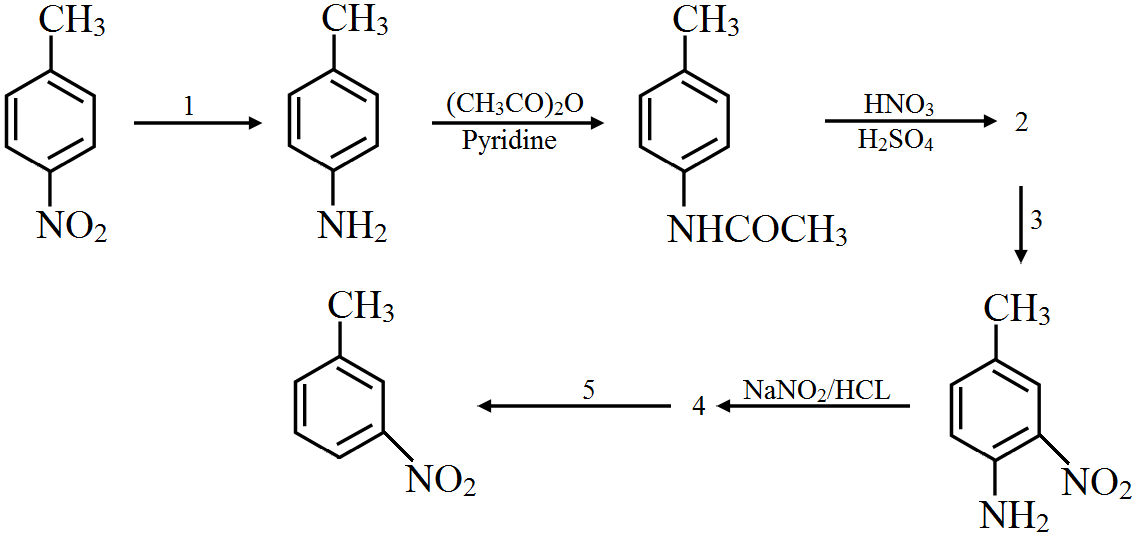
Predict the reagents or the products in the following reaction sequence:

Describe the standard hydrogen electrode with diagram.
Match the items given in Column I with the type of solutions given in Column II.
 
Column I
 
Column II
i.
Soda water
a.
A solution of gas in solid.
ii.
Sugar solution
b.
A solution of gas in gas.
iii.
German silver
c.
A solution of solid in liquid.
iv.
Air
d.
A solution of solid in solid.
v.
Hydrogen gas in palladium
e.
A solution of gas in liquid.
 
 
f.
A solution of liquid in solid.