Question
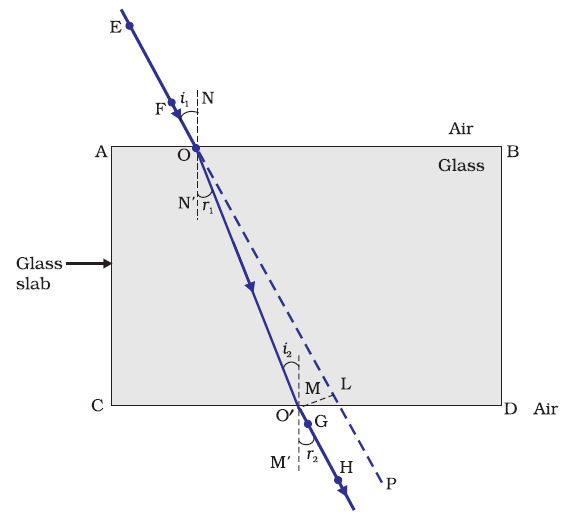
Why does a light ray incident on a rectangular glass slab immersed in any medium emerges parallel to itself? Explain using a diagram.

Answer

Perform an experiment to demonstrate that light bends from its path, when it falls obliquely on the surface of a glass slab. Also show that angle of incidence is about equal to the emergent angle.

  1. Take a glass slab and place it on a white sheet of paper fixed on a drawing board.
  2. Mark the boundary ABCD of the glass slab.
  3. Fix two pins P1 and P2, vertically on the drawing board such that line joining the pins is inclined to the edge AB of the glass slab (Figure).

  1. Now, look through the glass slab from opposite side so that the images of pins P1 and P2 are seen exactly in line. Fix two pins P3 and P4, vertically on the drawing board such that pins P3, P4 and image of P1 and P2 are exactly in one line.
  2. Remove the glass slab and all pins. Join the points P1 and P2 with a line and extend this line to touch the edge AB at P. Similarly join the points P3 and P4 with a line and extend the line to touch the edge DC at Q.
  3. Join points P and Q with a straight line.
  4. Draw normal NN’ at P on the edge AB and a normal N1N1' at Q on the edge DC.
  5. Measure $\angle\text{P}_2\text{PN}$ and $\angle\text{P}_3\text{QN}_1'$ using a protractor or dee.
This experiment shows that when light falls obliquely on a glass slab, it bends along PQ from its original path along PL.

Also $\angle\text{P}_2\text{PN}\approx\angle\text{P}_3\text{QN}_1'.$ That is, angle of incidence is about equal to the emergent angle.

Note: Distance between pins P1 and P2, and between P3 and P4 must be large.

Need a full question paper?

Generate a complete, print-ready paper with questions like this in minutes — across 16+ boards, with answer keys.

Start Generating Free

Similar questions

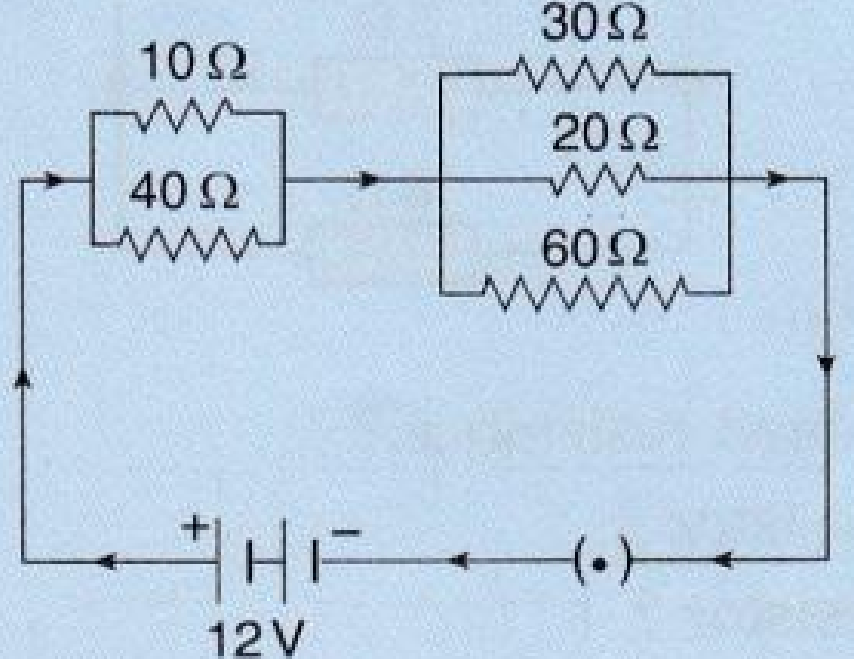
In the circuit diagram given below five resistances of $10 Ω, 40 Ω, 30 Ω, 20 Ω\ \text{and}\ 60 Ω$ are connected as shown to a 12V battery.

Calculate:
  1. Total resistance in the circuit.
  2. Total current flowing in the circuit.
Write the importance of ciliary muscles in the human eye. Name the defect of vision that arises due to gradual weakening of the ciliary muscles in old age. What type of lenses are required by the persons suffering from this defect to see the objects clearly?
Akshay, sitting in the last row in his class, could not see clearly the words written on the blackboard. When the teacher noticed it, he announced if any student sitting in the front row could volunteer to exchange his seat with Akshay. Salman immediately agreed to exchange his seat with Akshay. He could now see the words written on the blackboard clearly. The teacher thought it fit to send the message to Akshay’s parents advising them to get his eyesight checked.
In the context of the above event, answer the following questions:
  1. Which defect of vision is Akshay suffering from? Which type of lens is used to correct this defect?
  2. State the values displayed by the teacher and Salman.
  3. In your opinion, in what way can Akshay express his gratitude towards the teacher and Salman?
Draw ray diagrams to represent the nature, position and relative size of the image formed by a convex lens for the object placed:
  1. At 2F1
  2. between F and the optical centre O of the lens.
Which of the above two cases shows the use of convex lens as a magnifying glass ? Give reasons for your choice.
a. List four characteristics of the image formed by a convex lens when an object is placed between its optical centre and principal focus.
b. Size of the image of an object by a concave lens of focal length 20 cm is observed to be reduced to $\frac{1}{3} \mathrm{rd}$ of its size. Find the distance of the object from the lens.
With the help of a labelled circuit diagram illustrate the pattern of field lines of the magnetic field around a current carrying straight long conducting wire. How is the right hand thumb rule useful to find direction of magnetic field associated with a current carrying conductor?
A copper wire has diameter 0.5 mm and resistivity of 1.6 × 10⁻⁸ Ω m. What will be the length of this wire to make its resistance 10 Ω? How much does the resistance change if the diameter is doubled?
What is an electric motor? With the help of a labelled diagram, describe the working of a simple electric motor.
For the circuit shown in the diagram given below:

Calculate:
  1. The value of current through each resistor.
  2. The total current in the circuit.
  3. The total effective resistance of the circuit.
What is meant by power of a lens? Name and define its S.I. unit. One student uses a lens of focal length +50cm and another of -50cm. State the nature and find the power of each lens. Which of the two lenses will always give a virtual, erect and diminished image irrespective of the position of the object?
Write the main difference between an acid and a base. With the help of suitable examples the term  neutralization and the formation of:
  1. Acidic
  2. Basic
  3. Neutral salts.