MCQ
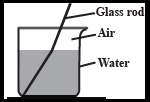
Why does a straight rod appear bent in water?
- ADue to reflection of light
- BDue to refraction of light
- CDue to variable refractive index of water.
- DNone of the above
Why does a straight rod appear bent in water?
Explanation:
This phenomenon occurs due to the property of light called refraction of light. When a stick is immersed in water, in actually we are putting it from rarer medium to denser medium. So, when the rays of light pass from a rarer medium to the denser medium they move towards the normal, the part of stick immersed in water appears to bend when immersed in water and this refraction causes an apparent shift in the position of the part of the rod within the water.
Generate a complete, print-ready paper with questions like this in minutes — across 16+ boards, with answer keys.
In a coil of area  and 10 turns with a magnetic field directed perpendicular to the plane and is changing at the rate of
  gauss/second. The resistance of the coil is 20 ohm. The current in the coil will be
|
(a) 5 amp |
(b) 0.5 amp |
(c) 0.05 amp |
(d) 5 |
A lens of focal power 0.5 D is
|
(a) A convex lens of focal length 0.5 m |
|
(b) A concave lens of focal length 0.5 m |
|
(c) A convex lens of focal length 2 m |
|
(d) A concave lens of focal length 2 m |
Refractive index for a material for infrared light is
|
(a) Equal to that of ultraviolet light |
|
(b) Less than for ultraviolet light |
|
(c) Equal to that for red colour of light |
|
(d) Greater than that for ultraviolet light |
The critical angle for diamond (refractive index = 2) is
|
(a) About 20° |
(b) 60° |
(c) 45° |
(d) 30° |
An electric heater of resistance 6 ohm is run for 10 minutes on a 120 volt line. The energy liberated in this period of time is
|
(a) 7.2 |
(b) 14.4 |
(c) 43.2 |
(d) 28.8 |
If the focal length of a double convex lens for red light is  its focal length for the violet light is
|
(a) |
(b) Greater than |
(c) Less than |
(d) |
The e.m.f. in a thermoelectric circuit with one junction at ૦℃ and the other at t℃ is given by  . The neutral temperature is then
(a) 
|
(b) - 
|
(c) - 
|
(d)
|