Question
Why does a wire break when stretched beyond a limit?

Answer

When the wire is stretched with more force, the distance between its atoms increases. When this distance becomes so much that the force of attraction between the atoms remains negligible. In this situation, when the force is removed, the atoms of the material are not able to return to theis original position and the wire is not able to assume its previous shape. This is the limit of elasticity. By applying more force, the permanent position of the atoms gets disturbed and if the force is increased, further on the wire, it breaks.
Need a full question paper?

Generate a complete, print-ready paper with questions like this in minutes — across 16+ boards, with answer keys.

Start Generating Free

Similar questions

Give the geometrical meaning of $(i)$ scalar product $(ii)$ cross product of two vectors.
A circular racetrack of radius 300 m is banked at an angle of 15°. If the coefficient of friction between the wheels of a race-car and the road is 0.2, what is the (a) optimum speed of the racecar to avoid wear and tear on its tyres, and (b) maximum permissible speed to avoid slipping ?
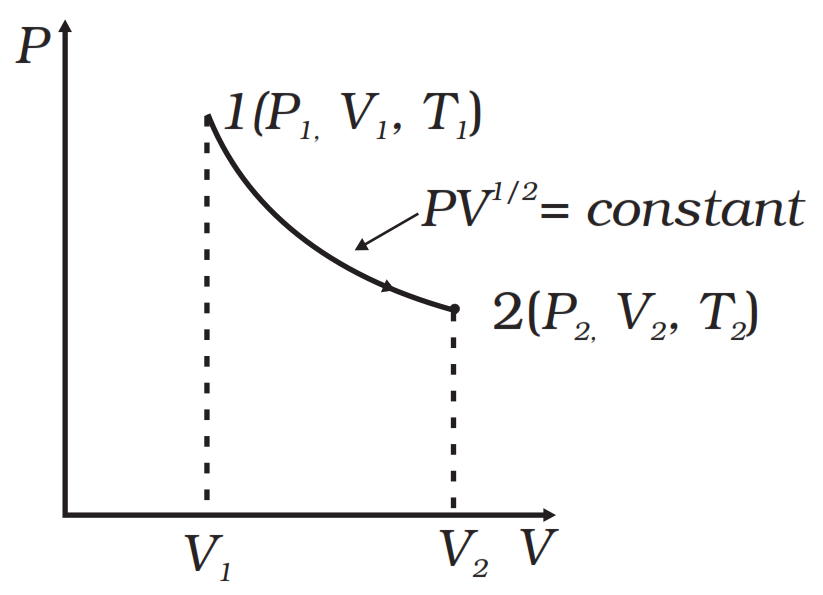
Consider a P-V diagram in which the path followed by one mole of perfect gas in a cylindrical container is shown in Fig. Find the work done when the gas is taken from state 1 to state 2.
A wire-loop confined in a plane is rotated in its own plane with some angular velocity. A uniform magnetic field exists in the region. Find the emf induced in the loop.
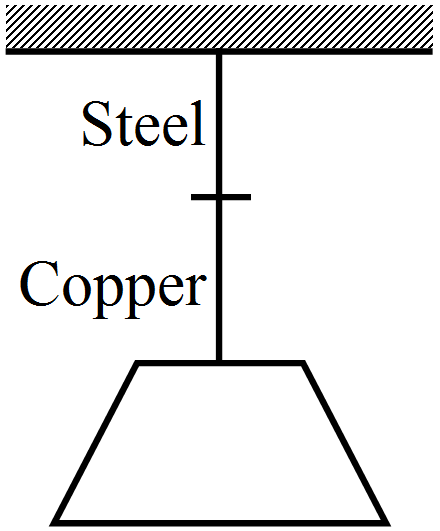
In the upper wire is made of steel and the lower of copper. The wires have equal cross-section. Find the ratio of the longitudinal strains developed in the two wires.
Two wires A and B are of the same material. Their lengths are in the ratio $1 : 2$ and the diameters in the ratio $2 : 1$ If they are pulled by the same force, then what will be the ratio of their increase in lengths?
An inductor-coil of inductance 17mH is constructed from r wire of length 100m and cross-sectional area a copper wire of length 100m and cross-sectional area $1mm^2$. Calculate the time constant of the circuit if this inductor is joined across an ideal battery. The resistivity of copper $=1.7\times10^{-8}\Omega-\text{m}.$
Two conducting spheres of radii $R_1$ and $R_2$ are kept widely separated from each other. What are their individual capacitances? If the spheres are connected by a metal wire, what will be the capacitance of the combination? Think in terms of series-parallel connections.
A 1 meter thick cement wall can withstand a pressure of $10^5 N / m ^2$. What should be the thickness of the wall at the base of a 200 m depth water of dam?
(Density of water $=10^3 kg / m ^3$ and acceleration due to gravity $=9.8 m / s ^2$ )
Write the formula for the speed of transverse waves in a stretched string and explain the symbols used in it