Question
Why does current in a steady state not flow in a capacitor connected across a battery? However momentary current does flow during charging or discharging of the capacitor. Explain.

Answer

In the steady state, the displacement current and hence the conduction current, is zero as $|\overrightarrow{E}|$ between the plates, is constant.
During charging/discharging, the displacement current and hence the conduction current is non zero as $|\overrightarrow{E}|$ between the plates, is changing with time.

Need a full question paper?

Generate a complete, print-ready paper with questions like this in minutes — across 16+ boards, with answer keys.
Start Generating Free

Similar questions

Write a brief history of Electro Magnetic waves.
In a resonance column experiment, a tuning fork of frequency 400Hz is used. The first resonance is observed when the air column has a length of 20.0cm and the second resonance is observed when the air column has a length of 62.0cm.
  1. Find the speed of sound in air.
  2. How much distance above the open end does the pressure node form?
Derive the formula for the torque acting on a dipole placed in a uniform external electric field.
A positive charge q is placed in front of a conducting solid cube at a distance d from its centre. Find the electric field at the centre of the cube due to the charges appearing on its surface.
Draw a plot showing the variation of (i) electric field (E) and (ii) electric potential (V) with distance r due to a point charge Q.
When we can consider a charged particle as point electric charge ?
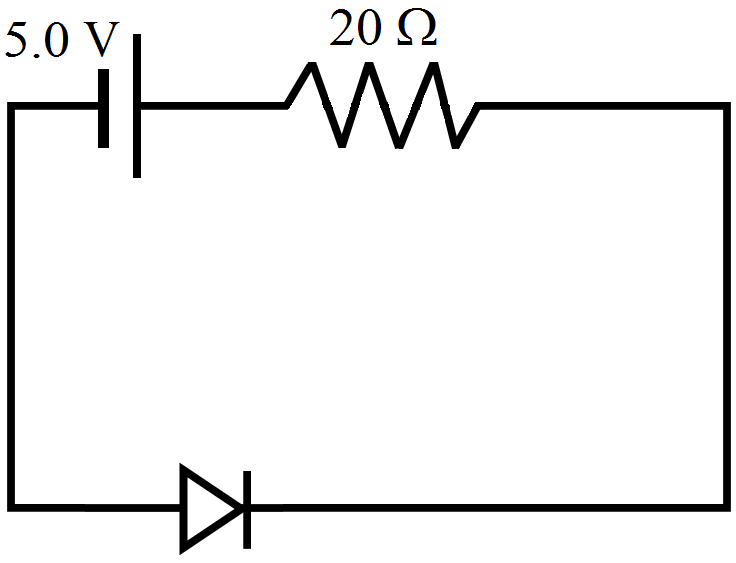
Calculate the current through the circuit and the potential difference across the diode shown in figure. The drift current for the diode is $20\mu\text{A}.$

Obtain the expression of electric field at any point by continuous distribution of charge on a volume.
In half-wave rectification, what is the output frequency if the input frequency is 50 Hz. What is the output frequency of a full-wave rectifier for the same input frequency.
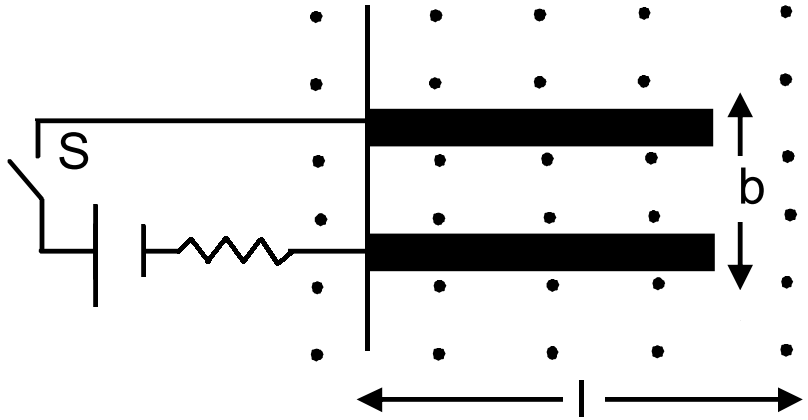
Two metal strips, each of length l, are clamped parallel to each other on a horizontal floor with a separation b between them. A wire of mass m lies on them perpendicularly, as shown in A vertically-upward magnetic field of strength B exists in the space. The metal strips are smooth but the coefficient of friction between the wire and the floor is $\mu.$ A current i is established when the switch S is closed at the instant t = 0. Discuss the motion of the wire after the switch is closed. How far away from the strips will the wire reach?