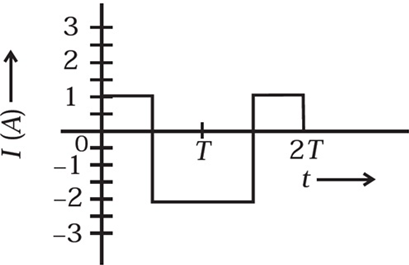
- Estimate the line power loss in the form of heat.
- How much power must the plant supply, assuming there is negligible power loss due to leakage?
- Characterise the step up transformer at the plant.
50 questions · timed · auto-graded

Alternate Answer
$\lambda = \frac{\text{h}}{\sqrt{2\text{meV}}}$ $ = \frac{6.63\times10^{-34}}{\sqrt{2\times9.1\times10^{-31}\times1.6\times10^{-19}\times120}}$ $\lambda = 0.112\text{ nm }$.Alternate Answer
Radiation Pressure – Electromagnetic waves exert radiation pressure. Hence, they carry momentum.
Alternate Answer
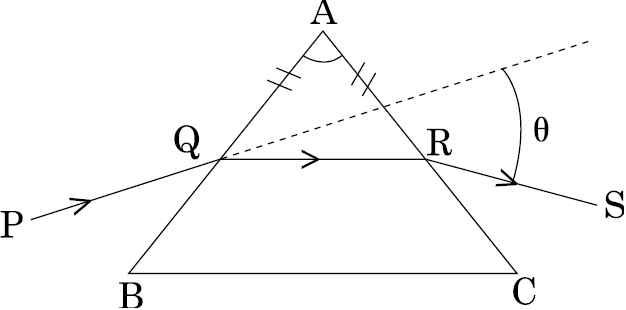
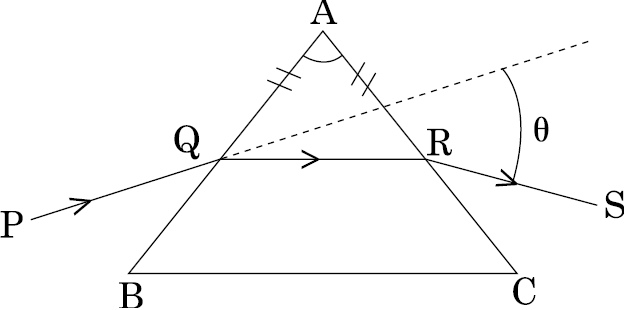
Since AQ=AR, we get $\angle\text{r}_{1} = \angle\text{r}_{2}$ $\therefore\theta$ is the angle of minimum deviation.) $\mu = \frac{\sin(\frac{\text{A} + delta\text{m}}{2})}{\sin(\text{A}/2)}$ $\therefore\sqrt{3} = \frac{\sin(\frac{60 + \delta\text{m}}{2})}{\sin30^{o}}$ $\therefore\frac{\sqrt{3}}{2} = \sin(\frac{60 + \delta\text{m}}{2})$ $\therefore\frac{60 + \delta\text{m}}{2} = 60$ or $\delta\text{m} = 60 ^{o}$.


Alternate Answer
Since AQ=AR, we get $\angle\text{r}_{1} = \angle\text{r}_{2}$ $\therefore\theta$ is the angle of minimum deviation. $\mu = \frac{\sin(\frac{\text{A} + delta\text{m}}{2})}{\sin(\text{A}/2)}$ $\therefore\sqrt{3} = \frac{\sin(\frac{60 + \delta\text{m}}{2})}{\sin30^{o}}$ $\therefore\frac{\sqrt{3}}{2} = \sin(\frac{60 + \delta\text{m}}{2})$ $\therefore\frac{60 + \delta\text{m}}{2} = 60$ or $\delta\text{m} = 60 ^{o}$.Alternate Answer
$ \begin{pmatrix} \text{j} = \sigma\text{E} = \frac{\text{E}}{\rho}\text{ or }\frac{\text{E}}{\text{j}} =\rho\\ \\\therefore \rho= \frac{\text{V}}{lnev_d} \\ \end{pmatrix} $ $\therefore\rho = \frac{5}{0.1\times8\times10^{28}\times1.6\times10^{-19}\times2.5\times10^{-4}}\Omega -\text{m}$ $ = 1.56\times10^{-5}\Omega -\text{m}$ $\simeq1.6\times10^{-5}\Omega - \text{m}$.$\because(\text{mq}) \text{is more for }\alpha - \text{particle} , \text{we have}$
$\lambda_{proton} > \lambda_{\propto} - particle$
(Also, $\frac{\lambda_{proton}}{\lambda_{\alpha}} =2\sqrt{2}(\text{ or }\sqrt{8} ) $
$\because $q is less for proton, we have
$(\text{K.}\text{E} )_{proton} < (\text{K.}\text{E} )_{\alpha - particle}$
$\text{Also},\frac{(\text{K.E.})\propto}{(\text{K.E.})_{\rho}} = 2 ) $.
Alternate Answer
$\lambda_{n} = \frac{\text{h}}{\text{P}_{n}} = \frac{\lambda}{\text{mv}_{n}}$ Velocity of electron in nth state $\upsilon_{n}\propto\frac{1}{n}$ $\lambda_{n}\propto\frac{1}{\upsilon_{n}}\therefore\lambda\propto\text{n}$ $\therefore \frac{\lambda_{4}}{\lambda_{1}} = \frac{\text{n}_{4}}{\text{n}_{1}} = \frac{4}{1}$| Space Wave | Sky Wave |
| In space wave mode, the waves travel in straight line directly from transmitter to receiver in. | Reflected by Ionosphere. |
Because frequencies is greater than 40 MHz, penetrate the ionosphere.
Alternate Answer
There frequencies (greater than 40 MHz) are not reflected by the ionosphere).

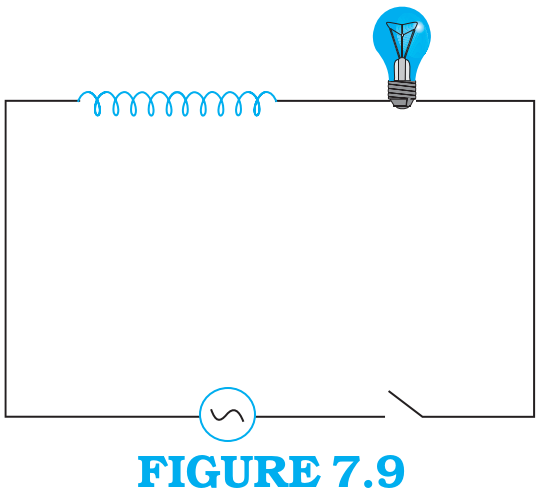
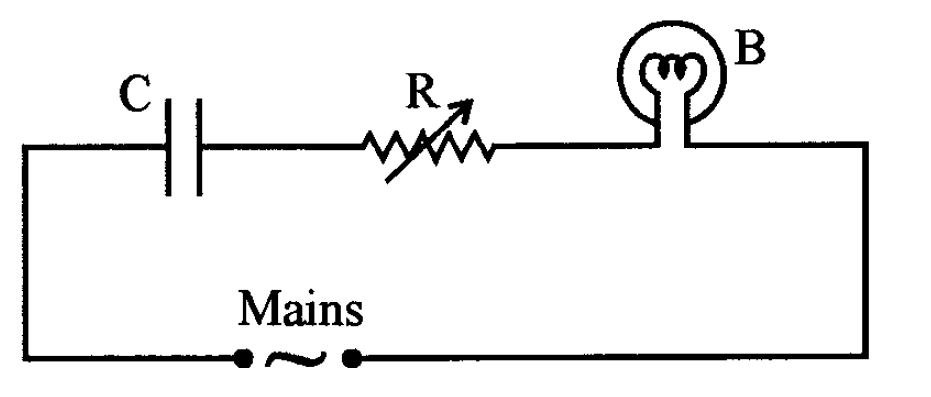
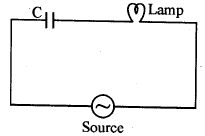
As C decreases, Xc will increase. Hence brightness will decrease.
As frequence (ν) decreases, Xc will increase. Hence brightness will decrease
$\text{V}=\frac{\text{V}_0}{\sqrt{2}}$
$=\frac{300}{\sqrt{2}}=212.1\text{V}$
I = 10A
Now, peak current is given as:
$\text{I}_0=\sqrt{2}\text{I}$
$=10\sqrt{2}=14.1\text{A}.$


$\text{I}=\frac{\text{V}}{\text{R}}$
$=\frac{220}{100}=2.20\text{A}$
P = VI
= 220 × 2.2 = 484W.