Question
Why does micelle formation take place when soap is added to water? Will a micelle be formed in other solvents like ethanol also?

Answer

Soap are sodium or potassium salts of long-chain carboxylic acids. When soap is added to the water, the hydrophilic end (acid end) will align along the surface of water and the hydrophobic tail (carbon chain) remains out of water. When a soap is dissolved in water, it forms a colloidal suspension in water in which the soap molecules cluster together to form spherical aggregates called micelles. In a soap micelle, soap molecules are arranged radially with hydrocarbon ends directed towards the centre and ionic ends directed outwards.

No, micelle will not be formed in other solvents such as ethanol because hydrocarbon chains of soap molecules are soluble in organic solvents like ethanol.

Need a full question paper?

Generate a complete, print-ready paper with questions like this in minutes — across 16+ boards, with answer keys.
Start Generating Free

Similar questions

State one characteristic each of the chemical reaction which takes place when:
i. Dilute hydrochloric acid is added to sodium carbonate.
ii. Lemon juice is added gradually to potassium permanganate solution.
iii. Dilute sulphuric acid is added to the barium chloride solution.
iv. Quick lime is treated with water.
v. Wax is burned in the form of a candle.
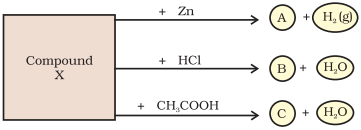
Identify the compound X on the basis of the reactions given below. Also, write the name and chemical formulae of A, B and C.
Write the formulae of sodium chloride and sodium carbonate. Explain why an aqueous solution of sodium chloride is neutral but an aqueous solution of sodium carbonate is basic (or alkaline). Write chemical equations of the reactions involved.
The pH of a salt used to make tasty and crispy pakoras is 14. Identify the salt and write a chemical equation for its formation. List its two uses.
Two carbon compounds X and Y have the molecular formula C4H8 and C5H12 respectively. Which one of these is most likely likely to show addition reaction ? Justify your answer. Also give the chemical equation to explain the process of addition reaction in this case.
An element E forms an oxide E2O. An aqueous solution of E2O turns red litmus paper blue.
  1. What is the nature of the oxide E2O?
  2. State whether element E is a metal or a non-metal.
  3. Give one example of an element like E.
Name the reaction which is usually used in the conversion of vegetable oils to fats. Explain the reaction involved in detail. Write a chemical equation to illustrate your answer.
How does the tendency to gain electrons change as we go down in group 17 of the periodic table? Why does it change this way?
How toothpaste prevents tooth decay?
Give reasons for the following observations:
  1. The element carbon forms a very large number of compounds.
  2. Air holes of a gas burner have to be adjusted when the heated vessels get blackened by the flame.
  3. Use of synthetic detergents causes pollution of water.