- $-\text{CHO}$
- $-\text{OH}$
- $-\text{COOH}$

- $-\text{X}$
- Aldehyde group.
- Alcohol group.
- Carboxylic acid group.
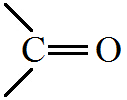
- Ketone group.
- Halo group.
22 questions · timed · auto-graded

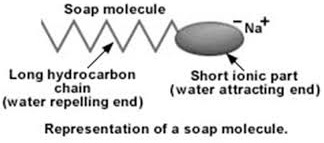
Soap are sodium or potassium salts of long-chain carboxylic acids. When soap is added to the water, the hydrophilic end (acid end) will align along the surface of water and the hydrophobic tail (carbon chain) remains out of water. When a soap is dissolved in water, it forms a colloidal suspension in water in which the soap molecules cluster together to form spherical aggregates called micelles. In a soap micelle, soap molecules are arranged radially with hydrocarbon ends directed towards the centre and ionic ends directed outwards.
No, micelle will not be formed in other solvents such as ethanol because hydrocarbon chains of soap molecules are soluble in organic solvents like ethanol.
$ \ \ \ \ \ \ \ \ \text{H} \ \ \ \ \ \text{H} \ \ \ \ \ \text{H} \ \ \ \ \ \text{H}\\ \ \ \ \ \ \ \ \ \ \text{|} \ \ \ \ \ \ \ \text{|} \ \ \ \ \ \ \ \text{|} \ \ \ \ \ \ \text{|}\\\text{H}-\text{C}-\text{C}-\text{C}-\text{C}-\text{OH}\\ \ \ \ \ \ \ \ \ \ \text{|} \ \ \ \ \ \ \ \text{|} \ \ \ \ \ \ \ \text{|} \ \ \ \ \ \ \text{|}\\ \ \ \ \ \ \ \ \ \text{H} \ \ \ \ \ \text{H} \ \ \ \ \ \text{H} \ \ \ \ \text{H}$
$\ \ \ \ \ \ \ \ \text{H} \ \ \ \ \ \text{H} \ \ \ \ \ \ \text{H} \ \ \ \ \ \text{O}\\ \ \ \ \ \ \ \ \ \ \text{|} \ \ \ \ \ \ \ \text{|} \ \ \ \ \ \ \ \ \text{|} \ \ \ \ \ \ \text{||}\\\text{H}-\text{C}-\text{C}-\text{C}-\text{C}-\text{OH}\\ \ \ \ \ \ \ \ \ \ \text{|} \ \ \ \ \ \ \text{|} \ \ \ \ \ \ \ \ \text{|}\\ \ \ \ \ \ \ \ \ \text{H} \ \ \ \ \text{H} \ \ \ \ \ \ \text{H}$
$ \ \ \ \ \ \ \ \ \text{H} \ \ \ \ \ \text{H} \ \ \ \ \ \text{H} \ \ \ \ \ \text{O}\\ \ \ \ \ \ \ \ \ \ \text{|} \ \ \ \ \ \ \ \text{|} \ \ \ \ \ \ \ \text{|} \ \ \ \ \ \ \text{||}\\\text{H}-\text{C}-\text{C}-\text{C}-\text{C}-\text{H}\\ \ \ \ \ \ \ \ \ \ \text{|} \ \ \ \ \ \ \ \text{|} \ \ \ \ \ \ \ \text{|}\\ \ \ \ \ \ \ \ \ \text{H} \ \ \ \ \ \text{H} \ \ \ \ \ \text{H}\\ \ \ \ \ \ \ \ \ \ \ \ \text{Butanal}$ $ \ \ \ \ \ \ \ \ \text{H} \ \ \ \ \ \text{O} \ \ \ \ \ \text{H} \ \ \ \ \ \text{H}\\ \ \ \ \ \ \ \ \ \ \text{|} \ \ \ \ \ \ \ \text{||} \ \ \ \ \ \ \text{|} \ \ \ \ \ \ \ \text{|}\\\text{H}-\text{C}-\text{C}-\text{C}-\text{C}-\text{H}\\ \ \ \ \ \ \ \ \ \ \text{|} \ \ \ \ \ \ \ \text{|} \ \ \ \ \ \ \ \text{|}\\ \ \ \ \ \ \ \ \ \text{H} \ \ \ \ \ \text{H} \ \ \ \ \ \text{H}\\ \ \ \ \ \ \ \ \ \ \ \text{Butanone}$
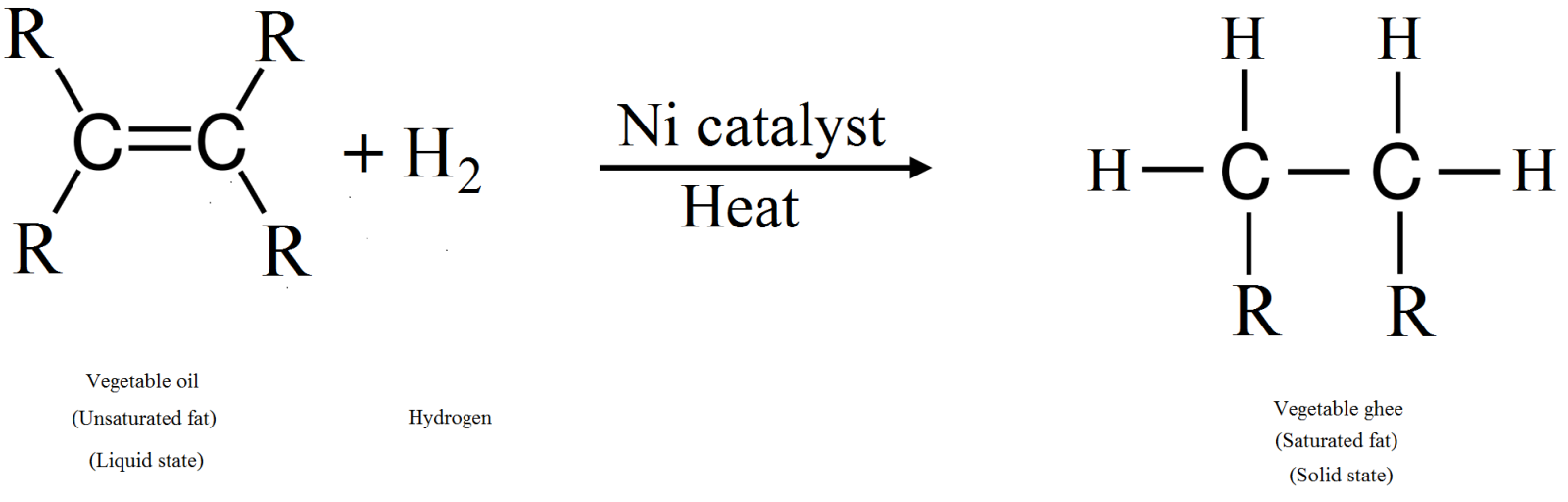
Catalytic hydrogenation is usually used in conversion of vegetable oils to fats.
Hydrogenation of oils: Vegetable oils are unsaturated fats having double bonds between some of their carbon atoms and can undergo addition reactions. When a vegetable oil (like groundnut oil) is heated with hydrogen in the presence of finely divided nickel as catalyst, then a saturated fat called vegetable ghee (or vanaspati ghee) is formed. This reaction is called hydrogenation of oils and it can be represented as follows:


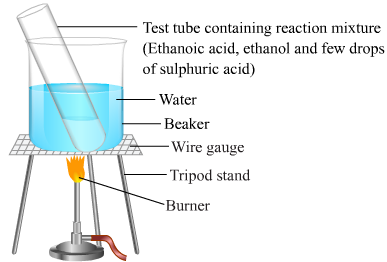
Reaction:
$\text{CH}_3\text{COOH}+\text{C}_2\text{H}_5\text{OH}\xrightarrow[{}]{{ \ \ \ \ \ \ \ \ \ \ \ \text{Cons}.\text{H}_2\text{SO}_4}\ \ \ \ \ \ \ \ \ \ \ \ \ }\text{CH}_3\text{COOC}_2\text{H}_5+\text{H}_2\text{O}\\\text{Ehanoic}\ \text{acid}\ \ \ \text {Ethanol}\ \ \ \ \ \ \ \ \ \ \ \ \ \ \ \ \ \ \ \ \ \ \ \ \ \ \ \ \ \ \ \ \ \ \ \ \ \text{Ethyl ethanoate}\ \ \ \text{Water}\$\text{Acetic}\ \text{acid})\ \ (\text{Ethyl}\ \text{alcohol})\ \ \ \ \ \ \ \ \ \ \ \ \ \ \ \ \ \ \ \ \ \ \ (\text{Ethylacetate}-\text{ester})$


C2H4, C3H4, C4H8, C5H12, C5H8, C3H8, C6H6
C5H12, C3H8
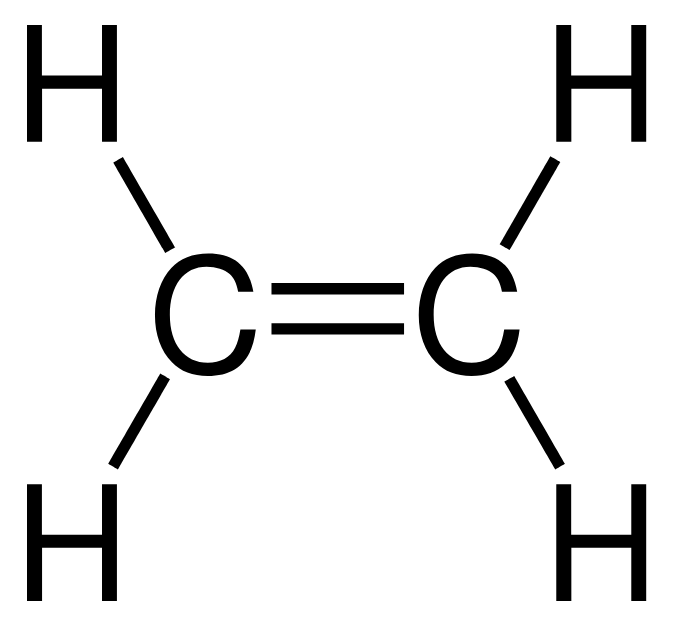
Alkenes.
C2H4, C4H8
Alkynes.
C3H4, C5H8
X is ethanic acid: $\ \ \ \ \ \ \ \ \ \ \ \ \ \text{O}\\ \ \ \ \ \ \ \ \ \ \ \ \ \ \text{||}\\ \text{CH}_3-\text{C}-\text{OH}$
Y is methyl ethanoate: $\ \ \ \ \ \ \ \ \ \ \ \ \ \text{O}\\ \ \ \ \ \ \ \ \ \ \ \ \ \ \text{||}\\ \text{CH}_3-\text{C}-\text{O}-\text{CH}_3$