Question
Why does thermionic emission not take place in non-conductors?

Answer

For thermionic emission, material should have low work function and large number of free electrons. But nonconductor does not have free electrons and they have higher work function. So, thermionic emission does not takes place in non-conductors.

Need a full question paper?

Generate a complete, print-ready paper with questions like this in minutes — across 16+ boards, with answer keys.
Start Generating Free

Similar questions

Read the passage given below and answer the following questions from 1 to 5. Satellites in a circular orbits around the earth in the equatorial plane with T = 24 hours are called Geostationary Satellites. Clearly, since the earth rotates with the same period, the satellite would appear fixed from any point on earth. It takes very powerful rockets to throw up a satellite to such large heights above the earth but this has been done in view of the several benefits of many practical applications. Thus radio waves broadcast from an antenna can be received at points far away where the direct wave fails to reach on account of the curvature of the earth. Waves used in television broadcast or other forms of communication have much higher frequencies and thus cannot be received beyond the line of sight. A Geostationery satellite, appearing fixed above the broadcasting station can however receive these signals and broadcast them back to a wide area on earth. The INSAT group of satellites sent up by India is one such group of geostationary satellites widely used for telecommunications in India. Another class of satellites is called the Polar satellites. These are low altitude (500 to 800 km) satellites, but they go around the poles of the earth in a north-south direction whereas the earth rotates around its axis in an east-west direction. Since its time period is around 100 minutes it crosses any altitude many times a day. However, since its height h above the earth is about 500-800 km, a camera fixed on it can view only small strips of the earth in one orbit. Adjacent strips are viewed in the next orbit, so that in effect the whole earth can be viewed strip by strip during the entire day. These satellites can view polar and equatorial regions. at close distances with good resolution. Information gathered from such satellites is extremely useful for remote sensing, meterology as well as for environmental studies of the earth.
  1. Time period of geospatial satellite is:
  1. 24 hours
  2. 48 hours
  3. 72 hours
  4. None of these
  1. Polar satellites are approximately revolving at height of
  1. 500 to 800km
  2. 1500 to 2000km
  3. 3000 to 4000km
  4. None of these
  1. Which satellite used to view polar and equatorial regions?
  1. Write note on polar satellites
  1. Write a note on geostationary satellite. Give its applications.
In a microwave oven, the food is kept in a plastic container and the microwave is directed towards the food. The food is cooked without melting or igniting the plastic container. Explain.
If a mosquito is dipped into water and released, it is not able to fly till it is dry again. Explain.
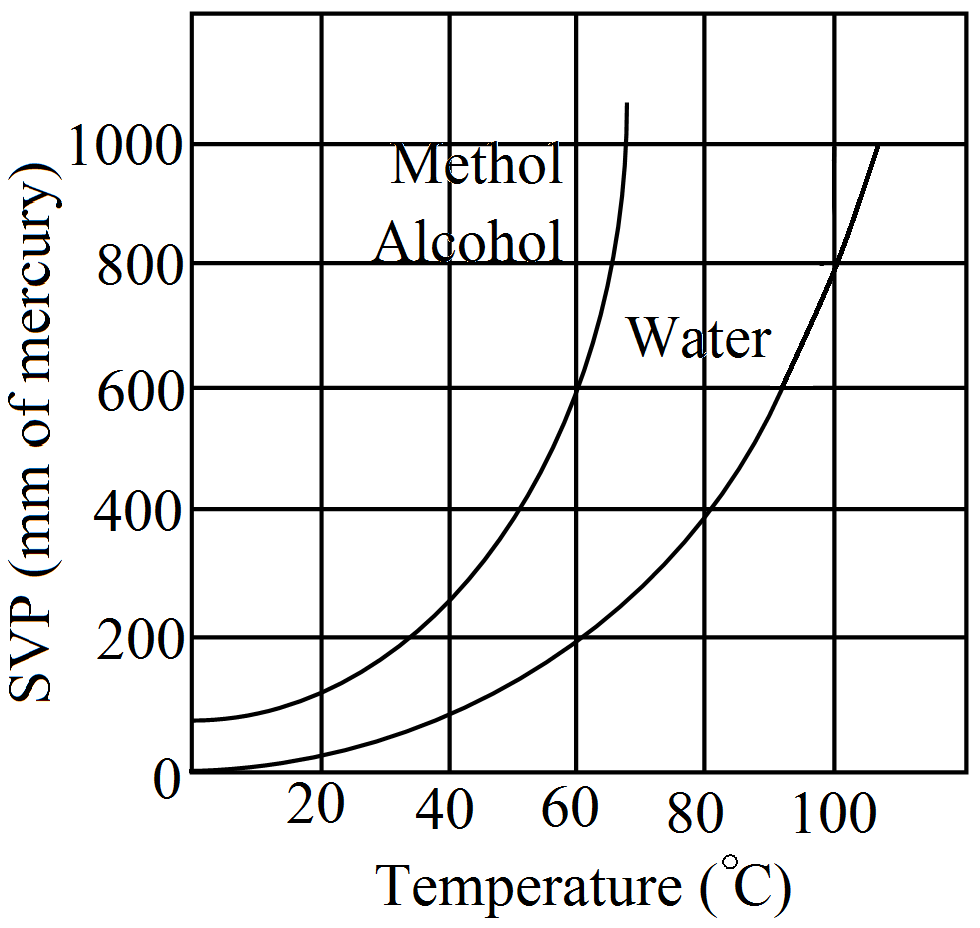
The human body has an average temperature of 98°F. Assume that the vapour pressure of the blood in the veins behaves like that of pure water. Find the minimum atmospheric pressure which is necessary to prevent the blood from boiling. Use figure. of the text for the vapour pressures.
The plate current in a triode can be written as $\text{i}_\text{p}=\text{k}\Big(\text{V}_\text{g}+\frac{\text{V}_\text{p}}{\mu}\Big)^{\frac{3}{2}}$ Show that the mutual conductance is proportional to the cube root of the plate current.
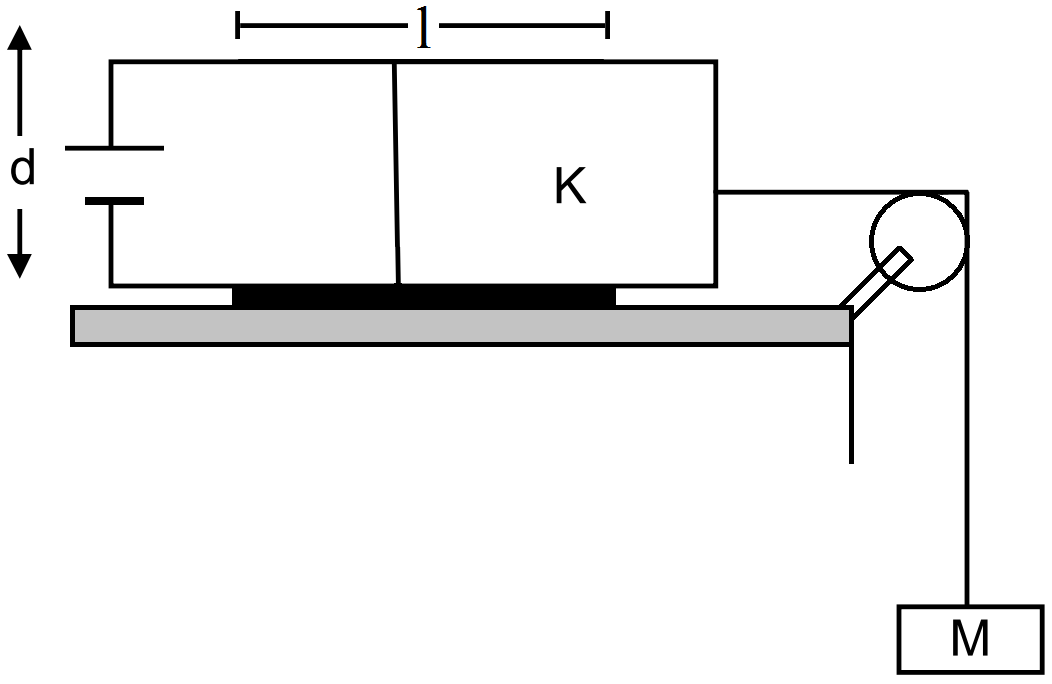
Consider the situation shown in figure. The width of each plate is b. The capacitor plates are rigidly clamped in the laboratory and connected to a battery of emf $\in.$ All surfaces are frictionless. Calculate the value of M for which the dielectric slab will stay in equilibrium.
Read the passage given below and answer the following questions from (i) to (v). Measurement of Physical Quantity All engineering phenomena deal with definite and measured quantities and so depend on the making of the measurement. We must be clear and precise in making these measurements. To make a measurement, magnitude of the physical quantity (unknown) is compared. The record of a measurement consists of three parts, i.e. the dimension of the quantity, the unit which represents a standard quantity and a number which is the ratio of the measured quantity to the standard quantity.
  1. A device which is used for measurement of length to an accuracy of about $10”5m$, is:
  1. screw gauge
  2. spherometer
  3. vernier callipers
  4. Either (a) or (b)
  1. Which of the technique is not used for measuring time intervals?
  1. Electrical oscillator
  2. Atomic clock
  3. Spring oscillator
  4. Decay of elementary particles
  1. The mean length of an object is 5cm. Which of the following measurements is most accurate?
  1. 4.9cm
  2. 4.805cm
  3. 5.25 cm
  4. 5.4 cm 63.
  1. If the length of rectangle I = 105 cm, breadth b = 2.1 cm and minimum possible measurement by scale = 0.1 cm, then the area is
  1. $22.0cm^2$
  2. $21.0cm^2$
  3. $22.5cm^2$
  4. $21.5cm$
  1. Age of the universe is about $10^{10}$ yr, whereas the mankind has existed for $10^6$ yr. For how many seconds would the man have existed, if age of universe were 1day?
  1. 9.2s
  2. 10.2s
  3. 8.6s
  4. 10.5s
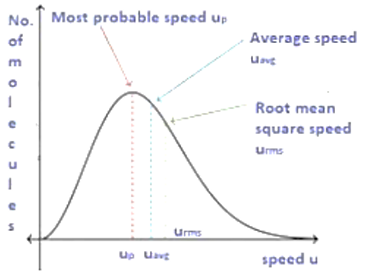
Root mean square velocity (RMS value)is the square root of the mean of squares of the velocity of individual gas molecules and the Average velocity is the arithmetic mean of the velocities of different molecules of a gas at a given temperature.
Image
1. Moon has no atmosphere because:
(a) the escape velocity of the moon’s surface is more than the r.m.s velocity of all molecules
(b) it is far away from the surface of the earth
(c) the r.m.s. velocity of all the gas molecules is more than the escape velocity of the moon’s surface
(d) its surface temperature is $10^{\circ} C$
2. For an ideal gas, $\frac{C_P}{C_V}$ is
(a) $\leq 1$    (b) none of these    (c) $>1$    (d) $<1$
3. The root means square velocity of hydrogen is $\sqrt{5}$ times that of nitrogen. If $T$ is the temperature of the gas then:
(a) $T\left(H_2\right)=T\left(N_2\right)$    (b) $T \left( H _2\right)< T \left( N _2\right)$
(c) $T \left( H _2\right) \neq T \left( N _2\right)$    (d) $T \left( H _2\right)> T \left( N _2\right)$
4. Suppose the temperature of the gas is tripled and $N _2$ molecules dissociate into an atom. Then what will be the rms speed of atom:
(a) $v_0 \sqrt{2}$    (b) $v_0 \sqrt{6}$    (c) $v_0 \sqrt{3}$    (d) $v_0$
OR
The velocities of the molecules are $v , 2 v , 3 v , 4 v \& 5 v$. The RMS speed will be:
(a) 11 v    (b) $v (12)^{11}$   (c) v    (d) $v (11)^{12}$
$50cc$ of oxygen is collected in an inverted gas jar over water. The atmospheric pressure is $99.4kPa$ and the room temperature is $27°C$. The water level in the jar is same as the level outside. The saturation vapour pressure at $27°C$ is $3.4kPa$. Calculate the number of moles of oxygen collected in the jar.
If you are walking on the moon, can you hear the sound of stones cracking behind you? Can you hear the sound of your own footsteps?