Question
Why is Agrobacterium tumefaciens a good cloning vector? Explain.###Write a short note on Agrobacterium.

Answer

(1) Agrobacterium tumefaciens, causes tumor in several dicot plants and able to transfer a piece of DNA known as 't-DNA' to convert normal plant cells in tumor and direct these tumors cells to secrete the chemical required by the pathogen.
(2) The tumours including (Ti) plamid of Agro-bacterium have been modified into cloning vector which is not pathogenic to the plants.
(3) Thus, once a gene or DNA fragment is joined to a suitable vector it is transferred into a bacterial plant or animal host where it undergoes multiplication.

Need a full question paper?

Generate a complete, print-ready paper with questions like this in minutes — across 16+ boards, with answer keys.
Start Generating Free

Similar questions

“Bt toxin synthesized by some bacteria kills insects carrying protein, but not themselves.” Explain the statement with reasons.
In isolating recombinant insulin from a culture of E. coli, the cells were filtered and the filtrate was subjected to a purification protocol. However, no insulin was obtained.Why?
Amniocentesis for sex determination is banned in our country. Is this ban necessary? Comment.
Answer the following questions:
When do farmers prefer using apomictic seeds?
Arrange the following in the decreasing order (most important first) of their importance, for the welfare of human society. Give reasons for your answer.
Biogas, Citric acid, penicillin and curd.
Monohybrid and Dihybrid.
Write a note on the barrier method of family planning.
A student on a school trip started sneezing and wheezing soon after reaching the hill station for no explained reasons. But, on return to the plains, the symptoms disappeared. What is such a response called? How does the body produce it?
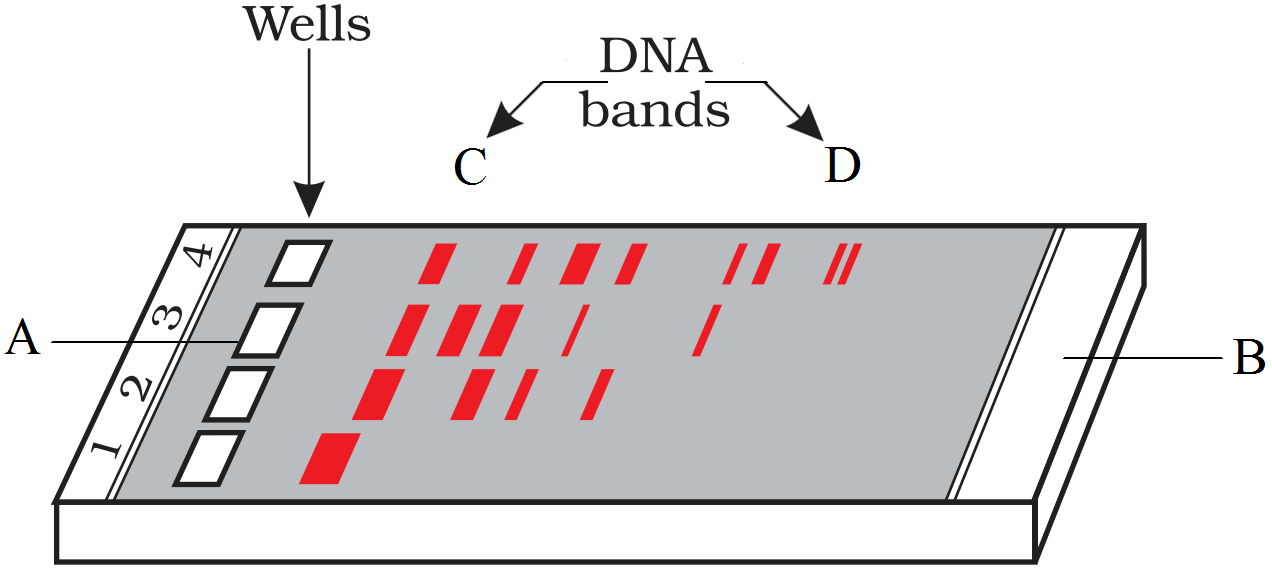
Study the diagram given below and answer the following questions:

  1. Why have DNA fragments in band 'D' moved farther away in comparison to those in band 'C'?
  2. Identify the anode end in the diagram.
  3. How are these DNA fragments visualised?