MCQ
Why is $B t$ toxin not toxic to human beings?
  • A
    The toxin recognises only insect specific targets
  • B
    Bttoxin activation requires temperature above the human body temperature
  • C
    Bttoxin formation froms pro Btstate which requires $pH$ lower than one present in human stomach
  • Conversion of pro Bt to Btstate takes place only in highly alkaline condition
Answer

Correct option: D.
Conversion of pro Bt to Btstate takes place only in highly alkaline condition
d
Bttoxin is not toxin to human being because conversion of pro Bt to Btstate takes place only in highly alkaline conditions

Need a full question paper?

Generate a complete, print-ready paper with questions like this in minutes — across 16+ boards, with answer keys.

Start Generating Free

Similar questions

Removal of $RNA$ polymerase $I$ from nucleoplasm will affect the synthesis of
Identify figure.
Ovule with funiculus lying close to micropyle is known as
Which of the following statement is not correct about cloning vector ?
A cell plate is laid down during
Among bitter gourd, mustard, brinjal, pumpkin, china rose, lupin, cucumber, sunhemp, gram, guava, bean, chilli, plum, petunia, tomato, rose, Withania, potato, onion, aloe and tulip how many plants have hypogynous flower?
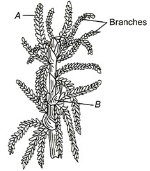
$A$ and $B$ in given figure represents
Read the following statements and choose option which contain wrong statement for growth.
(i) The period of growth is generally divided into three phases, namely, meristematic, elongation and maturation.
(ii) The constantly dividing cells, both at the root apex and the shoot apex, represent the meristematic phase of growth.
(iii) The cells proximal (just next, away from the tip) to the zone represent the phase of elongation.
(iv) Further away from the apex, i.e., more proximal to the phase of elongation, lies the portion of axis which is undergoing the phase of maturation.
(v) The cells in elongation phase region are rich in protoplasm, possess large conspicuous nuclei and cell walls are primary in nature.
(vi) Increased vacuolation, cell enlargement and new cell wall deposition are the characteristics of the cells in phase of meristematic region.
(vii) The cells of zone of maturation, attain their maximum size in terms of wall thickening and protoplasmic modifications.
The cofactor of the enzyme carboxypeptidase is:
Grand place of growth is an another name of